
Quad Maritime Cooperation in the Indo-Pacific: What Next?
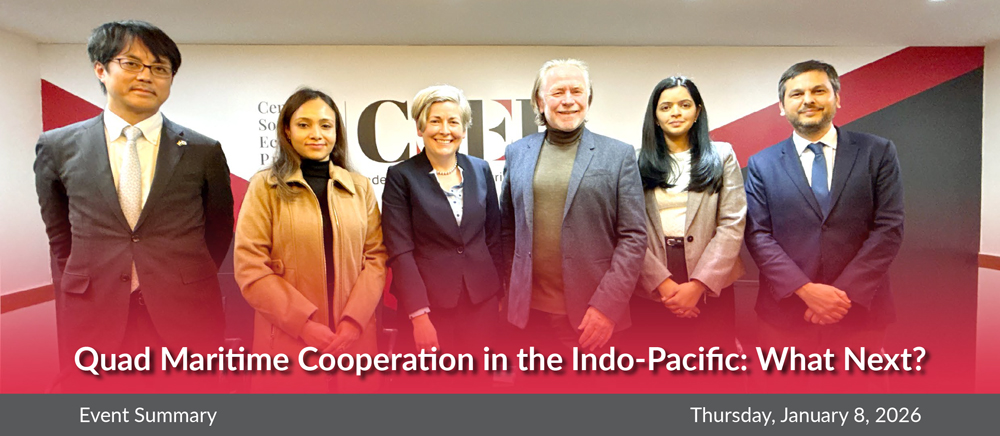
- The Centre for Social and Economic Progress hosted an in-person seminar featuring a presentation by Riya Sinha, Former Associate Fellow, CSEP, to launch her paper “India and the Quad in Port Development in the Bay of Bengal Region.”
- The discussion panel included H.E. Philip Green, High Commissioner of Australia to India, Amy Schedlbauer, Minister Counselor for Economic Affairs, Embassy of the United States, Saswati Dey, Director, Ministry of External Affairs, and Kenji Matsuno, Counsellor, Economic Affairs, Embassy of Japan. The session was moderated by Constantino Xavier, Senior Fellow, CSEP.
- Building on Sinha’s research, the seminar explored whether a port-focused strategy should anchor the Quad’s maritime cooperation. The conversation emphasised port connectivity as a strategic tool, rejected a false dichotomy between security and economics, and considered how Quad goals should be matched with bilateral actions to strengthen supply-chain resilience.
Port Infrastructure and Quad Cooperation
Riya Sinha’s presentation reframed the Bay of Bengal’s port infrastructure as both an economic and strategic asset. Her paper focuses on the demand–supply puzzle in regional port development by assessing how Quad members – Australia, India, Japan and the United States – can pool resources to build resilient, efficient ports. She argued that ports in the Bay of Bengal operate under varied governance models, often lack digitisation and efficiency, and face a pronounced infrastructure deficit. Key ports run at over 90% capacity and have infrastructural limitations, including storage shortages and shallow drafts, which contribute to higher time and cost of doing trade.
She emphasised that geopolitical competition exacerbates these challenges. China’s Belt and Road Initiative (BRI) has invested about US$ 4 billion in ports in the region, surpassing the combined US$ 2.7 billion once contributed by Quad members. This investment has led to concerns that ports such as Hambantota in Sri Lanka and Gwadar in Pakistan might enable coercive influence. Sinha noted that India’s MAHASAGAR policy emphasises port development as part of a broader strategy to enhance regional connectivity while also countering Chinese influence. The study proposes three policy models for India: Bilateral engagement, where India takes the lead; Diplomatic and technical engagement, where India selectively coordinates with Quad members on specific projects; and Full integration with the Quad, where access to financing and technology, increases leverage in international negotiations, however, full integration could require India to cede some control.
Riya’s presentation concluded that the choice is not simply Quad versus bilateral but rather how to combine them. She highlighted the need for targeted interventions across the port value chain and urged the Quad to leverage their individual comparative strengths. The subsequent discussion built on these themes.
Moving Beyond the Security–Economics Dichotomy
The conversation underscored that port connectivity is inherently strategic. Participants noted that the Bay of Bengal’s ports are not just conduits for trade but nodes of geopolitical influence; neglecting them would leave regional economies vulnerable to monopolisation by external powers. The discussants acknowledged that China has outspent the Quad in port investments, using infrastructure financing to cultivate leverage across South Asia. This competition has heightened the urgency for the Quad to offer high-quality, transparent alternatives. At the July 2025 Quad Foreign Ministers’ meeting, ministers pledged to launch a Quad Ports of the Future Partnership to mobilise government and private investments in quality port infrastructure.
Discussants argued that the often-invoked dichotomy between security and economics is a false binary. Port infrastructure sits at the intersection: while it facilitates trade and economic growth, the control and operation of ports bear direct implications for maritime security. The false separation can lead to policy blind spots; focusing solely on economic profitability may overlook vulnerabilities that adversaries could exploit, while over-securitising ports might deter essential investment.
Instead, participants called for a holistic approach that treats ports as key nodes in a wider geo-economic contest. They observed that quality infrastructure, though more expensive upfront, yields long-term dividends by reducing maintenance costs, improving resilience, and creating local employment. While countries welcome cheap, rapid infrastructure development, transparency and sustainability are also becoming increasingly valued. Participants noted that India’s MAHASAGAR, Sagarmala and Indo-Pacific Oceans Initiative policies should prioritise climate-resilient port design, efficient logistics and digital platforms to improve turnaround times.
Indo-Pacific Maritime Domain Awareness and Supply-chain Resilience
Beyond ports, the participants also emphasised the importance of the Indo-Pacific Maritime Domain Awareness (IPMDA) and pairing Quad goals with bilateral actions to strengthen supply-chain resilience. Throughout 2025, the Quad sustained near-monthly working-level engagements across officials’ meetings, technical dialogues, and capacity-building activities, helping ensure cooperation remained active even when leader-level convenings were delayed. At their 2025 meeting, Quad ministers reaffirmed their commitment to expand maritime law-enforcement cooperation to combat piracy, drug trafficking and illegal, unreported and unregulated (IUU) fishing. Crucially, the Quad agreed to implement the IPMDA by increasing space-based collection and sharing radio-frequency data and expanding the program across the Indian Ocean region, which will help regional partners monitor maritime spaces and respond to crises.
The discussion linked IPMDA with supply-chain resilience. The Quad’s Critical Minerals Initiative seeks to diversify supply chains and encourage e-waste recovery, while the Ports of the Future Partnership aims to mobilise investments in advanced ports and logistics. Participants noted that undersea cable connectivity and resilience are equally vital; plans to host an undersea cables forum will encourage regulatory harmonisation and ease access for Quad companies. These initiatives underscore the Quad’s recognition that economic interdependence and security are intertwined.
Participants argued that the Quad must pair its multilateral initiatives with bilateral or trilateral arrangements tailored to specific contexts. For example, the India–US–Palau undersea cable project and the India–Japan cooperation in green technology showcase how partnerships can deliver concrete outcomes. The Quad’s combined development finance institutions could coordinate to spread risk, reduce costs, and deliver sustainable port projects.
Balancing Quadrilateral and Bilateral Approaches
The final portion of the discussion considered what the next phase of coordination might look like. Participants agreed that the Quad’s informal, flexible structure, without a permanent secretariat, allows it to adapt quickly and avoid bureaucratic inertia. They cautioned that formal institutionalisation could stifle innovation and intensify regional anxiety about anti-China alignments. Nonetheless, trust among the four partners is crucial; disagreements in other domains should not derail cooperation in maritime security. A connected recurring theme was the need to combine Quad-level initiatives with bilateral relationships. India’s strategic autonomy and complex regional environment demand a calibrated approach. Working with one or two partners on specific projects can yield quicker, tailored results than waiting for consensus among all four members.
Finally, participants emphasised that working-level cooperation must continue even when high-level summits are delayed. The discussion concluded, noting that by focusing on working-level tangible results, such as improving port efficiency, enhancing maritime domain awareness, and building resilient supply chains, the Quad can maintain momentum and credibility.



The Centre for Social and Economic Progress (CSEP) is an independent, public policy think tank with a mandate to conduct research and analysis on critical issues facing India and the world and help shape policies that advance sustainable growth and development.