

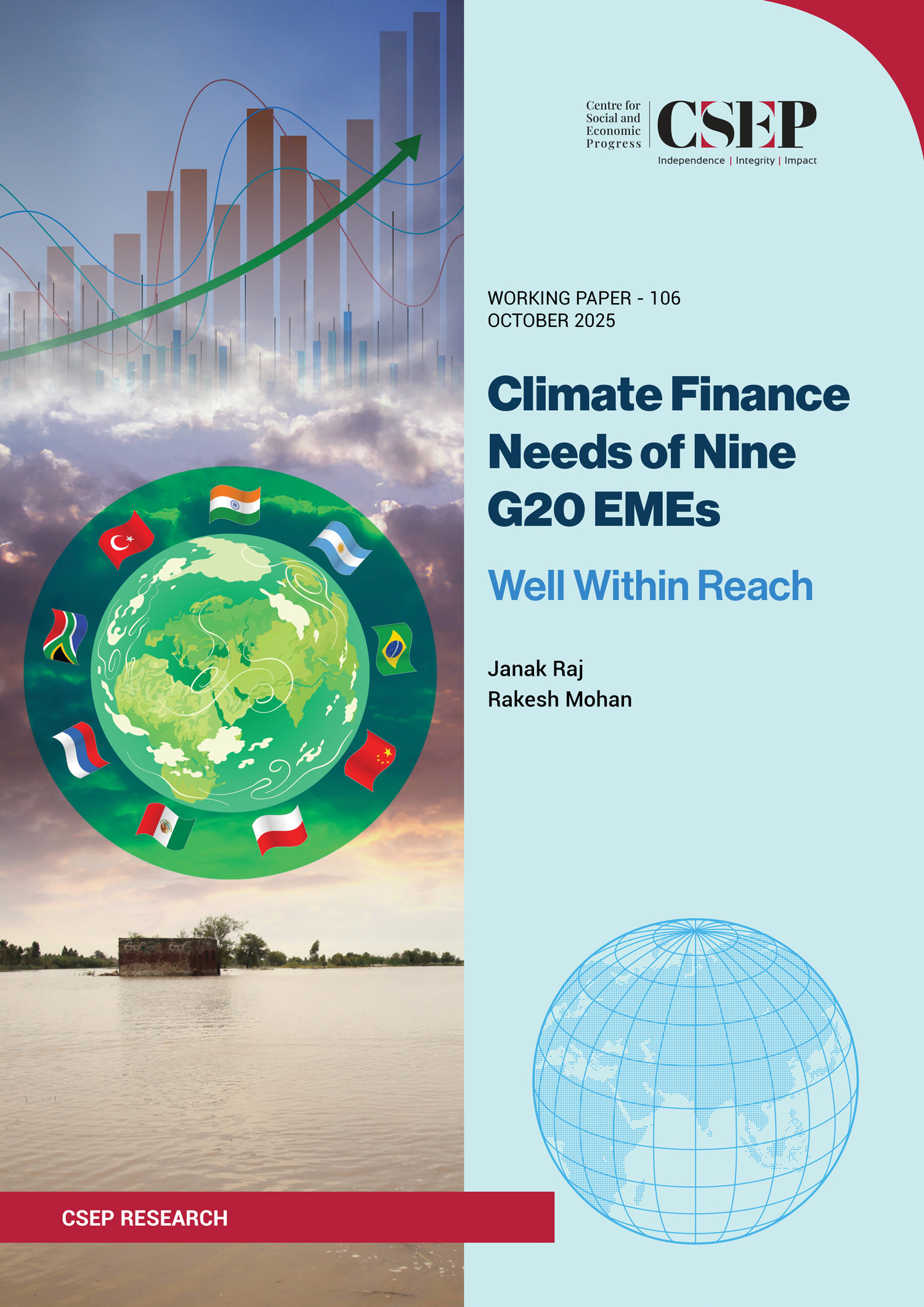
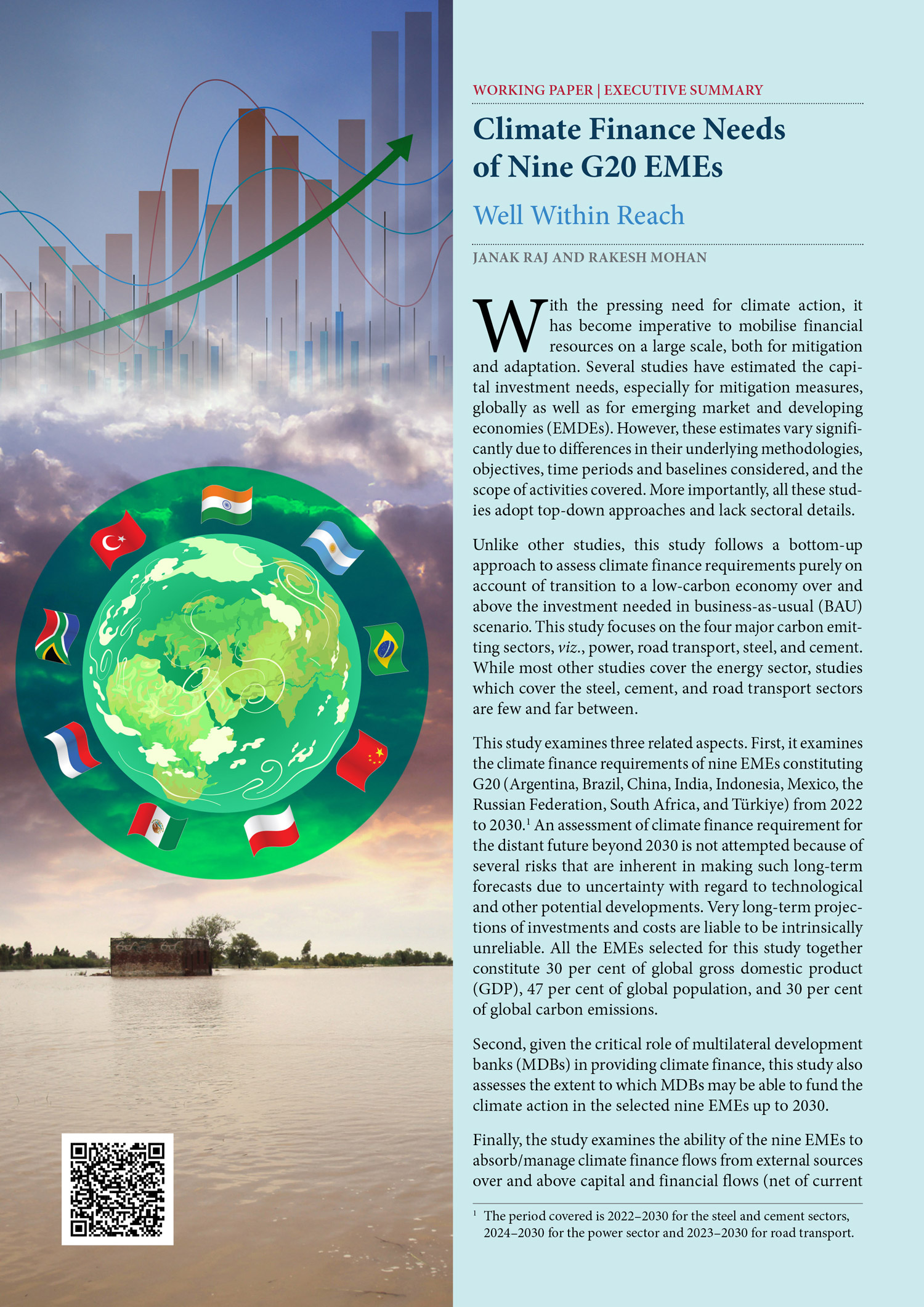
Climate Finance Needs of Nine G20 EMEs: Well Within Reach
Reading Time: 6 minutes

Executive Summary
With the pressing need for climate action, it has become imperative to mobilise financial resources on a large scale, both for mitigation and adaptation. Several studies have estimated the capital investment needs, especially for mitigation measures, globally as well as for emerging market and developing economies (EMDEs). However, these estimates vary significantly due to differences in their underlying methodologies, objectives, time periods and baselines considered, and the scope of activities covered. More importantly, all these studies adopt top-down approaches and lack sectoral details.
Unlike other studies, this study follows a bottom-up approach to assess climate finance requirements purely on account of transition to a low-carbon economy over and above the investment needed in business-as-usual (BAU) scenario. This study focuses on the four major carbon emitting sectors viz., power, road transport, steel, and cement. While most other studies cover the energy sector, studies which cover the steel, cement, and road transport sectors are few and far between.
This study examines three related aspects. First, it examines the climate finance requirements of nine EMEs constituting G20 (Argentina, Brazil, China, India, Indonesia, Mexico, the Russian Federation, South Africa, and Türkiye) from 2022 to 2030.[1] An assessment of climate finance requirement for the distant future beyond 2030 is not attempted because of several risks that are inherent in making such long-term forecasts due to uncertainty with regard to technological and other potential developments. Very long-term projections of investments and costs are liable to be intrinsically unreliable. All the EMEs selected for this study together constitute 30 per cent of global gross domestic product (GDP), 47 per cent of global population, and 30 per cent of global carbon emissions.
Second, given the critical role of multilateral development banks (MDBs) in providing climate finance, this study also assesses the extent to which MDBs may be able to fund the climate action in the selected nine EMEs up to 2030.
Finally, the study examines the ability of the nine EMEs to absorb/manage climate finance flows from external sources over and above capital and financial flows (net of current account balance) in the BAU scenario. This is the first study to examine macroeconomic consistency of climate finance estimates.
This study focuses on assessing climate finance requirements that arise purely because of the need for mitigating climate change in four major carbon emitting sectors (power, transport, steel, and cement). These four sectors collectively contribute about 49 per cent, on average, to carbon emissions in the nine economies, and hence are crucial to decarbonise the global economy.
The study uses two distinct methodologies for the four sectors for estimating climate finance. For the power and road transport sectors, climate finance is estimated as the additional capital expenditure (ACE) required for switching over from fossil fuel-based sources to renewables (power) and from internal combustion engine vehicles (ICEVs) to electric vehicles (road transport), over and above the capital expenditure (capex) planned in the BAU scenario. Investment for the BAU scenario for these sectors is calculated assuming that there would be no efforts to mitigate climate change. For the steel and cement sectors, climate finance has been worked out as the total capex required to completely mitigate the carbon emissions in these two sectors, emanating from the existing capacity as well as the capacity that would be installed up to 2030.
Climate finance [2] requirement of the nine economies is estimated at US$ 2.2 trillion (US$ 255 billion annually) for all the four sectors, driven mainly by the steel sector (US$ 1.2 trillion or 51 per cent of total), followed by road transport (US$ 459 billion or 21 per cent), cement (US$ 453 billion or 21 per cent), and power (US$ 149 billion or 7 per cent). Climate finance requirement as percentage of GDP works out to 0.6 per cent on average. Thus, contrary to the common narrative, the transitioning of the power sector from fossil fuel-based sources to renewables does not require large climate finance. Of the estimated climate finance requirement, 60 per cent is attributable to China. Excluding China, the climate finance requirement for the eight other economies works out to US$ 854 billion (US$ 100 billion annually or 0.5 per cent of their GDP).
The steel and cement sectors are hard-to-abate as there are limited options to reduce carbon dioxide (CO2) emissions released during the production process in these sectors other than through carbon capture and storage (CCS). This is expensive but the only feasible technology to deploy at this stage. Hence, the steel and cement sectors require the largest chunk of the climate finance estimated. The road transport sector also requires significant climate finance. However, most of the capex requirement in the road transport sector is for developing the charging infrastructure rather than for transitioning from the ICEVs to EVs. The power sector requires the least amount of climate finance relative to other sectors in the study because the unit capital cost for solar and wind power plants has declined to the extent where it is now lower than that required for installing fossil fuel-based sources of power.
The study also assesses potential carbon emission reductions that can be achieved through climate related investment estimated in the study. Climate investment estimated for the nine EMEs for three sectors [3] (power, steel, and cement) has the potential to mitigate 33 billion tonnes of CO2. The average cost to mitigate one tonne of CO2 (tCO2) is estimated at US$ 53. In terms of per unit cost, the power sector is found to be the most expensive to decarbonise at a cost of US$ 66 per tCO2, followed by steel at US$ 53 per tCO2 and cement at US$ 49 per tCO2. These estimates rely on current market technologies and any future technological advances have the potential to significantly reduce the climate finance requirement for the steel and cement sectors.
In 2022, climate finance provided by MDBs to all countries constituted 36 per cent of their total annual loan book. The share of climate finance extended by MDBs to the nine EMEs covered in this study in their total climate finance portfolio was 16 per cent in 2022. MDBs’ global climate finance portfolio is projected to increase at a compound annual growth rate (CAGR) of 14 per cent, from US$ 74 billion in 2022 to US$ 215 billion in 2030. During the same period, climate finance to the nine EMEs included in the study is expected to grow from US$ 12 billion to US$ 34 billion. At this level, climate finance by MDBs is projected to cover only 7–9 per cent of the estimated climate finance requirement of the nine economies. The situation improves somewhat when China is excluded, increasing the share of climate finance by MDBs in total climate finance requirement of the eight other economies to 15–25 per cent. MDBs finance multiple activities such as health, education, transport, agriculture, water and waste management, and urban infrastructure, among others. Since the cement and steel sectors in most of the economies are largely in the private sector, which MDBs normally do not finance, they need to treat decarbonisation of the cement and steel sectors as a public good for financing purposes. The International Finance Corporation (IFC), a part of the World Bank group, in any case finances the private sector.
A macroeconomic consistency analysis shows that it would be a challenge to manage both (i) external financial flows; and (ii) estimated climate finance flows from external sources for most of the nine economies. External financial flows (capital and financial flows net of current account balance) for the nine economies are estimated at US$ 2.7 trillion during 2023–2030 (US$ 1.1 trillion excluding China) in the BAU scenario. However, expansion in monetary base (M0) for the nine economies has been projected at US$ 3.1 trillion (US$ 1.2 trillion excluding China) for the period from 2023–2030. This leaves a small room of only US$ 423 billion (US$ 37 billion excluding China) for absorbing climate finance from external sources. At an economy level, while Türkiye can absorb external financial flows and estimated climate finance flows easily, three other economies (China, Mexico, and Russia) have some room to manage climate finance flows over and above the external financial flows in the BAU. All other EMEs would need to skillfully manage both external financial flows in the BAU scenario and climate finance from external sources.
Q&A with author
What is the core message of your paper?
The core message of the paper is that the climate finance requirements of nine G20 emerging market economies (Argentina, Brazil, China, India, Indonesia, Mexico, Russia, South Africa, and Türkiye) for transitioning to a low-carbon pathway are well within reach. Using a bottom-up sectoral approach for power, road transport, steel, and cement, the study estimates the additional capital expenditure purely on account of climate mitigation. Contrary to the prevailing perception of very large investment needs, the overall requirement—at US$255 billion or 0.6 per cent of GDP annually—is manageable. The study also examines the macroeconomic consistency of these estimates, highlighting that climate finance mobilisation from external sources must align with each economy’s absorptive capacity and its ability to manage capital flows consistent with economic fundamentals.
What presents the biggest opportunity?
The biggest opportunity arises from the significant scope for the nine EMEs to pursue low-carbon growth without jeopardising their development objectives. The transition to renewables in the power sector has become economically viable primarily because of two factors. First, the additional investment needed for renewables is partly offset by the declining investment in fossil fuel-based capacity, resulting in a significant netting effect. Second, the sharp fall in the unit capital cost of solar and wind power has made renewables more competitive than fossil fuel-based generation. Consequently, the transition in the power sector can be achieved at a relatively modest cost compared to other sectors. This presents a major opportunity for EMEs to accelerate decarbonisation, strengthen energy security, and achieve emission reduction targets without imposing a heavy financial burden on their economies.
What presents the biggest challenge?
The biggest challenge arises from the exceptionally large climate finance requirements for the steel and cement sectors, which together account for nearly three-fourths of the total estimated need. These are hard-to-abate sectors with limited options for emission reduction other than through carbon capture and storage (CCS), a technology that remains expensive, but the only feasible option at this stage. Consequently, these sectors alone require about US$ 1.6 trillion up to 2030 of the overall climate finance of US$2.2 trillion. Mobilising such large resources, largely for privately owned industries, will be challenging, unless technological breakthroughs substantially reduce CCS costs. The government, therefore, may have to provide incentives to the private sector to decarbonise these sectors.
FOOTNOTES
[1] The period covered is 2022–2030 for the steel and cement sectors, 2024–2030 for the power sector and 2023–2030 for road transport.
[2] Additional capital expenditure (ACE) or capex over and above the investment needed in the BAU scenario without considering climate change.
[3] The CO2 mitigation for the road transport sector could not be assessed due to lack of availability of relevant data.

Janak Raj
Rakesh Mohan
Find on this page

The Centre for Social and Economic Progress (CSEP) is an independent, public policy think tank with a mandate to conduct research and analysis on critical issues facing India and the world and help shape policies that advance sustainable growth and development.