
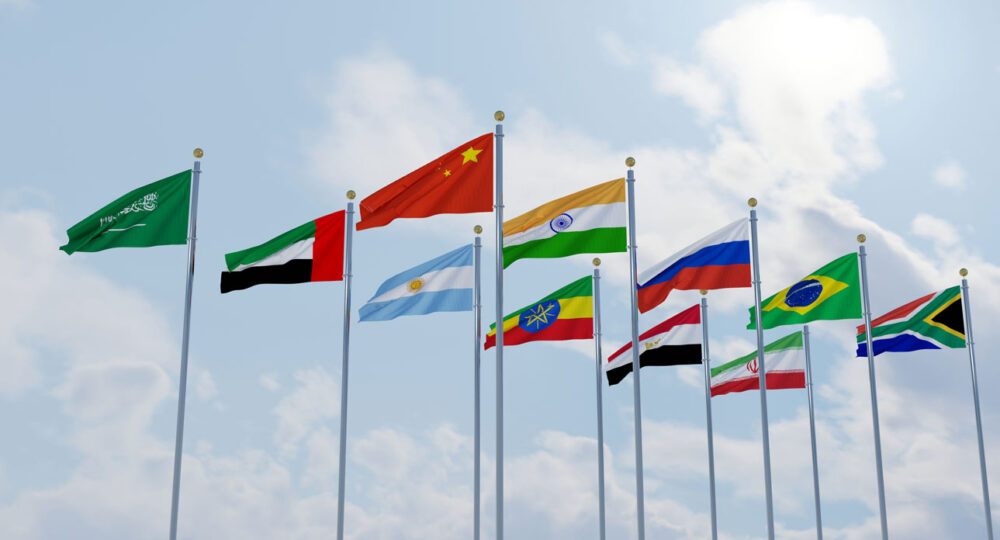
India’s 2026 BRICS Presidency: Key Priorities for a Multipolar World
Reading Time: 6 minutesIndia assumed the BRICS presidency on January 1, 2026, for the fourth time since the grouping’s inception in 2009, a moment that carries particular significance given the bloc’s remarkable multipolar expansion in the turbulent global context. What began as a dialogue among five emerging economies has now evolved into an Eleven-Member Bloc representing nearly half the world’s population, around 40% of global GDP, and over a quarter of global trade, widening the scope of discussion.
India’s previous BRICS presidencies, in 2012, 2016, and 2021, each left a distinct imprint on the grouping’s institutional evolution. India’s 2026 presidency of BRICS, at a time of weakening global governance, protectionist policies, and heightened uncertainty, carries renewed hopes and expectations of collaboration, governance, and delivery.
Major Milestones Under India’s Presidency
Several key initiatives, resulting in major achievements in intra-regional integration, were taken when India was the chair of BRICS. These achievements span a wide spectrum, from strengthening economic and trade partnerships to advancing health cooperation, enhancing digital preparedness, deepening cultural ties, and fostering stronger people-to-people connections.
India’s 2026 presidency of BRICS, at a time of weakening global governance, protectionist policies, and heightened uncertainty, carries renewed hopes and expectations of collaboration, governance, and delivery.
Fourth Summit (2012)
In 2012, India assumed the BRICS presidency for the first time, hosting the fourth summit in Delhi under the theme “BRICS Partnership for Global Stability, Security, and Prosperity,” with a focus on expanding institutional cooperation. Among the major milestones of the Delhi Declaration was the consideration of establishing a New Development Bank (NDB) to mobilise resources for infrastructure and sustainable development in BRICS and other developing countries. An agreement to extend local-currency credit facilities under the BRICS Interbank Cooperation Mechanism to enhance intra-BRICS trade was also concluded. The bloc affirmed the concept of a green economy within the framework of sustainability, calling for lowering trade and investment barriers to advance it. The first-ever BRICS Report, coordinated by India, to explore synergies among member countries, was released. The BRICS Exchange Alliance was established as a joint initiative for BRICS securities exchanges.
Among the major milestones of the Delhi Declaration was the consideration of establishing a New Development Bank (NDB) to mobilise resources for infrastructure and sustainable development in BRICS and other developing countries.
Eighth Summit (2016)
The eighth BRICS Summit, held in Goa in 2016 under the theme “Building Responsive, Inclusive and Collective Solutions,” focused on strengthening ties, enhancing security cooperation, and advancing economic partnership. Among the most significant milestones under the Goa Declaration was the formal operationalisation of the New Development Bank (NDB), first mooted during India’s 2012 presidency, alongside the operationalisation of the BRICS Contingent Reserve Arrangement (CRA), a short-term liquidity support mechanism through currency swaps to mitigate BOP crises. For the first time, the idea of an independent BRICS Rating Agency was proposed to strengthen the global governance architecture. India hosted the first BRICS trade fair to promote commercial ties, while the first BRICS film festival and the first BRICS Under-17 football tournament were also held for people-to-people engagement. An MoU to establish the BRICS Agricultural Research Platform was signed.
Thirteenth Summit (2021)
In 2021, India assumed the role of BRICS chair for the third time, hosting the thirteenth summit under the theme “BRICS @ 15: Intra-BRICS Cooperation for Continuity, Consolidation and Consensus,” marking the grouping’s fifteenth anniversary. Among the significant achievements under the New Delhi Declaration was the signing of the Agreement on BRICS Cooperation on Remote Sensing Satellite Constellation to enhance capabilities in climate change research, disaster management, and environmental protection. India proposed the BRICS Platform for Digital Public Goods, a repository of open-source technology applications to achieve the SDGs, marking a landmark institutional contribution. The Agreement on BRICS Cooperation in Customs Matters was also finalised, advancing trade facilitation across the bloc. The BRICS Digital Health Summit, complemented by the virtual launch of the BRICS Vaccine Research and Development Centre to bolster collective health preparedness, was held.
Recent export controls on critical minerals and technology by several countries may have serious repercussions not just for global supply chains but also for BRICS integration.
The Way Forward
The 17th BRICS Summit was held in Rio de Janeiro, Brazil, in July 2025, titled “Strengthening Global South Cooperation for More Inclusive and Sustainable Governance”. The discussion emphasised a range of topics, including global governance, economic cooperation, peace and stability, and social and cultural development. The topics are even more relevant in today’s geo-economic context.
India’s 2026 presidency inherits a bloc navigating an increasingly fragmented global order, marked by supply chain disruptions, geo-economic competition, climate volatility, and institutional paralysis in multilateral forums. India has chosen the theme “BRICS: Building for Resilience, Innovation, Cooperation and Sustainability,” emphasising a “Humanity First” approach in continuity with Brazil’s presidency. The 18th BRICS Summit is scheduled for September 2026 in India. The real question remains: what would it take to operationalise this motto in practice?
Resilience
In the past decade, humanity has suffered due to the pandemic, food shortages, climate change, and multiple geo-conflicts. The BRICS discussions under India’s Presidency need to emphasise the establishment of overarching resilience across the member and partner economies, including economic growth, low-emissions and climate-resilient development strategies, improved human development indices, global peace, predictable trade policies, and efficient supply chains. BRICS should become a platform that collectively absorbs shocks.
Supply chain resilience, particularly in semiconductors, critical minerals, and pharmaceuticals, should be a priority on the agenda. Recent export controls on critical minerals and technology by several countries may have serious repercussions not just for global supply chains but also for BRICS integration. The BRICS member countries’ trade interdependence in raw and intermediate inputs should facilitate overcoming this vulnerability. On climate resilience, while the NDB redesigned its mandate under its General Strategy 2022–2026 to disburse 40% of total funding toward climate-related projects, actual approvals tell a different story: of 45 projects approved between 2022 and 2025, only 7 addressed clean energy and energy efficiency, and a mere 3 covered environmental protection. This gap between stated ambition and operational delivery should be bridged under India’s presidency.
Innovation
Innovation within BRICS should enable the creation, adaptation, and scaling of solutions suited to members’ development realities. From digital public infrastructure (DPI) to biotech manufacturing and green technologies, some of the countries in the bloc possess complementary strengths but lack regulatory and institutional connectivity. India’s success in implementing the DPI through Aadhaar for the identity layer, the Unified Payments Interface (UPI) for the payments layer, and DigiLocker for the paperless layer can guide other BRICS member countries in adopting the DPI. DPI enables the inclusion of poor households living at the margins. Other important integrations among member countries can come from knowledge sharing and mutual learning on emerging technologies, artificial intelligence, and innovation networks.
Moreover, establishing a formal BRICS Innovation Network, well-linked to industry and academia, with dedicated joint R&D funding mechanisms and technology transfer protocols, would convert these fragmented strengths into a coherent bloc-wide innovation architecture. Additionally, an inclusive BRICS Framework for Artificial Intelligence Governance may be collectively developed.
From digital public infrastructure (DPI) to biotech manufacturing and green technologies, some of the countries in the bloc possess complementary strengths but lack regulatory and institutional connectivity.
Cooperation
Meaningful cooperation does not require uniformity but predictability, transparency, and gradual harmonisation. For much of its existence, BRICS has functioned primarily as a forum for political coordination rather than economic integration. Cooperation under India’s presidency should therefore shift to pragmatic alignment. Practical initiatives, such as customs coordination, mutual recognition of trusted traders, investment facilitation in non-sensitive sectors, and regulatory dialogues in emerging industries, can deepen economic linkages without requiring a formal trade agreement. Discussions should advance time-bound strategies for development finance, trade facilitation, and supply chain resilience, alongside common positions on the IMF, World Bank, and WTO.
However, cooperation equally demands responsible trade behaviour. The practice of abrupt agricultural export restrictions severely disrupts food security across member and partner economies. BRICS should therefore institutionalise a predictable, transparent, and advance-notified protocol for any agricultural trade measures, ensuring that intra-bloc food supply chains remain stable, dependable, and insulated from unilateral policy shocks. In this respect, the BRICS Agricultural Trade Conduct Protocol, ensuring the food security of the members without ceding strategic autonomy, may be adopted.
India can encourage dialogue on green bonds, climate-smart agriculture, green industrial policies, resilient port infrastructure, and common principles on carbon accounting.
Sustainability
Sustainability in the BRICS framework entails dual responsibilities: pursuing growth while ensuring climate resilience and developmental balance. As many countries in the bloc confront rising climate pressures and the proliferation of carbon-linked trade measures, sustainability should translate into coordinated responses rather than fragmented national strategies. India can encourage dialogue on green bonds, climate-smart agriculture, green industrial policies, resilient port infrastructure, and common principles on carbon accounting. There needs to be a just transition away from thermal energy generation toward renewable energy. By aligning sustainability goals with competitiveness, India may bring the bloc into line with the United Nations Sustainable Development Goals.
To achieve sustainability goals across different dimensions, the sector-specific strengths of member countries should be harnessed. Brazil’s world-leading biofuel ecosystem, China’s technology in electric vehicle manufacturing and solar panel production, and India’s rapidly scaling solar energy capacity together represent a formidable base for a green economy that, if collectively coordinated, could redefine the bloc’s position in global clean energy value chains. For this purpose, India may pitch for the BRICS Green Economy Framework, a structured mechanism that translates individual members’ strengths into a collective power.
Concluding Remarks
India, as the chair of BRICS, should proactively facilitate a consensus on measures to steer the bloc toward becoming an action-oriented multilateral forum for its members, in line with broader global growth and development. The time cannot be more demanding than now to act. India should use its presidency to confront and resolve the bloc’s internal contradictions, including tensions among members and developmental divergences, that risk reducing BRICS into a routine regional integration exercise. Acknowledging these fault lines openly and building a cooperative architecture will determine and buttress the credibility of BRICS.
Rajesh Chadha

Himanshu Jaiswal

Find on this page

The Centre for Social and Economic Progress (CSEP) is an independent, public policy think tank with a mandate to conduct research and analysis on critical issues facing India and the world and help shape policies that advance sustainable growth and development.