India’s Strategic Autonomy Trade-offs: Accessing US Markets and Sourcing Oil
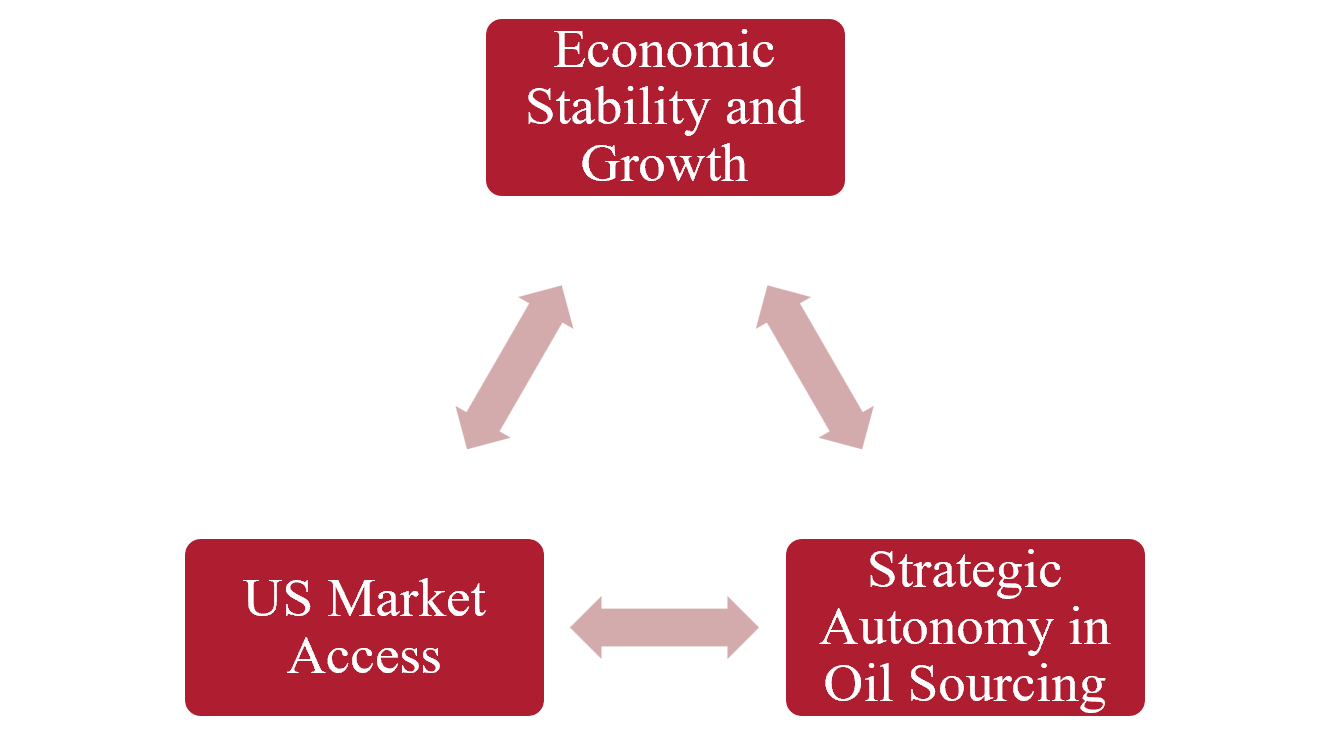
Reading Time: 5 minutesIndia’s choice involves responding to a “geoeconomic trilemma”: balancing economic security and growth, access to the US (India’s most significant export destination), and strategic autonomy in oil sourcing.
India’s trade negotiations with the US are unfolding amidst a chaotic upheaval in the global trading order. Since early 2025, the US has rolled out “Liberation Day” tariffs (later repealed by the US Supreme Court), a 10% universal baseline tariff (President of the United States of America, 2026), and sectoral trade investigations into partners, including India. These steps have driven trade asymmetry to a new high. Now, as we move into mid-2026, the US is ready to deploy a new mechanism of coercion: an additional 12.5% tariff on India and other nations over alleged forced labour violations (Labiak, 2026). Against this volatile backdrop, a primary point of contention is India’s sourcing of Russian oil.
India’s Geoeconomic Trilemma
The US has increasingly leveraged its “weaponised interdependence” through its powerful position in global trade to coerce others by imposing trade costs. Beyond baseline tariffs, Washington has threatened an additional 25% punitive tariff on India if it continues to purchase Russian crude (The White House, 2026), with even harsher tariff legislation currently moving through the US Congress (US Congress, 2025).
Notably, countries such as Brazil and Türkiye continue importing Russian energy without facing US retaliation. However, India faced punitive tariffs from August 2025 to February 2026. For a while, India appeared to comply, significantly reducing Russian oil imports to satisfy the US monitoring mechanism, which, in turn, paused the punitive tariffs. Then, with the Strait of Hormuz closed, the US granted India multiple 30-day waivers, allowing retaliation-free Russian crude imports, to help stabilise global oil prices (Mollan, 2026).
New Delhi has stated that India is “very much wedded to strategic autonomy” (Press Trust of India, 2026) and that the West will not dictate India’s energy sourcing decisions. With the final US waiver having expired on June 17, 2026, India has since resumed importing Russian oil—and that too in record amounts (Bharadwaj, 2026). With global oil markets still fragile and domestic inflation a real concern, India is choosing to exercise its sovereignty when confronting the US. That choice involves responding to a “geoeconomic trilemma”: balancing economic security and growth, access to the US (India’s most significant export destination), and strategic autonomy in oil sourcing.
What Our Model Shows
To understand what is at stake for India, our recent research at CSEP uses a computable general equilibrium (CGE) model (Corong et al., 2017). The CGE model is a tool for estimating how different sectors of an economy might respond to domestic or external policy shocks. We simulate two scenarios:
- Compliance: India scales back Russian oil purchases to avoid US tariffs.
- Defiance: India continues buying Russian oil and pays the punitive tariffs.
We also introduce a further twist to each scenario by assuming a hypothetical oil price shock originating from the Middle East.
Who Gains and Who Loses
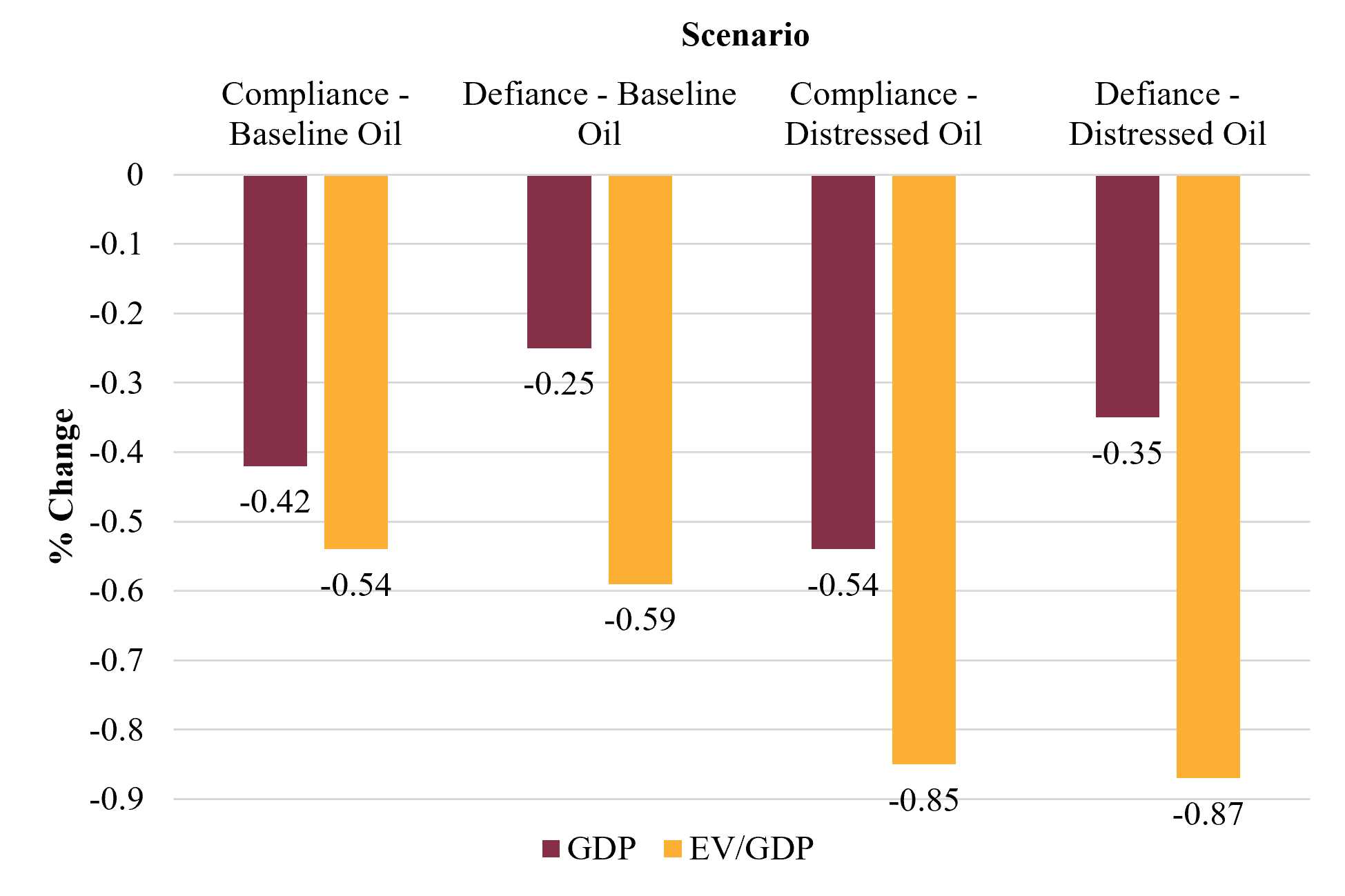
Our simulation results show a divergence between the impacts on Gross Domestic Product (GDP) and the purchasing power of Indian households (see figure above). Because defying the sanctions allows India to maintain access to cheaper energy, our industries can keep operating at relatively low cost, and the macroeconomic impact is seemingly less severe when defying the US. However, GDP alone does not capture the costs imposed on Indian households.
Impact of defiance on households: During a period of higher oil prices, defying the US reduces India’s national welfare (a measure of regional household consumption) by US$31.5 billion, equivalent to around 0.87% of the GDP. This reduction is driven mainly by losses in India’s terms of trade. With higher US tariffs at the border, Indian exports become less competitive, forcing India to export larger quantities at lower prices to maintain the same level of global imports. Interestingly, this loss in Indian national welfare is almost entirely “transferred” to the US, which gains US$34.7 billion from these tariffs. Such a transfer follows the “optimal tariff” hypothesis, which holds that a large economy can weaponise its market size to improve its own terms of trade at the expense of its trading partners.
By defying the US and facing punitive tariffs, India and its unskilled labour market effectively bear the burden of Washington exerting its strategic autonomy as factories slow or shut down.
Impact of defiance on industries: Our simulations highlight that not all industries are impacted equally. The US has exempted certain strategic sectors, most notably pharmaceuticals and petroleum products, from base and punitive tariffs, resulting in reallocations within India’s industrial sectors. In the defiance scenario, India would be able to import Russian crude, process it, and export refined petroleum to the US. Similarly, given the exemption, our pharmaceutical exports would rise by 9.9% as the sector absorbs cheaper domestic capital and skilled labour.
While these sectors gain, the additional punitive tariffs on non-exempt sectors massively reduce demand for labour-intensive manufacturing in India. Our results show that exports of textiles to the US would collapse by 76%, machinery by 61%, and electronics by 36%—a sector for which India has a Production-Linked Incentive scheme. These contractions have direct ramifications on the domestic factors of production: while real returns to skilled labour drop by 0.22% in the defiance scenario, the demand for unskilled labour shrinks by 0.65%. On the other hand, when complying, the reductions are 0.44% and 0.54%, respectively. By defying the US and facing punitive tariffs, India and its unskilled labour market effectively bear the burden of Washington exerting its strategic autonomy as factories slow or shut down.
India should exercise its strategic autonomy by actively reshaping its terms of reference through a calibrated, multi-layered geoeconomic strategy—moving away from binary alignment or defiance—to protect our vulnerable manufacturing sectors and secure our energy independence.
What Could India Do Next?
Faced with this reality, under baseline conditions, it becomes clear why India had earlier complied with the US embargo: it protected manufacturing jobs. However, our simulations show that during a period of high oil prices—such as the ongoing disruptions in the Strait of Hormuz—this economic rationale weakens. In a distressed oil market, defiance becomes the more strategic choice, as accessing Russian oil allows our industries to continue consuming energy, buffering the country from inflationary shocks and better stabilising the GDP.
India cannot simply exit the existing interdependence, nor can we expect our trade delegation to perform miracles when Washington is so focused on rewriting the rules of global trade. Based on our modelling, there are three approaches:
- Short-term: Continue pursuing waivers to import Russian oil by highlighting the risk of global oil price spikes.
- Medium-term: Diversify oil sources and bolster Strategic Petroleum Reserves.
- Long-term: Look beyond bilateral agreements with the US and focus more on multilateral pushback. If all affected countries coordinate retaliatory tariffs while liberalising trade amongst themselves, it can almost fully negate welfare loss.
India should exercise its strategic autonomy by actively reshaping its terms of reference through a calibrated, multi-layered geoeconomic strategy—moving away from binary alignment or defiance—to protect our vulnerable manufacturing sectors and secure our energy independence.
FOOTNOTES
References
Bharadwaj, A. (2026, July 1). India's Russian oil imports hit a record high of 2.6 million bpd in June. Moneycontrol. https://www.moneycontrol.com/news/business/economy/india-s-russian-oil-imports-hit-record-high-of-2-6-million-bpd-in-june-13963400.html
Corong et al. (2017). The standard GTAP model, version 7. Journal of Global Economic Analysis. https://jgea.org/ojs/index.php/jgea/article/view/47
Labiak, M. (2026, June 3). US announces new tariffs over forced labour concerns. BBC News. https://www.bbc.com/news/articles/cq6pe7nvldmo
Mollan, C. (2026, March 6). US eases sanctions on Russian oil sales to India during the Iran conflict. BBC News. https://www.bbc.com/news/articles/cy031d1ny7jo
President of the United States of America. (2026, February 20). Imposing a temporary import surcharge to address fundamental international payments problems. The White House: https://www.whitehouse.gov/presidential-actions/2026/02/imposing-a-temporary-import-surcharge-to-address-fundamental-international-payments-problems/
Press Trust of India. (2026, February 14). "India very much wedded to strategic autonomy": S Jaishankar. NDTV. https://www.ndtv.com/india-news/india-very-much-wedded-to-strategic-autonomy-s-jaishankar-11005024
The White House. (2026, February 6). Modifying duties to address threats to the United States by the government of the Russian Federation. The White House: https://www.whitehouse.gov/presidential-actions/2026/02/modifying-duties-to-address-threats-to-the-united-states-by-the-government-of-the-russian-federation-04b2/
US Congress. (2025, April 1). Sanctioning Russia Act of 2025. Congress.gov: https://www.congress.gov/bill/119th-congress/senate-bill/1241
Rajesh Chadha

Ganesh Sivamani


Find on this page

The Centre for Social and Economic Progress (CSEP) is an independent, public policy think tank with a mandate to conduct research and analysis on critical issues facing India and the world and help shape policies that advance sustainable growth and development.