
Battery Circularity in India – A Billion-Dollar Long-Term Opportunity: The Case of EV Batteries
Reading Time: 7 minutesDOWNLOADS
Executive Summary
India’s electric vehicle (EV) transition is accelerating rapidly, with nearly 8 million EVs added between financial year (FY) 2016–17 and FY 2025–26, the majority of which are electric two-wheeled (2W) and electric three-wheeled (3W) vehicles. Considering that the EV share of total vehicle sales is still in the single digits (estimated at 8.25% in FY 2025–26), there is considerable headroom for the EV market to grow further in the country. This transition is significantly increasing the deployment of lithium-ion batteries (LiBs), creating both an environmental challenge and an economic opportunity. As EV batteries reach end-of-life (EoL), they can either become a hazardous waste stream or serve as a valuable secondary source of critical minerals, such as lithium, nickel, cobalt, copper, and manganese.
India currently depends heavily on imports for battery minerals and advanced battery cells. Lithium, nickel, cobalt, copper, and graphite have been identified by the Ministry of Mines as critical and strategic minerals. For three of these—lithium, nickel, and cobalt—the country is 100% import-dependent. Developing a domestic EV battery recycling ecosystem can therefore strengthen supply-chain security, reduce import dependence, support industrial growth, and contribute to climate and sustainability goals.
This study assesses India’s EV battery circular economy opportunity through FY 2040–41 by analysing EV sales trajectories, battery chemistry trends, recoverable mineral volumes, recycling capacity requirements, and associated investment needs. It reviews the country’s policy landscape relevant to used EV battery recycling, examines the key recycling methods, projects the potential volume of EoL EV batteries available for recycling, and estimates the capital expenditure (CapEx) required to set up recycling facilities.
EV Sales Trajectory
Total EV sales are projected to reach about 9.1 million in FY 2030–31, increasing further to nearly 49.9 million by FY 2037–38. Electric two-wheeled vehicles account for the dominant share, rising from about 7.1 million in FY 2030–31 to about 40.1 million in FY 2037–38. By contrast, electric buses and medium- and heavy-duty electric trucks remain much smaller in absolute numbers, though they may still contribute materially to future recycling volumes because of their larger battery pack sizes.
These differences in EV adoption rates matter for battery circularity because they shape not only the number of batteries entering circulation but also the timing, battery chemistry, and mineral profile of future EoL streams.
Key Findings
The projected EoL battery flows indicate that India’s EV battery recycling opportunity remains limited in the near term but is expected to rise sharply after 2030 (Figure ES–1). The projection indicates that the total recoverable mineral volume is expected to reach about 573 kilotonnes (kt) over the assessment period, from FY 2026–27 to FY 2040–41.
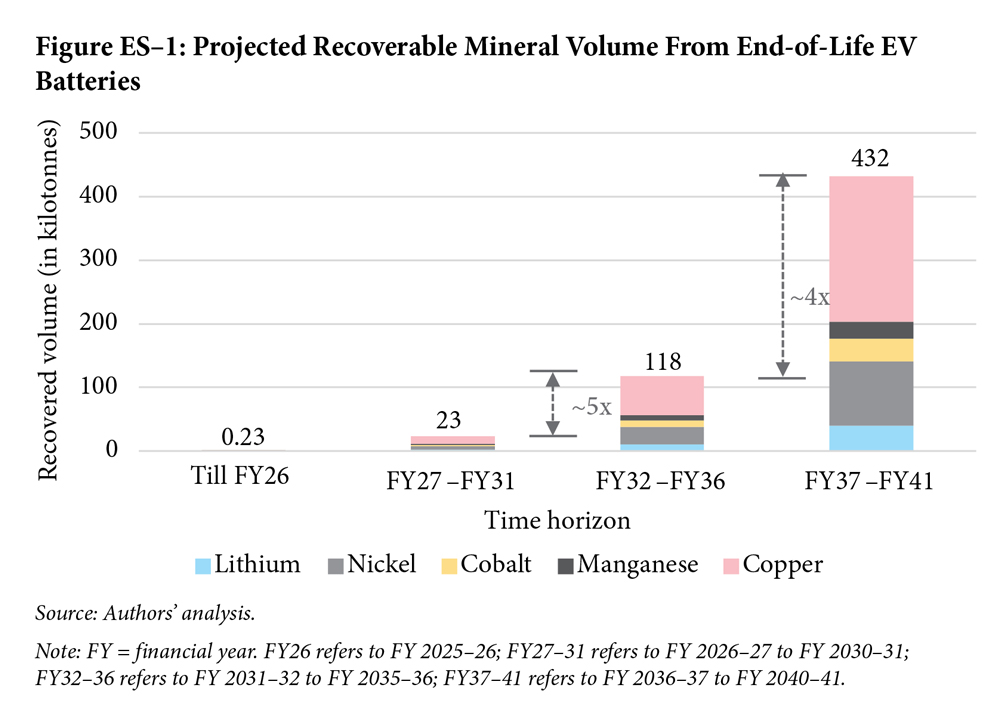
Copper accounts for the largest share of recovered battery minerals by quantity across the assessment horizon. This shows that the recycling opportunity is likely to be driven not only by high value critical minerals but also by bulk mineral embedded in LiBs. Further, the analysis shows that, in a scenario where sales of two-wheeled and three-wheeled vehicles reach a 100% electric share by FY 2037–38 (i.e., the end of the EV projection period), the quantity of recoverable battery minerals may increase by 445 kt over the entire assessment period.
In sync with the trajectory of the recoverable quantity of battery minerals, the economic value of recovered minerals is also projected to rise sharply over time. The estimated value of recycled battery minerals is about ₹1,01,491 crore (US$11,941 million) [1] over the assessment period, from FY 2026–27 to FY 2040–41. Unlike the quantity of recovered minerals, the economic value of EV battery recycling is driven by high-value critical minerals. Lithium contributes the largest share of the recoverable value across the period, even though copper dominates in terms of quantity. In a 100% EV penetration scenario for two-wheeled and three-wheeled vehicle segments, the recycling industry can potentially unlock approximately ₹73,600 crore (US$8,661 million) in additional economic value.
The study finds that recycling can meet about 10% of the lithium demand for EV battery manufacturing from FY 2026–27 to FY 2030–31. The contribution increases to around 12% over the next five years (FY 2031–32 to FY 2035–36) as the quantity of recycled minerals increases.
Among the vehicle segments, electric two-wheeled vehicles make the largest contribution—about 57%—to the quantity of minerals available for recycling. In contrast, medium- and heavy-duty EVs (which include electric buses and electric trucks) together have a small share, around 1.2% of the total minerals available for recycling.
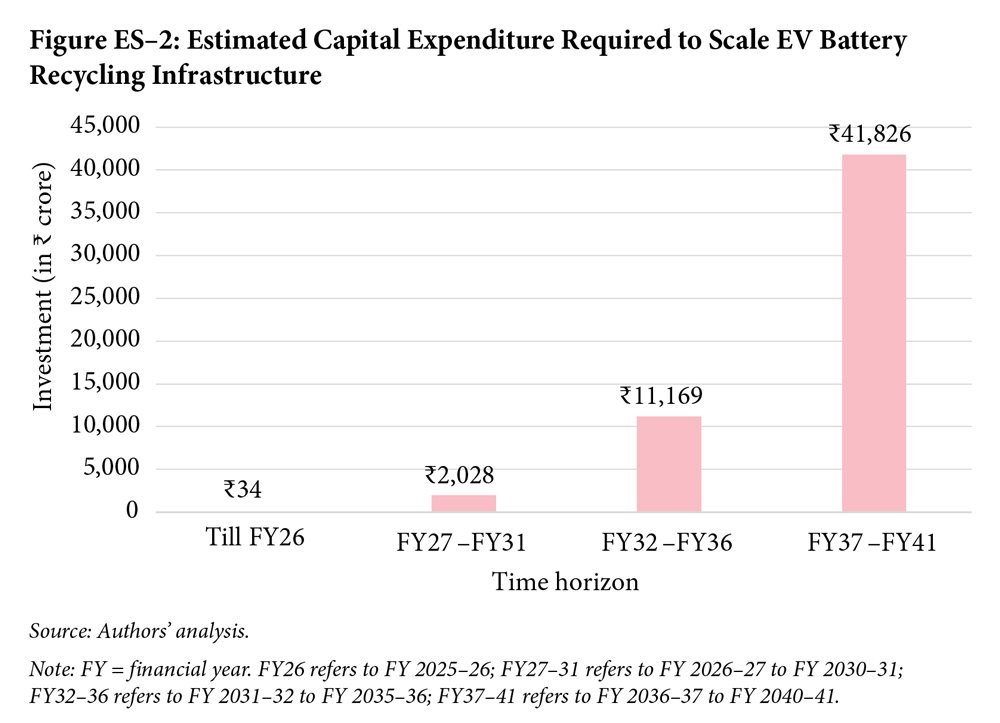
Processing the projected EoL EV battery volumes would entail a cumulative requirement of about 3,315 kt of recycling capacity across the periods assessed. This would require capital investment of about ₹55,057 crore (US$6,477 million) (Figure ES–2).
Challenges and Policy Recommendations
Realising the recycling potential of India’s growing stock of EV batteries will require addressing several market and policy barriers. This study recommends 10 key interventions to strengthen the country’s EV battery circularity ecosystem.
i. Mandate sourcing of recycled critical and strategic minerals as part of the effort to create the national critical minerals stockpile.
India needs a stronger policy signal to create a domestic demand for recycled minerals. The National Critical Mineral Mission (NCMM) advocates institutionalising the National Critical Mineral Stockpile Programme to stockpile critical and strategic minerals and avoid disruptions in mineral supply for domestic utilisation. The Mission should mandate that recycled critical and strategic minerals comprise a minimum share of the proposed minerals stockpile. This would create demand for domestically recovered minerals.
Responsible stakeholder: Ministry of Mines.
ii. Revisit the existing provisions in the Battery Waste Management Rules, 2022 to align timelines for EV battery collection targets with actual battery life and set mineral-specific recovery targets.
Current Extended Producer Responsibility (EPR) provisions under the Battery Waste Management Rules, 2022 (BWMR) may induce “forced” early retirement of EV batteries, as these are based on conservative assumptions about battery life. Therefore, the timelines for achieving battery collection targets should be revisited based on the actual longevity of the EV batteries recorded in the Indian market across vehicle categories.
BWMR also lacks mineral-specific recovery targets, potentially limiting incentives for recyclers to recover minerals rather than stop at producing “black mass”. Such targets would complement BWMR’s existing minimum recycled-content provisions by linking demand for secondary materials with verified domestic mineral recovery. Currently, the Rules stipulate an overall minimum recovery target for battery materials based on the percentage of total recovered materials relative to the dry weight of a battery. [2]
Responsible stakeholder: Ministry of Environment, Forest and Climate Change.
iii. Develop and notify standards for battery characterisation, repurposing, and recycled mineral quality.
There are currently no notified standards for battery circularity, while BWMR does not specify technical requirements for evaluating batteries or verifying the quality and purity of recycled minerals. Necessary standards should therefore be developed for battery characterisation, warranty, repurposing, and recycled mineral quality. This would give battery manufacturers greater confidence in repurposing and help producers ensure that recovered minerals meet the required grades for use in new EV battery cells.
Responsible stakeholders: Bureau of Indian Standards (BIS), Ministry of Electronics and Information Technology (MeitY), and Ministry of Mines.
iv. Introduce buy-back or take-back programmes for spent EV batteries.
The current spent EV battery collection system remains fragmented, making it difficult to channel waste batteries to authorised recyclers—and this is a challenge for both the manufacturers and EV users. EV makers can introduce take-back or buy-back mechanisms for retired EV batteries, with dealers and authorised service centres being the interface between vehicle customers and makers, thus playing a pivotal role in sensitising and guiding users and facilitating participation in these programmes.
Responsible stakeholders: EV owners, EV manufacturers, automobile dealers, service providers, and battery recyclers.
v. Introduce standards to support ease of battery circularity at the design and manufacturing stage.
There is currently no standard supporting the principle of “Design for Repurposing and Recycling” that promotes consideration of the ease of repurposing and/or recycling at the battery pack design and manufacturing stage. Standards should be introduced to allow for efficient, safe, and economical repurposing and/or recycling of used EV batteries.
Responsible stakeholders: BIS, MeitY, and Ministry of Road Transport and Highways (MoRTH).
vi. Develop testing infrastructure for battery characterisation to support repurposing and recycling.
Characterisation and evaluation of battery health are important to determine whether an EV battery can be repurposed or should be sent directly for recycling. This requires state-of-the-art testing facilities across the country. Budgets allocated under EV programmes could fund the development of this infrastructure. PM Electric Drive Revolution in Innovative Vehicle Enhancement (PM E DRIVE), the flagship central government scheme supporting EV adoption, has a budgetary allocation of ₹780 crore for upgrading testing agencies.
Responsible stakeholder: Ministry of Heavy Industries (MHI).
vii. Monitor black mass movement and limit exports to ensure domestic mineral recovery.
Domestic utilisation of black mass for mineral recovery is of strategic importance. Stronger enforcement and monitoring are needed to prevent the unauthorised movement of black mass and increase its availability to domestic processing units for mineral recovery. Domestic mineral recovery remains important even in the absence of a sizeable LiB cell manufacturing capacity. Exporting recovered minerals instead of black mass would also constitute a higher-value export.
Responsible stakeholder: Ministry of Commerce and Industry.
viii. Build recycling capacity, collection, and transportation networks before retirement volumes grow dramatically.
The analysis indicates that sizeable quantities of recoverable minerals are expected to become available over the next decade. Recycling capacity and investment should therefore be planned well in advance. Establishing collection and transportation networks, building recycling facilities, and stabilising process lines for mineral recovery take time to reach commercial scale. The findings also emphasise the need for a targeted approach to used-battery collection and handling as some EV segments, such as electric two-wheeled vehicles, have an outsized share in EoL battery volume.
Responsible stakeholder: Battery recyclers.
ix. Harmonise regulations for safe collection, storage, and transportation of used EV batteries.
As EV battery waste volume increases, regulations governing the safe collection, storage, and transportation of used LiBs will become increasingly important. These batteries can pose fire and safety risks if they are damaged, improperly segregated, poorly stored, or mishandled during collection and transport. Since fire-safety requirements are often governed at the state or urban local body level, varying regulations across states can create compliance uncertainty for industry. Harmonised regulations would help industry meet safety requirements more consistently, reduce fire risks, and improve compliance.
Responsible stakeholders: Petroleum and Explosives Safety Organisation and state governments.
x. Encourage long-term agreements between manufacturers and recyclers.
Uncertainty around used-battery sourcing, management, volumes, and price affects both EV and battery manufacturers and recyclers. Long-term contracts between manufacturers and recyclers can improve predictability. Drawing from international experience, EV and battery makers should explore developing industry-level alliances or common platforms to manage the collection, second-life use, and recycling of waste batteries.
Responsible stakeholders: EV manufacturers and battery recyclers.
Allied actions to address the gaps in the existing broader recycling ecosystem in the country, including research and development of mineral recycling technologies, skill development, industry policy, and awareness generation, would also benefit EV battery recycling. Today’s preparedness will determine whether EoL EV batteries will become a useful “resource” for the economy as the EV population in the country grows.
FOOTNOTES
[1] All calculations conducted in this paper assume US$1 = ₹85.
[2] In the case of EV batteries, the targets for 2024–25, 2025–26, and from 2026–27 onwards are 70%, 80%, and 90%, respectively.

Shyamasis Das

Kartik Nair
Find on this page

The Centre for Social and Economic Progress (CSEP) is an independent, public policy think tank with a mandate to conduct research and analysis on critical issues facing India and the world and help shape policies that advance sustainable growth and development.