Opening the Vault: Enhancing Access to Indian Archives
Archives and Policy Seminar Series
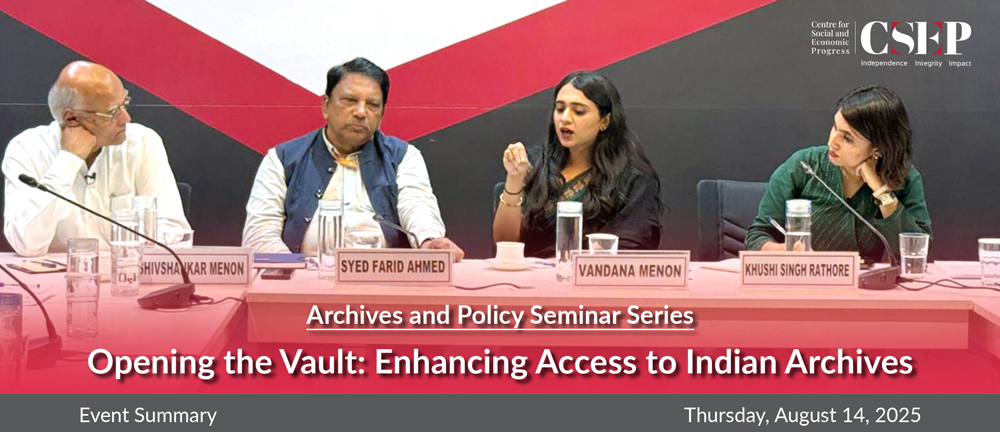
- On August 14, 2025, the Centre for Social and Economic Progress (CSEP), in partnership with King’s College London, NYU Abu Dhabi, and the New International Histories of South Asia (NIHSA) network, hosted the inaugural session of its Archives and Policy Seminar Series titled “Opening the Vault: Enhancing Access to Indian Archives.”
- The discussants were Syed Farid Ahmed, Deputy Director, National Archives of India; Vandana Menon, independent journalist covering archival issues across South Asia; and Shivshankar Menon, Distinguished Fellow, CSEP and Visiting Professor at Ashoka University. The session was moderated by Khushi Singh Rathore, Non-Resident Associate Fellow, CSEP.
- The seminar brought together archivists, researchers, policymakers, journalists, and technologists to engage in a candid and solutions-oriented dialogue on India’s archival ecosystem.
- The session aimed to explore practical interventions to address longstanding access, usability, and governance challenges that hinder the effective use of archival materials in India.
- The Archives and Policy Seminar Series is a closed-door discussion platform curated by CSEP, King’s College London, NYU Abu Dhabi, and the New International Histories of South Asia (NIHSA) network to explore challenges and policy solutions for improving archival access and governance in India. It brings together experts from diverse fields to strengthen archives as vital public resources.
- Initiated by Shivshankar Menon, Distinguished Fellow, CSEP and Visiting Professor of International Relations, Ashoka University; Constantino Xavier, Senior Fellow, CSEP; Bérénice Guyot Réchard, Reader (Associate Professor) in International and South Asian History, King’s College London; and Rahul Sagar, Associate Professor of Political Science, NYU Abu Dhabi; this series is curated by Khushi Singh Rathore, Non-Resident Associate Fellow, CSEP.
Digitising Archives: Milestones and Ongoing Challenges
A major focus of the seminar was the digitisation efforts underway at the National Archives of India (NAI). Nearly 16 crore pages have already been scanned under an ambitious target of 34 crore, using a multi-vendor system. The challenges regarding the learning curve involved in undertaking such a vast project were discussed, noting that much of the technological and procedural groundwork had to be developed organically over time.
The scale of the achievement was acknowledged while also offering constructive feedback on aspects such as usability, metadata quality, and accessibility, suggesting ways to enhance the overall researcher experience. Key challenges included metadata inaccuracies, non-intuitive search functionalities, and user restrictions such as scanned files being available only in TIF format, with no easy options for downloads or offline access. Feedback highlighted that existing platforms like Abhilekh Patal presented navigation challenges and were frequently not conducive to thematic or exploratory research.
It was emphasised that mass digitisation alone does not ensure accessibility or meaningful engagement. Effective discoverability and usability require collaborative input from scholars and archivists. Suggestions included developing AI-powered tools for improved search and categorisation, adopting standardised metadata frameworks, integrating Optical Character Recognition (OCR), and applying user-centred design principles. Many agreed that without these complementary measures, the benefits of digitisation risk being underutilised by the very communities they are meant to serve.
Decentralising and Democratising Archival Access
There was also discussion on the disproportionate focus on central archives like the National Archives of India, while state and regional archives continue to be neglected in terms of funding, staffing, and digital capacity. It was also noted that digitisation initiatives at the state level often lack consistency, technical expertise, or integration with national platforms, leading to fragmented archival ecosystems.
It was emphasised that archives must be recognised as critical components of India’s public knowledge infrastructure, not merely as passive warehouses of historical records. The need for a fundamental shift in archival access for enabling knowledge production was acknowledged. Suggestions included issuing universal researcher identifications that would be accepted across archival institutions, simplifying access procedures (especially for foreign researchers), and reducing reliance on cumbersome letters of introduction.
In addition to administrative reforms, tangible on-site improvements: providing high-speed Wi-Fi, better seating and power access in reading rooms, more responsive consultation services, and hiring support staff trained to work with researchers were also discussed. Collectively, these suggestions reflect a broader call to treat archives as dynamic public-facing institutions that can serve scholars, journalists, students, and the wider public alike.
Physical Archives, Digital Futures, and Born-Digital Records
A recurring theme was the importance of preserving the materiality of archives, especially in light of digital vulnerabilities. The British Library cyberattack of 2023 is a cautionary tale, underscoring why physical and digital formats must complement rather than replace each other. There was a broad consensus that archives, as custodians of public memory, require multi-layered safeguards, both physical and digital, to ensure resilience and continuity.
Concerns were raised about the handling of born-digital records, calling for the development of dedicated protocols for their appraisal, classification, and long-term storage. One participant shared a proposal for an annual performance index to track the operational status and staff of archival record rooms in each central ministry, including a tracker on the number of files transferred to the NAI. The discussion also emphasised the vital role of education and training, as well as the deeper involvement of historians and archivists throughout the process, particularly in metadata creation and cataloguing. Outsourced digitisation teams often lack subject expertise, leading to ineffective categorisation and interfaces that frustrate scholarly research rather than facilitate it.
Towards a Collaborative Archival Ecosystem
One of the most discussed ideas during the seminar was the formation of a “Friends of the Archives” network, a collaborative initiative envisioned to bridge the gap between public institutions, private collectors, community groups, and researchers. This network could serve as a decentralised yet coordinated platform to support archival work across India, especially in under-resourced or overlooked regions. It was proposed that such a network could operate as a peer-learning and mentorship space, enabling knowledge exchange between experienced scholars and emerging practitioners. It could also serve as a resource hub, providing access to shared tools, templates, and best practices related to preservation, digitisation, and access protocols.
Beyond technical support, the network could take on broader roles in public advocacy and community engagement to promote the value of archives in public life. Importantly, it could also support crowd-sourced efforts to improve tagging and metadata, especially for collections with limited institutional capacity. By fostering collaboration across sectors, the “Friends of the Archives” initiative was seen as a promising step toward making India’s archival ecosystem more inclusive, sustainable, and dynamic. The seminar concluded with a consensus on systematic reform that balances technical innovation with deep respect for the emotional and historical significance of physical records.






The Centre for Social and Economic Progress (CSEP) is an independent, public policy think tank with a mandate to conduct research and analysis on critical issues facing India and the world and help shape policies that advance sustainable growth and development.