

The State of China’s Local Economy: Policy Responses to Slowing Growth and Trade War Pressures
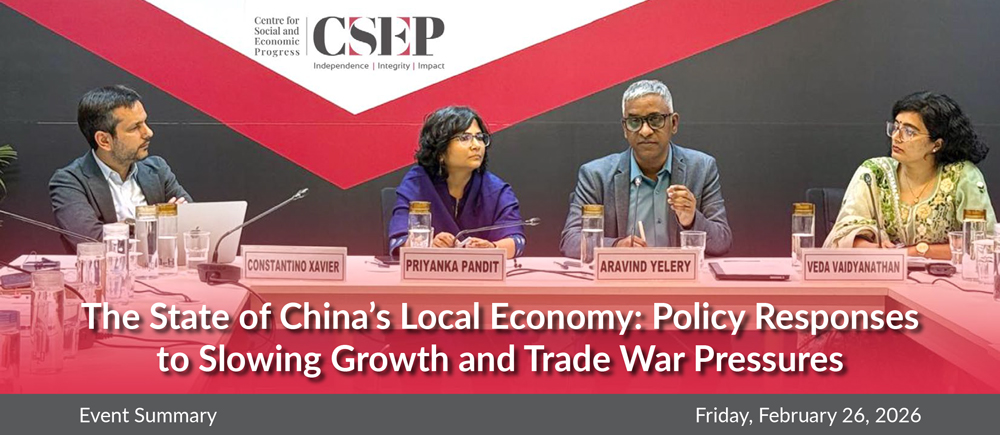
- CSEP hosted its 38th Foreign Policy and Security Studies Tiffin Talk, featuring Aravind Yelery from the Centre for East Asian Studies, Jawaharlal Nehru University.
- The presentation was titled, “The State of China’s Local Economy: Policy Responses to Slowing Growth and Trade War Pressures,” and aimed at China’s provincial political economy, shifting attention away from aggregate national indicators to a more granular dimension of the country’s economy. The seminar examined how China’s provinces are responding to mounting fiscal stress, slowing growth, and intensifying external trade pressures, emphasising the importance of provincial dynamics in shaping the country’s broader economic trajectory.
- The session featured comments from discussant Priyanka Pandit, Assistant Professor, Shiv Nadar University and was moderated by Veda Vaidyanathan, Fellow, CSEP.
- This series of closed-door research seminars is curated by Constantino Xavier, Senior Fellow, CSEP, and Shivshankar Menon, Distinguished Fellow, CSEP. It focuses on contemporary, evidence based research with policy relevance to bridge Delhi’s scholar-practitioner divide.
Provincial Political Economy and Fiscal Stress
The session began with the presenter examining the fiscal pressures shaping China’s provincial economies and the evolving financial relationship between the central government and local administrations. The core argument of the talk was that provincial dynamics are now central to understanding China’s economic trajectory. Since 2014, the State Council has sought to redefine fiscal relationships between the centre and provinces in response to tax imbalances and mounting subnational debt. Local governments, facing declining land revenues and growing repayment obligations, have experienced significant financing stress. Much of their earned revenue is absorbed by debt servicing, leaving limited fiscal space for new development initiatives.
While coastal provinces continue to receive special funding, smaller interior provinces often lack comparable access. This asymmetry has compelled provincial governments to align closely with central priorities to secure funds and bond quotas. This has created institutional pressures, where provincial performance is increasingly assessed not only in terms of GDP growth, but also in terms of compliance, governance integrity, and structural transformation. This has given rise to a degree of competitiveness among the provinces for access to resources from the centre.
Regional Differentiation and Industrial Strategy
A key insight from the session was the differentiated regional strategy unfolding across China. Coastal provinces are prioritising industrial upgrading and technological innovation; inland regions are absorbing excess capacity from top-tier provinces; and older industrial regions are attempting selective revival while transitioning into new sectors.
Tier-1 cities such as Shanghai and Beijing continue to face high debt stocks, falling land revenues, and rising social expenditure commitments. Despite their historic advantages, these cities are under pressure to maintain growth amid tariff volatility. In contrast, newer Tier-1 and Tier-2 cities, unburdened by legacy debt, have displayed greater flexibility in debt management and industrial expansion.
Western “dual hubs” have also outperformed expectations, particularly through upgrades in automobile manufacturing and related sectors. Contrary to the earlier perception of one of the discussants that development tapered off in Sichuan, the presenter argued that growth has shifted further westward, reflecting a broader redistribution of industrial activity.
The speaker employed the case study of Ningxia province to throw light on how provincial economies are restructuring in response to both fiscal constraints and shifting central priorities. Historically focused on agriculture, Ningxia witnessed a shift in export composition from agri-products to tyres and organic chemicals post-2015 and is now pivoting toward the e-commerce and technology sectors. A discussant suggested that this rapid transformation reflects central pressure to reorient provincial economic behaviour rather than purely endogenous market forces.
The 15th Five-Year Plan (2026–2030) sets ambitious expectations for infrastructure expansion and industrial growth, especially in smaller provinces. However, concerns were raised by some participants that these projections may be overly optimistic, given tightening debt supervision and governance oversight. The Ningxia example underscored a broader trend where provinces must align with national industrial priorities to remain eligible for financial support from the centre.
Recentralisation and Coercive Federalism
A major theme of the discussion was the nature of China’s ongoing recentralisation of power. Attending scholars characterised it as structural rather than purely political, rooted in fiscal federal tensions that date back to the 1994 tax-sharing reform. While control over fiscal resources lies largely with the central government, spending responsibilities rest with provinces. This mismatch forces provinces to scramble for funds, often through local government financing vehicles and state-owned enterprises.
Discussants debated whether this dynamic amounts to “coercive federalism,” particularly when provinces are compelled to alter trade patterns or industrial structures to secure central support. The coercive element was acknowledged by the presenter, but he also argued that the leadership views this competition as economically necessary. Under Chinese President Xi Jinping’s framework, inter-provincial competition has been institutionalised, allowing industries to compete across provinces for market space, leading to a form of natural allocation based on competitiveness and central favour.
At the same time, concerns were raised about fiscal sustainability. A participant questioned the sources of funding amid reluctance to increase external borrowing, noting that provinces face restrictions on foreign lending; while private firms may borrow abroad, subnational governments cannot, thus reflecting the centre’s desire to contain sovereign risk.
Implications for India
The session concluded with reflections on implications for India. Some warned that emerging provincial hubs, or in other words, “new Chinas”, could intensify export competition, including through indirect routing of goods to bypass trade barriers. Blocking Chinese exports may prove insufficient if firms reconfigure supply chains through third countries.
Meanwhile, opportunities exist. As Tier-2 provinces absorb overcapacity and climb value chains, they may seek external markets and investment destinations. Chinese investments in India, if permitted, are likely to concentrate on basic infrastructure. One participant emphasised that India should draw lessons on institutional reform and consider deeper engagement in regional trading arrangements, rather than focusing solely on origin-based trade restrictions.
Overall, the seminar highlighted that China’s economic story is increasingly provincial. Understanding the pressures, competition, and adaptive strategies unfolding at the subnational level is essential for interpreting China’s slowing growth, as well as for assessing its evolving global economic footprint and its consequences for the global polity.







The Centre for Social and Economic Progress (CSEP) is an independent, public policy think tank with a mandate to conduct research and analysis on critical issues facing India and the world and help shape policies that advance sustainable growth and development.