

Tiffin Talk I Gendering Indian Diplomacy: Narratives and Numbers
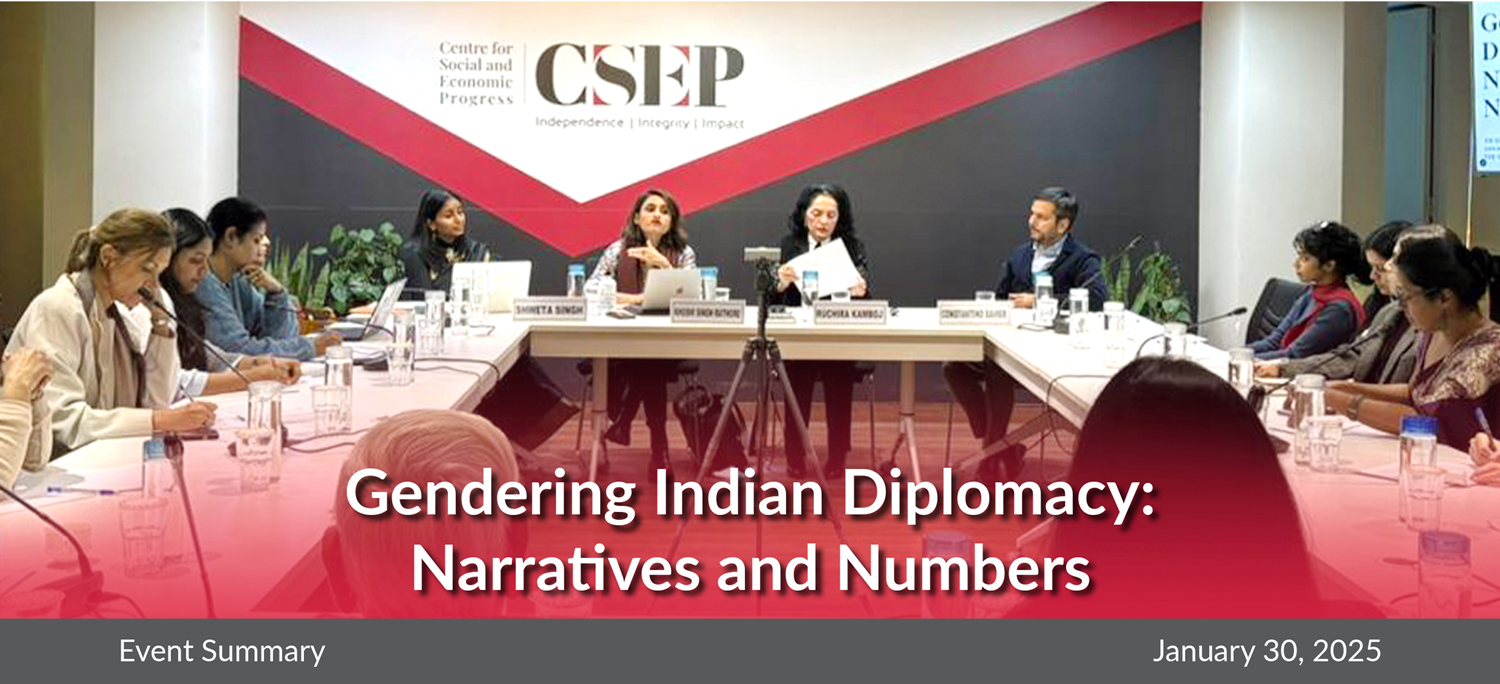
- CSEP hosted its 30th Foreign Policy and Security Studies Tiffin Talk on ‘Gendering Indian Diplomacy: Narratives and Numbers’ with Khushi Singh Rathore. She recently received her PhD from the Centre for International Politics, Organization and Disarmament (CIPOD) at Jawaharlal Nehru University and is Associate Editor at the Hague Journal of Diplomacy.
- The discussion examined women’s role in Indian diplomacy and the structural challenges within the Indian Foreign Service (IFS) using a unique quantitative database. It further focused on a feminist scholarly lens and practitioners’ insights on the gendered nature of the institution.
- The discussants were Ruchira Kamboj, former Permanent Representative of India to the United Nations, and Shweta Singh, Associate Professor, South Asian University. The talk was moderated by Constantino Xavier, Senior Fellow, CSEP.
- The discussion included participants from various Indian government institutions, foreign diplomatic missions and embassies, former civil servants, academic institutions and think tanks from India and abroad.
- This series of closed-door research seminars is curated by Constantino Xavier, Senior Fellow, CSEP and Shivshankar Menon, Distinguished Fellow, CSEP. It focuses on contemporary, evidence-based research with policy relevance to bridge Delhi’s scholar-practitioner divide.
Indian Foreign Service: Historical Context and Challenges
The “gender turn” in the study of diplomacy is a relatively new but growing field, with prominent contributions from scholars of gender and diplomacy such as Karin Aggestam, Ann Towns, Sara Chenab, among others. Building on their work, the speaker conducted a longitudinal study of women within the Indian Foreign Service (IFS). The speaker has created a unique database reflecting their roles and representation and draws on historical accounts tracing officers’ diplomatic careers.
The speaker foregrounded the discussion with how the archetype of a diplomat is generally of a male diplomat, although the recent disciplinary discourse has highlighted how diplomacy is a ‘feminine art’. Despite this, the speaker highlighted, women remain underrepresented in diplomacy, and the Indian foreign office is no exception to the same.
The speaker also noted that women were not a part of the debates concerning the foundation of the Indian Foreign Service (IFS) back in 1946. This makes an interesting reflection on the gendered marginalisation in the coming together of the Indian foreign office, given how women were an integral part of the independence struggle. Women IFS officers have faced structural and normative barriers over the years. This can be seen in gender disparities among positions of leadership. In one illustration, the speaker recounted the “marriage ban” only for women IFS officers, which was in effect until 1973, requiring them to resign should they choose to marry. The speaker introduced the concept of a “leaking pipeline” to describe how women hit a glass ceiling during the progression of their diplomatic careers.
Moving Beyond the Numbers
The speaker examined the increasing representation of women in the IFS, noting how from 2018 to 2020, women exceeded the 40% share of recruits from just 16% in 1987. Currently, only 12.6% of India’s foreign missions are currently led by women, mostly concentrated at the multilateral level.
One participant argued that the recent increase in the number of recruits to the IFS is promising and aligns with the growing global footprint of women in diplomacy. However, they suggested that beyond the numbers, it will be important to map the types and nature of the roles assigned to women in the service – they are often offered the ‘softer’ roles, working on non-traditional areas of diplomacy, whereas the traditional diplomatic roles pertaining to defence and security tend to be offered to men. The participant further observed that women in leadership positions often facilitate greater opportunities for other women, underscoring the importance of tracking career trajectories and institutional structures that enable such advancements.
Another participant urged a deeper engagement with the politics of knowledge production in the speaker’s analysis. Noting that feminist movements have developed along distinct trajectories in the Global North and the Global South, the participant suggested contextualising the author’s research within the larger trajectories of the evolution of feminism in post-colonial India. In this regard, a comparative approach would be important, considering how gender discourse was framed in colonial India. Additionally, they outlined three key aspects of the evolution of feminist discourse—dialogue, dissidence, and difference—arguing that feminism in the Global South is simultaneously in dialogue with and in opposition to dominant Northern narratives.
Global Comparisons and the Way Forward
The discussion encompassed a diverse range of perspectives on gender representation in diplomacy across various national contexts. Participants noted that some countries such as Sri Lanka and Thailand have a higher proportion of women in their foreign services than India. On the other hand, countries such as Norway have appointed only two women as Minister of Foreign Affairs – equivalent to an Indian Foreign Secretary – while India has had three (the latter being a reflection of the slow progress of women in Indian diplomacy as per the speaker). Similarly, women comprise less than 30% of foreign service officials in Italy. The British foreign service was also highlighted as an example of enduring institutional barriers, including a historical marriage ban that restricted women’s participation. The illustrations threw light on the consistencies and inconsistencies in the place of women in diplomacy globally.
Participants also discussed structural issues, particularly the impact of age limits and restrictions on the number of examination attempts, which disproportionately affect female applicants. Others highlighted that self-censorship among women, with officers themselves being reluctant to take up certain positions, is also a prevalent concern, reinforcing existing gender disparities in the profession.
Participants noted that a better system would consider women’s disproportionate (and often invisibilized) domestic responsibilities and advocated for initiatives designed to enhance retention and career progression. The discussion concluded with a consensus that the system should be made more inclusive that ensures women’s representation in higher and coveted positions. Future research could adopt an intersectional approach to examining female diplomats, incorporating factors such as caste and class to provide a more nuanced understanding of gendered experiences in foreign services.

The Centre for Social and Economic Progress (CSEP) is an independent, public policy think tank with a mandate to conduct research and analysis on critical issues facing India and the world and help shape policies that advance sustainable growth and development.