


Editor's Note
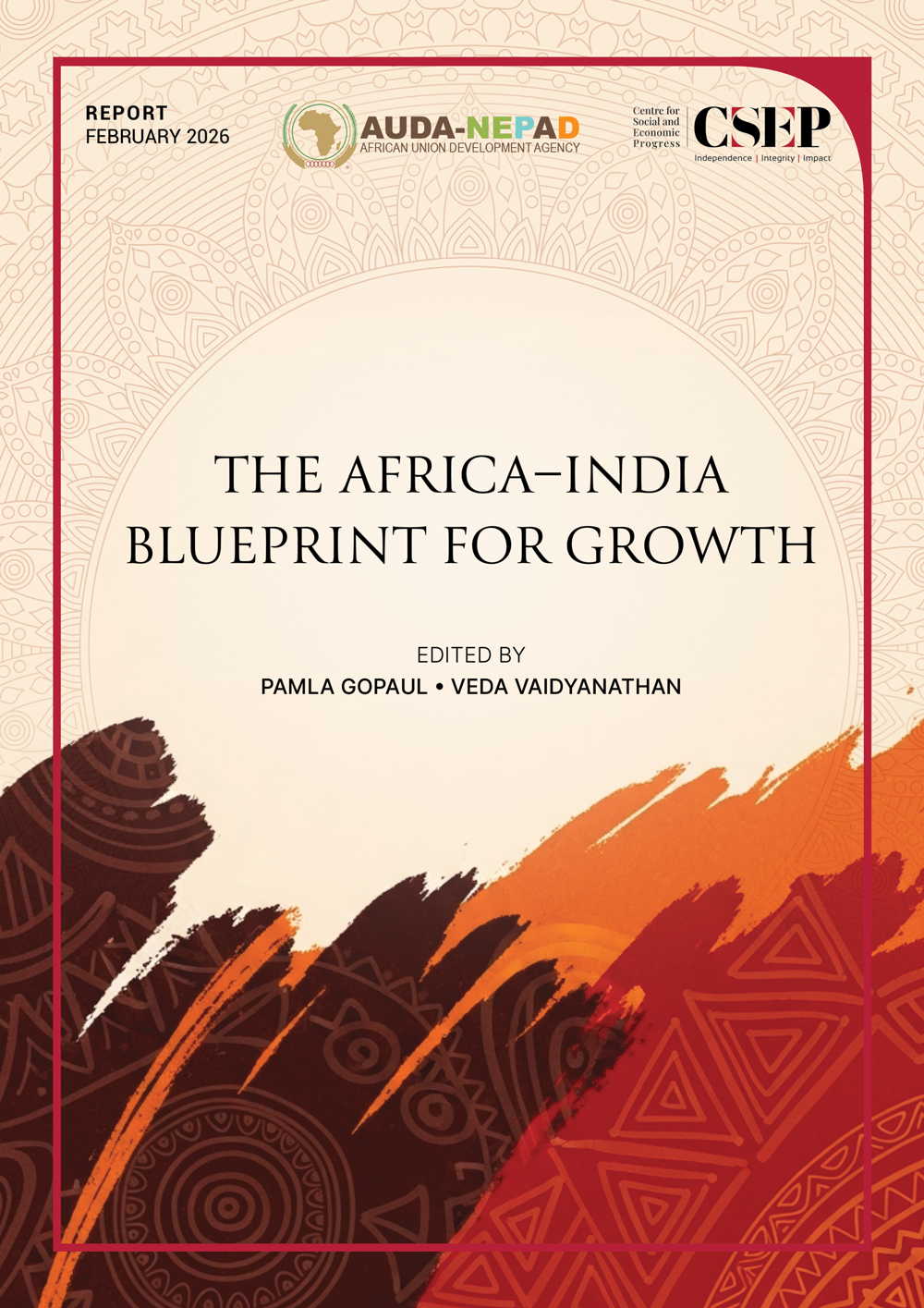
This report is a collaborative effort between the Centre for Social and Economic Progress (CSEP) and the AUDA-NEPAD Africa Policy Bridge Tank (APBT).
DOWNLOADS
Introduction
The global system is undergoing a profound structural transition. An increasingly fragmented and contested global order is redefining how countries cooperate, compete, and articulate their development pathways. Across the Global South, nations are searching for new frameworks, tools, and narratives to shape an alternative and more equitable paradigm of growth. In this context, the Africa–India partnership stands out as both historic and forward-looking. Rooted in shared political solidarities and deep economic complementarities, these dynamic regions are entering a new era of sustainable and mutually beneficial cooperation. Yet despite the depth and longevity of this relationship, a critical knowledge asymmetry persists: policymakers, private sector actors, and scholars often lack a consolidated body of insights, evidence, and innovative models to guide a fit-for-purpose Africa–India partnership.
To help bridge this gap, in January 2025 the Centre for Social and Economic Progress (CSEP), and the African Union Development Agency-NEPAD (AUDA-NEPAD) Economic Analysis and Foresight Unit launched The Africa–India Global Dialogue Series, a monthly webinar designed to convene fresh perspectives from both regions. Across 10 episodes, over 30 African, Indian, and global experts explored themes spanning geopolitics, digital innovation and critical minerals, to health systems, energy transitions, infrastructure, agriculture, and the creative economies shaping a new cultural imagination.
Recognising that the dialogue marked only a starting point, and that the moment demands greater ambition, the initiative expanded into the creation of a comprehensive, idea-rich report: 32 policy briefs authored by leading experts and scholars offering policymakers a coherent suite of actionable options to advance the partnership. The report distils its insights across four interlinked themes: Geopolitics and Security; Green Growth and Just Transitions; Economic Diplomacy and Digital Futures; and Health and Human Capital, highlighting cross-cutting opportunities for collaboration and innovation. Authors were asked to use a “problem → evidence → policy options” approach, writing to advise policymakers. This method anchors each contribution in applied problem-solving rather than abstract analysis, ensuring relevance across diverse policy and institutional contexts. The format is intentionally non-uniform: some pieces cite sources, others draw on experience or specific cases. All, however, aim to deliver actionable, evidence-informed knowledge and insights.
The first section, titled “Strategic Partnerships in a Changing World,” examines how India–Africa relations must be strategically recalibrated amid intensifying geopolitical competition and global disorder. Contributors emphasise the need for strategic clarity, normative purpose, and mutual agency. Together, these contributions argue for moving beyond transactional engagement toward a partnership grounded in shared strategic imagination and political intent.
Sanusha Naidu highlights Africa’s constrained but real agency, urging India to treat African partners as co-architects. Jabin T. Jacob stresses a clearer normative purpose to guide India’s engagement, while Constantino Xavier proposes framing ties as an Indo-Atlantic partnership, embedding Africa within India’s oceanic strategic imagination. Rajiv Bhatia underscores that global polycrises have sidelined Africa, calling for renewed political attention and a comprehensive strategy to restore momentum.
Multilateral coordination emerges as a critical source of strategic leverage. Mandira Bagwandeen and Riaan Dhankhar argue that India and African states should act as a coordinated coalition at the United Nations (UN) to advance meaningful United Nations Security Council (UNSC) reform, while Sarang Shidore extends this logic to Brazil, Russia, India, China, and South Africa (BRICS), urging focus on delivery in climate resilience, global health, and multilateral reform. The section also stresses operationalising security and maritime cooperation. Abhishek Mishra and Ovigwe Eguegu call for shifting from episodic defence engagement toward sustained capacity building, technology transfer, and co-production. Complementing this, Harsh V. Pant and Samir Bhattacharya advocate transforming maritime cooperation in the Western Indian Ocean into an institutionalised, capability-driven governance framework.
The second section, titled “Green Growth and Just Transitions,” examines how Africa–India cooperation can advance a clean-energy future that is both economically transformative and socially inclusive. Africa’s rich endowment of critical minerals, essential for renewable technologies, can complement India’s strengths in manufacturing, finance, and technology, enabling green-industrial value chains, if underpinned by deliberate policy coordination and investment alignment. Scholars such as Lethabo Sithole and Divyam Nagpal with Darryn Allan, argue that coordinated strategies, including infrastructure development, skills transfer, policy exchange, and joint investment, can move both regions beyond raw resource exports toward shared prosperity while advancing the Global South agenda.
Equally critical is ensuring a just and inclusive transition. Mutuso Dhliwayo, Michelle N Chitando and Hillary T Mugota emphasise community-driven energy partnerships that prioritise women and marginalised groups, avoiding top-down approaches that reproduce energy poverty. Rahul Tongia and Prudence Lihabi point to transferable lessons from India’s electrification experience and integrated energy planning to guide locally tailored, financially sustainable, and well-sequenced rollouts. Grace Chileshe adds that decentralised access, smart grids, cross-border power trade, and climate-resilient infrastructure can embed equity and resilience into the transition. Together, these perspectives show that Africa–India cooperation can combine industrial opportunity, governance, and social inclusion to deliver a green-energy transition that is both economically robust and just.
The third section, titled “Economic Diplomacy and Digital Futures,” highlights how India–Africa cooperation can advance inclusive, resilient growth by combining infrastructure, investment, finance, and digital innovation. A central theme is leveraging and expanding development engagement. Sushmita Rajwar stresses that India’s infrastructure projects should be intentionally aligned with Africa’s regional integration agenda, using Regional Economic Communities (RECs) and the African Continental Free Trade Area (AfCFTA) to translate connectivity into trade, value chains, and productive assets. Building on this, David Rasquinha argues the next phase of cooperation, should supplement hard infrastructure with soft infrastructure, including institution-building, capacity development, and mechanisms to channel private investment into African economies. On the other hand, Aude Darnal urges African leaders to urgently explore innovative investment models that support local social enterprises, building skills, knowledge, and businesses for homegrown development. Amit Jain and Udaibir S. Das, meanwhile, add that deeper African capital markets and balance-sheet-resilient financing are key to mobilising domestic resources and ensuring inflows strengthen rather than destabilise local economies. Abdoulkadre Ado highlights agricultural joint ventures to boost local value chains, while Gurjit Singh advocates an FDI-first strategy with blended finance, Public–Private Partnerships (PPPs), and stronger follow-through aligned with African priorities.
On digital and technology-driven inclusion, Pria Chetty and Scott Timcke stress foundational digital public infrastructure (DPI) and data governance to enable locally relevant artificial intelligence (AI) and digital trade under AfCFTA. Laveesh Bhandari emphasises interoperable, mobile-first ecosystems to expand opportunity and lower transaction costs, while Karthik Sastry cautions that technology must be context-appropriate, advocating homegrown Research and Development (R&D) over imported solutions. Yash Kalash highlights that central bank digital currencies (CBDCs) offer India and Africa a chance to address financial exclusion, reduce reliance on costly systems, and assert a Global South voice in digital finance. Together, these approaches integrate infrastructure, investment, and digital innovation for a new era of Africa–India partnership.
The final section, titled “Health and Human Capital,” highlights how India–Africa cooperation can strengthen systems, skills, and institutions to advance human development and sustainable capacity. A key theme is institutionalised knowledge and education cooperation. Lina Benabdallah emphasises that knowledge cooperation must move beyond ad-hoc exchanges toward recurring, co-produced research linking universities, think tanks, and civil society to policymaking. Nivedita Ray and Unami Dube with Kipkirui Langat stress the importance of targeted, scalable education and workforce initiatives, from digital learning and Technical and Vocational Education and Training (TVET) to teacher training and employer-linked apprenticeships, adapted to African labour markets, to convert demographic potential into employable skills by 2030.
Another major theme is health systems strengthening and health sovereignty as a strategic capability rather than a purely sectoral goal. Njabulo Mbanda argues for framing India–Africa health cooperation as global health diplomacy, prioritising Universal Health Coverage (UHC) financing, data systems, and local pharmaceutical capacity. Desta Lakew highlights the need to build “health sovereignty” through domestic financing, programmatic ownership, and community-led primary care and integrated mental health models. Sandhya Venkateswaran emphasises institutionalising practical learning, joint R&D and manufacturing, digital health architecture, and coordinated advocacy to amplify a Global South voice in health governance. Collectively, these perspectives underline that durable India–Africa partnerships in health and human capital require systemic, coordinated, and people-centred approaches to education, workforce development, and health systems.
This report reflects the significance of bringing together 39 scholars from around the world to deliberate on Africa–India cooperation. By combining diverse perspectives, disciplines, and experiences, the exercise fosters innovative ideas, cross-pollination, and forward-looking solutions that a single viewpoint could not produce, demonstrating the value of collaborative, policy-oriented scholarship in shaping real-world decision-making. Its objective is clear: turn a shared vision into a sustainable blueprint for impact, strengthening one of the world’s most consequential South–South partnerships at a decisive moment in global affairs.

Pamla Gopaul

Veda Vaidyanathan



Find on this page

The Centre for Social and Economic Progress (CSEP) is an independent, public policy think tank with a mandate to conduct research and analysis on critical issues facing India and the world and help shape policies that advance sustainable growth and development.