

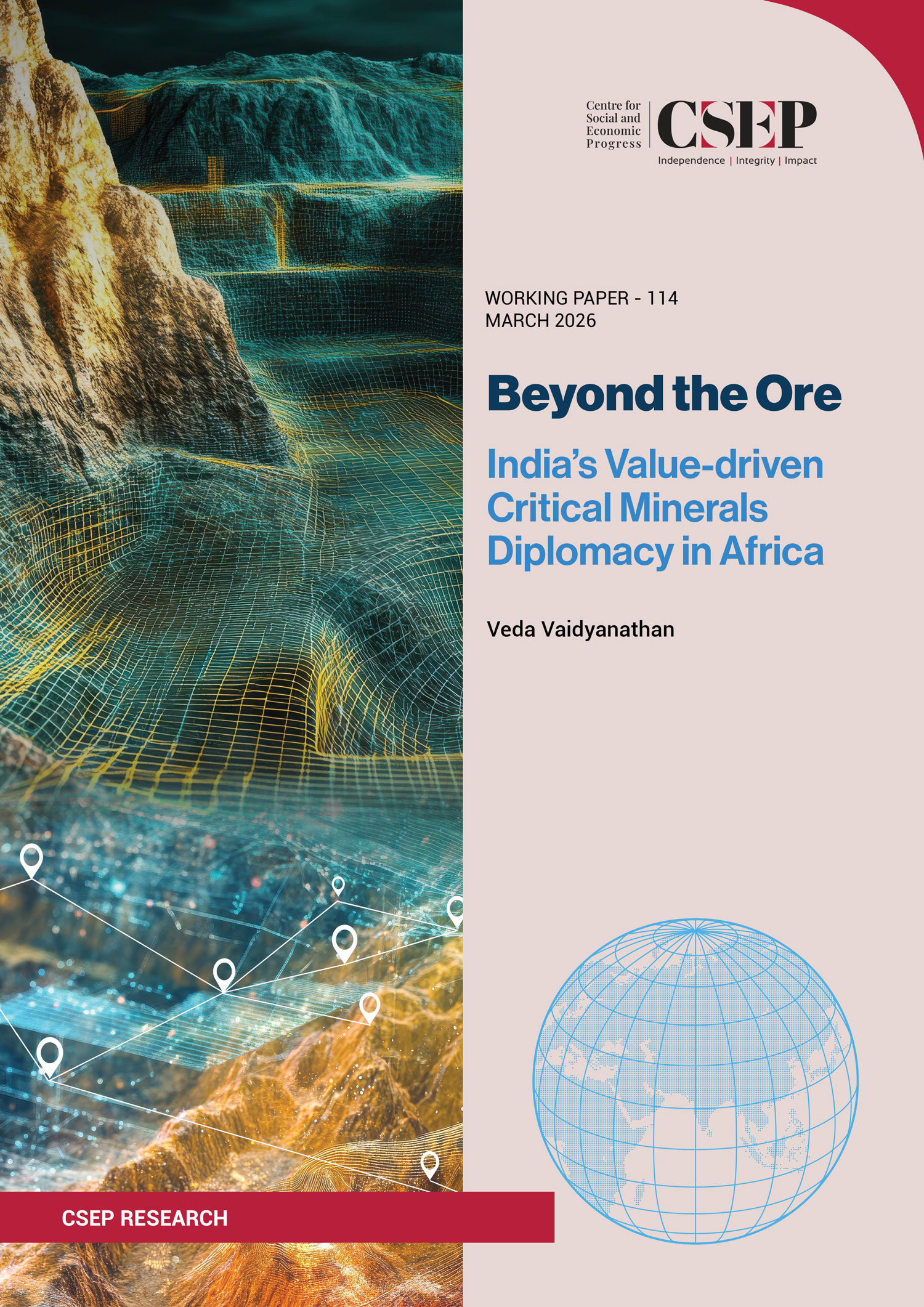
Beyond the Ore: India’s Value-driven Critical Minerals Diplomacy in Africa
Reading Time: 5 minutesDOWNLOADS
Executive Summary
As global demand for critical, green or transition minerals accelerates, India is working to secure supplies to meet its industrial and energy transition goals. With over 30% of global reserves of these located in Africa, countries on the continent are central to New Delhi’s effort.
This paper explores how India can deepen its engagement across Africa’s critical minerals ecosystems by moving beyond transactional trade and concessional finance towards embedded partnerships grounded in institutional capacity building, technology transfer and shared value creation. Building on an earlier study, it identifies three practical entry points for India in an increasingly competitive geopolitical landscape. These include critical mineral workforce development, sustainable and responsible mining practices, and knowledge networks for mineral mapping, surveying, and geological collaboration.
However, the move from ambition to implementation is constrained by shared institutional and structural challenges. Massive infrastructure deficits, regulatory and policy uncertainty across various African mining jurisdictions, and intense geopolitical competition complicate long-term planning. Indian institutions and companies face operational and technical hurdles as they expand into new markets and expose mineral supply chains to disruption. To anchor India’s mineral diplomacy in stable, long-term, and substantive partnerships, addressing these factors will be key.
Scope of the Study and Focus
This paper focuses on Zambia, Zimbabwe, and Tanzania, chosen for their existing engagement with India, their mineral endowments, and their relevance to global supply chains. While the themes explored have been matched to a particular country, they will also find resonance in other mineral-producing geographies.
The paper shifts the focus from identifying ‘where’ India should engage to examining ‘how’ such engagements can be operationalised through targeted policy instruments. The potential of joint geological surveying and knowledge networks in Zambia, the commercial logic for responsible mining practices in Zimbabwe, and opportunities for workforce development in Tanzania are analysed in depth. In doing so, the paper shows how India’s ambitions in critical minerals are being translated, or constrained, by operational realities on the ground, with important implications for India’s future role in global critical mineral supply chains.
These country-theme case studies not only underscore India’s bilateral outreach but also serve as diagnostic tools to assess the strengths and weaknesses of its engagement in practice. With diverse regulatory environments and domestic political economies, along with the rise of resource nationalism across Africa, balancing India’s commercial interests with the development priorities of the partner countries will require nimble policymaking, leveraging New Delhi’s strengths.
The three case studies explored in the paper are as follows:
Zambia: Where and How Much? Resource Mapping as a Foundation for Copper Cooperation.
Zimbabwe: How to Mine Right and Why it Pays? Sustainability as a Strategy in Lithium Diplomacy.
Tanzania: Can Knowledge Power Value Chains? Capacity as the Cornerstone of Critical Mineral Cooperation.
Policy Pathways
In Zambia, India’s focus could be on enhancing technical cooperation in geological mapping and early-stage exploration. Existing agreements, including the India–Zambia Technology Transfer Programme and the Joint Permanent Commission framework, provide a platform for operationalising Memoranda of Understanding (MoUs) and advancing concrete projects.
- To improve transparency, resource quantification, and investment certainty, co-developing digital mineral data repositories and facilitating technical exchanges between Indian and Zambian scientists could be undertaken.
- Cooperation can focus on strengthening Zambia’s geoscientific infrastructure. A blueprint for a joint innovation hub for mineral-focused collaborations already exists with the Indo-Zambia bank, which is co-owned by the Zambian government (40%) and Indian state-owned banks (60%).
In Zimbabwe, Indian actors could accrue credibility by making responsible mining overseas a central tenet of their operations.
- In addition to aligning operations with global environmental, social and governance (ESG) standards, an India–Zimbabwe Sustainability Charter could be developed. This could establish benchmarks for the Indian industry, with incentives for working closely with local civil society organisations.
- Introducing pilot projects in low-emission mining technologies, mine-site rehabilitation, and setting up clean recycling or value-added processing near mining sites, which provides training for local communities, could further enhance the accountability of Indian firms.
Central to Tanzania’s Vision 2030 strategy is the goal of boosting productivity and local value addition in the mining sector. Given Dodoma’s long-standing educational and technical ties with New Delhi, India could play a substantive role in a core component of this aspiration—workforce development.
- The Indian Institute of Technology (IIT) Madras, which hosts the first overseas campus in Zanzibar, could be positioned as a regional hub for mineral education.
- Partnerships with local technical institutions could incorporate industry-linked internships and exchange programmes with national metallurgical labs in India.
The findings presented in this paper draw on extensive literature reviews, stakeholder consultations, dialogues, and workshops conducted across geographies. The evidence was triangulated to examine how India can enhance its credibility as a responsible actor in Africa’s critical mineral supply chains.
In an increasingly complex global architecture, positioning India as a ‘viable alternative’ would require identifying the unique value proposition it offers to host countries. This paper argues that by leveraging its developmental diplomacy, private sector dynamism, and capacity to craft innovative models of cooperation, New Delhi can disrupt traditional narratives of resource extraction. The objective should be to grow into a competitive, reliable partner that not only secures supply chains but also actively shapes the future of mineral governance and green industrialisation across the region.
Q&A with author
What is the core message of your paper?
India’s efforts to secure critical minerals from Africa require a shift away from transactional trade and concessional financing towards deeper, long-term partnerships. This paper outlines three key avenues for such engagement: strengthening geological knowledge through collaborative mapping and data-sharing, promoting environmentally sustainable and responsible extraction practices and investing in the training and expansion of local mining workforces. Drawing from insights from Zambia, Zimbabwe and Tanzania, it illustrates how these strategies can be adapted to other mineral producing geographies in the Global South.
The paper also underscores persistent hurdles, including inadequate infrastructure, regulatory unpredictability and rising geopolitical competition, all of which complicate implementation. Ultimately, it concludes that India’s ability to build secure and resilient mineral supply chains will depend on aligning its commercial objectives with the development goals of African partners. By leveraging its established strengths and existing frameworks, India can position itself as a credible and responsible actor in this new era of resource diplomacy.
What presents the biggest challenge?
Across Zambia, Zimbabwe and Tanzania, the paper identifies distinct yet overlapping operational constraints shaping India’s mineral engagement. In Zambia, limited international experience of institutions such as the Geological Survey of India, inconsistent data standards, logistical vulnerabilities and long project gestation periods slow exploration and demand sustained policy continuity. In Zimbabwe, unreliable geological datasets, weak domestic processing capacity, ESG-related risks and uneven regulatory enforcement erode investor confidence, further compounded by infrastructure deficits and policy volatility. In Tanzania, the absence of refining capacity, inadequate transport and energy infrastructure, and India’s own technological limitations in nickel processing restrict downstream value addition. Collectively, these challenges highlight the need for structured de-risking measures, improved institutional coordination and long-term partnerships aligned with host-country development priorities.
What presents the biggest opportunity?
Across Zambia, Zimbabwe, and Tanzania, the very constraints shaping their mineral sectors also open strategic entry points for India to differentiate its engagement. In Zambia, gaps in reliable geological data create an opportunity for institutions like the Geological Survey of India and private sector actors to anchor long-term partnerships through resource mapping, data standardisation, and technology-led exploration. In Zimbabwe, weak enforcement of ESG frameworks allows Indian firms to position responsible mining practices as a competitive advantage, building credibility while aligning with local sustainability priorities. In Tanzania, deficits in industrial capacity, skills, and infrastructure present space for India to embed itself across the value chain through workforce development, technical training, and renewable-linked infrastructure support. Taken together, these contexts enable India to move beyond extraction-led engagement and establish itself as a co-developer of resilient, value-added mineral ecosystems.

Veda Vaidyanathan


Find on this page

The Centre for Social and Economic Progress (CSEP) is an independent, public policy think tank with a mandate to conduct research and analysis on critical issues facing India and the world and help shape policies that advance sustainable growth and development.