

Sri Lanka’s Regional Connectivity: Building a Green Future for Energy and Trade
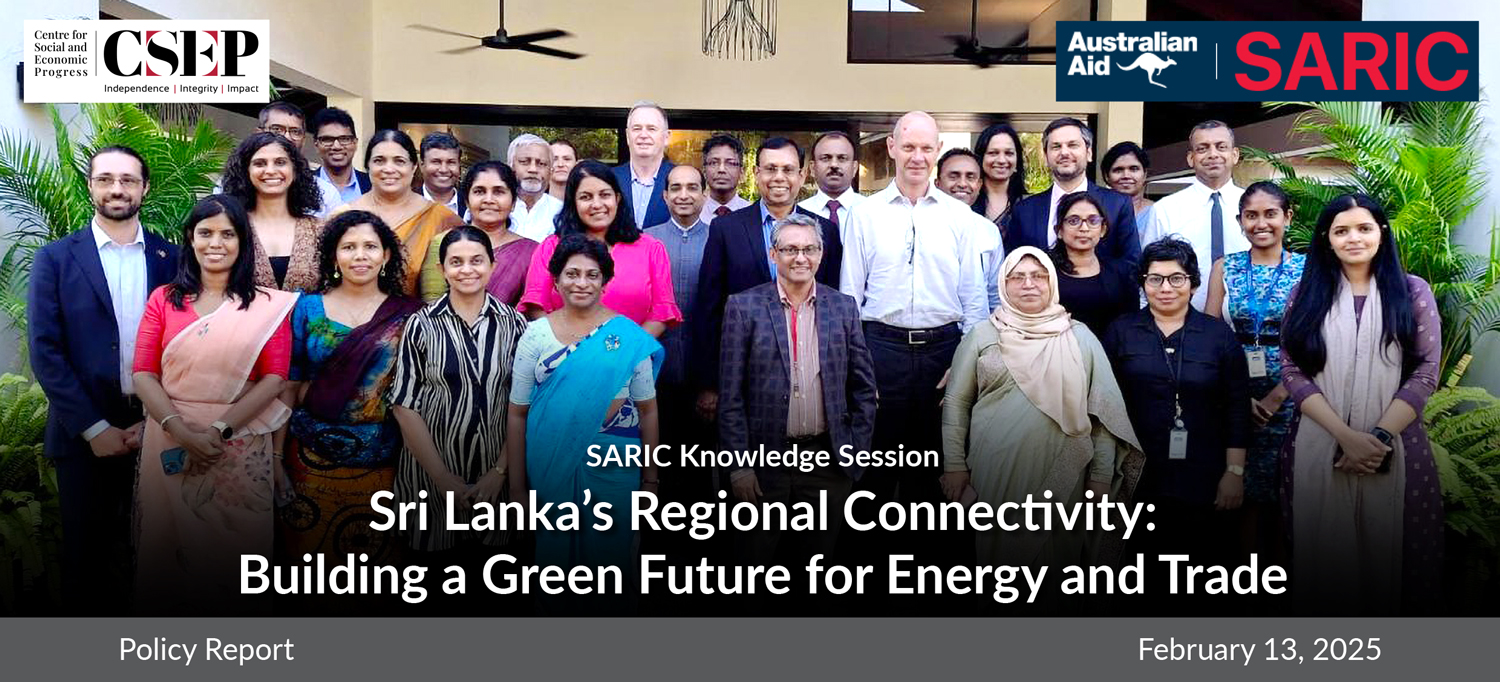
On February 13, 2025, the Department for Foreign Affairs and Trade (DFAT) and the South Asia Regional Infrastructure Connectivity (SARIC) initiative, with the Centre for Social and Economic Progress (CSEP) as the Knowledge Partner, hosted a Knowledge Session in Colombo on Transforming Sri Lanka: A Green Future for Energy and Logistics.
His Excellency Paul Stephens, High Commissioner of Australia to Sri Lanka, and Dr. Constantino Xavier, Senior Fellow, CSEP, gave the framing remarks. There were two focussed Knowledge Sessions: on digitisation and trade facilitation, and on Sri Lanka’s 2030 Energy Transition. The aim of the sessions was to foster a regional dialogue with comparative experiences to help improve Sri Lanka’s connectivity landscape and reduce carbon emissions through targeted interventions in key sectors, including logistics and energy transition.
The speakers at the Session included Mr. Rohan Masakorala, CEO, Shippers Academy Colombo, Dr. Rahul Tongia, Senior Fellow, CSEP, Dr. Rohan Samarajiva, Chairman, LIRNEasia, and Ms. Riya Sinha, Associate Fellow, CSEP.
The closed-door event brought together alumni from DFAT’s SARIC network, as well as experts from multilateral institutions (World Bank and International Finance Corporation (IFC)), regulators, the private sector, academia, and think tanks (see Annexure 1 for the full list of participants).
SARIC is funded by DFAT. The training, networking and knowledge component under SARIC is managed by Palladium.
Deepening Economic Linkages and Strengthening Regional Prosperity
Setting the context, High Commissioner Paul Stephens noted that SARIC is an initiative funded by the Australian government and implemented by the World Bank, the IFC and the Palladium Group. SARIC recognises that while South Asian Countries are experiencing economic growth, there is still untapped potential in deepening cross-border linkages. South Asia’s intra-regional trade is only 5% of total trade, far below ASEAN (25%) and Europe (60%), highlighting the need for stronger cross-border connectivity. Therefore, connectivity and regional integration are essential but require acceleration through targeted policy interventions.
Constantino Xavier highlighted that the South Asian region is undergoing social, economic, and political transitions, impacting growth and stability. South Asia must navigate global shifts, including US-China competition and technological disruption. As a result, three scenarios could emerge – countries could (1) emerge and thrive, (2) experience moderate growth, or (3) face stagnation or systemic collapse. To drive economic momentum, technology, trade and energy will remain the key drivers of connectivity, growth, and interdependence, but may also emerge as points of friction.
Xavier suggested that, therefore, countries such as Sri Lanka must build governance frameworks and align with regional and global standards to maximise connectivity benefits. The urgency to address trade, tech, and energy transitions is driven by rapid regional and global changes.
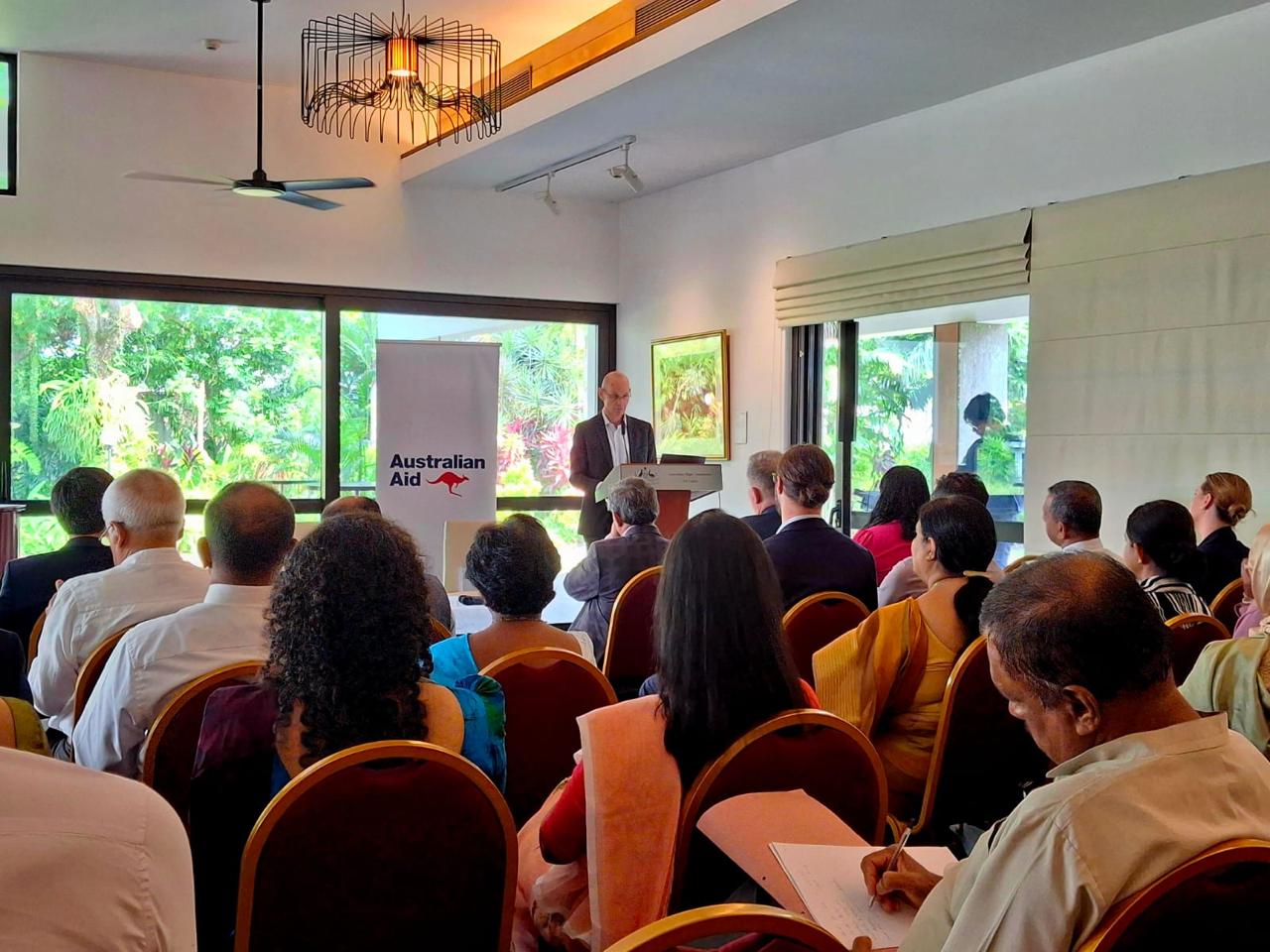
H.E. Paul Stephens delivering the Framing Remarks.
Both speakers also highlighted the role that Australia is playing in the region and specifically through SARIC in the energy and transport sectors by working with regional governments and the private sector to promote partnerships, engagement, financing, support public investments and inform policy on the program along with supporting technical capacity building and regional networking. Australia is committed to fostering discussions, partnerships, and collaborative solutions for enhanced regional connectivity.
Session I: Technology’s Role in Trade Facilitation and Carbon Reduction: Regional Experiences
A major sector critical to decarbonisation in Sri Lanka is logistics. The Sri Lankan Port Authority has a vision to transform the port into an eco-friendly port by 2030. However, heavy reliance on road transportation for evacuation, combined with inefficient trade facilitation has been exacerbating the environmental impact. Lengthy customs procedure, reliance on paper documentation, high dwell time for goods at ports, and outdated systems hinder green initiatives such as the digitisation process and adoption of sustainable technologies. While Colombo formed the National Committee on Trade Facilitation in 2014, the country is yet to achieve 100% implementation of its commitments under the WTO’s Trade Facilitation Agreement, further limiting the adoption of digital initiatives to streamline logistics. There is an urgent need to integrate green logistics with sustainable infrastructure and sustainable energy solutions to not only align with global decarbonisation goals (and therefore, gaining incentives), but also contributing to a more efficient trade ecosystem in Sri Lanka.
Rohan Masakorala noted that despite efforts in trade facilitation, Sri Lanka has faced setbacks due to policy changes and lack of digitalisation. Sri Lanka was once very competitive in the region in logistics but has now fallen behind in efficiency and trade facilitation. In the area of transhipment, where Sri Lanka was once the regional leader, its ports are losing ground to Indian competitors, with containers now being routed through Indian ports of Mundra and Vizhinjam. There have also been delays in trade processes, with export/import (EXIM) processes taking 10-14 days in Sri Lanka, compared to 8-24 hours in Singapore, due to outdated systems. These and other examples shared during the session stressed the urgent need for digitisation and automation.
On the legal front, outdated laws, such as a 200-year-old customs ordinance, hinder digital trade reforms more than technological limitations. There has also been a failure to implement reforms. A national export strategy was developed with global expertise in 2020, but no progress has been made for five years. Such inefficiencies in logistics and customs raise transaction costs, making Sri Lanka’s exports less competitive. Masakorala emphasised that lack of reforms and digitisation deters foreign investment, which has been stagnating at $1 billion annually for two decades.
This impacts regional trade as well. Sri Lanka’s inefficiencies make it difficult to integrate into regional value chains with India, Bangladesh, and beyond. If Sri Lanka accelerates digitisation and legal reforms, it can attract regional business and investment. Sri Lanka aims for $36 billion in exports within the next 60 months, but this is unrealistic without systemic reforms. To remain competitive, Sri Lanka must immediately implement its existing trade and logistics reform plans.
Highlighting the importance of digitisation, Riya Sinha noted that digitisation or paperless trade is a low hanging fruit towards decarbonization of the logistics sector in South Asia. Electronic documentation reduces trade costs, enhances data storage and reuse, and can significantly lower the time required for exports and imports. There are and regional initiatives such as the WTO Trade Facilitation Agreement (2016) and the UN’s framework on cross-border paperless trade aim to promote digital trade facilitation. While domestic paperless trade is improving, most South Asian countries struggle with cross-border digital customs and payments due to regulatory and infrastructure gaps.
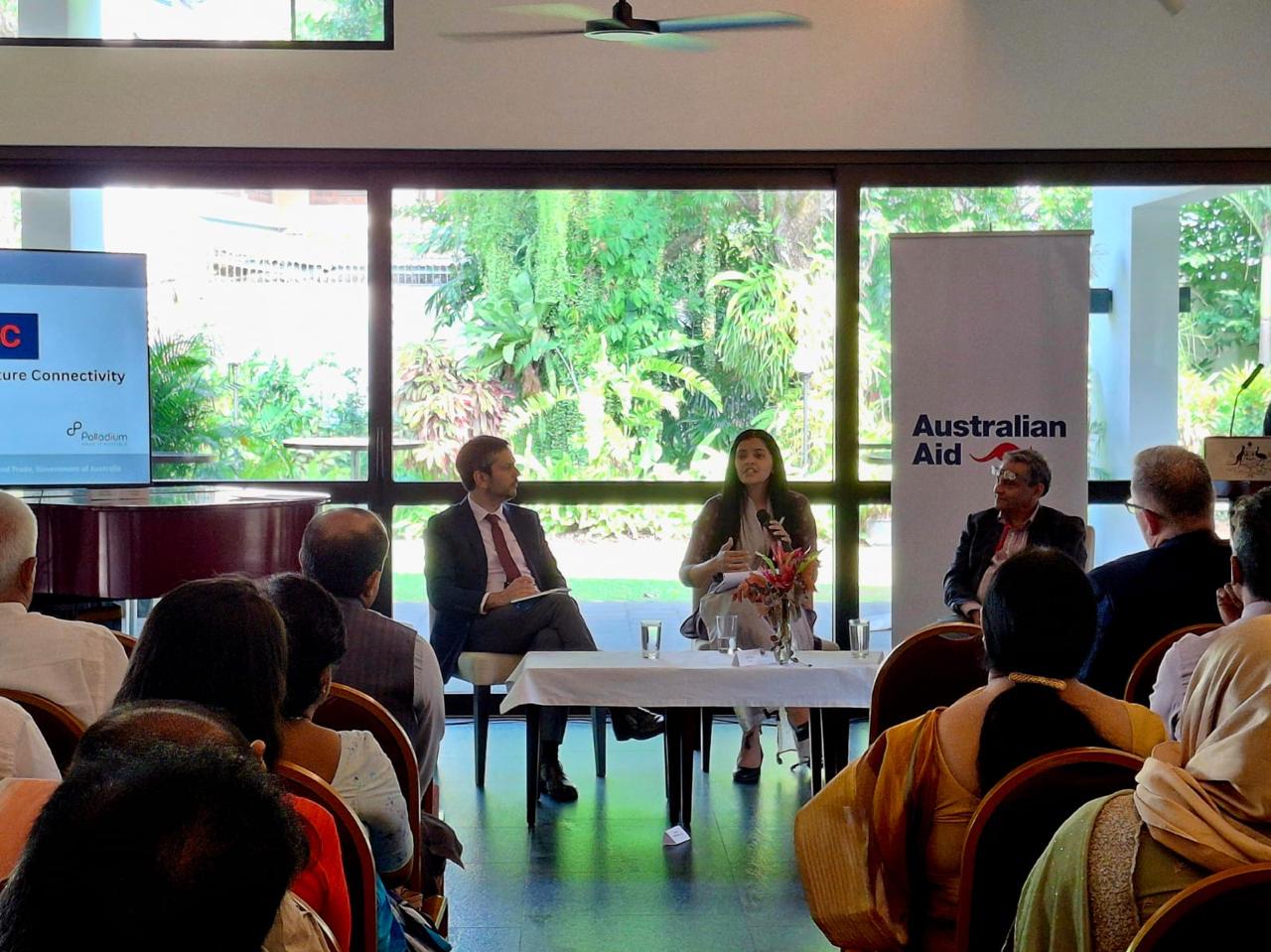
L-R: Constantino Xavier, Riya Sinha and Rohan Masakorala speaking at Session I.
Taking the case study of India, Sinha also noted that while Sri Lanka was ahead of India in trade facilitation a year ago, India has made significant progress in digital trade facilitation over the past nine years. India has fully implemented its WTO trade facilitation commitments, unlike other South Asian countries that still require capacity-building. Several digital initiatives taken by India include, faceless customs clearance (Turant Customs), pre-arrival processing, automated risk management, electronic container tracking, and 100% RFID tagging. New Delhi has also launched a beta version of Unified Logistics Interface Platform (ULIP), integrating multiple logistics stakeholders into a single digital platform. India’s infrastructure and logistics planning tool, the Gati Shakti National Master Plan, integrates 16 ministries to streamline execution of infrastructure projects and trade facilitation.
Such digital interventions have cut export clearance time at key Indian ports from 14 days to 24-48 hours. India’s headway in digitisation is largely due to collaboration between the government and private sector in logistics and trade facilitation. Building on this experience, South Asian countries need mutual recognition of digital certificates and legal frameworks for successful cross-border digitisation. Creation of digital trade corridors can be a first step with pilot programs for specific product categories can be used to gradually introduce cross-border paperless trade. Furthermore, digitisation could further benefit from the participation of regional institutions, where organisations like BIMSTEC could establish binding commitments for digital trade facilitation to enhance regional cooperation.
The discussion with participants during this session also focussed on identifying challenges and opportunities. In Sri Lanka, trade unions have resisted digitisation due to fears of redundancy, hindering reform efforts. Furthermore, despite laws enabling digitisation, outdated regulations and lack of harmonisation across agencies create inefficiencies. India overcame similar resistance through nationwide consultations, inter-ministerial coordination, and trade facilitation committees. In India, resistance is now more about automation than digitisation; capacity building is needed to improve adoption. Even where technology is available, limited training slows down digital transitions. Speakers also referenced to best practices from Pakistan, Mongolia, Southeast Asia, and Australia for improving port and trade facilitation.
Lastly, the private sector presents an important opportunity. Unlike 20 years ago, the private sector is now a key driver in pushing for efficiency and digitalization in trade. This needs to be complemented with stronger political will. Without strong government commitment, reforms will remain stalled despite technical solutions being available.
The session concluded with a call for deeper dialogue, drawing from past successes and future potential in trade facilitation.
Session II: Sri Lanka’s 2030 Energy Transition: Financing and Sectoral Requirements
Currently, fossil fuels, including imported coal and oil, account for nearly half of Sri Lanka’s electricity generation. To meet its 2030 renewable energy target, Sri Lanka must overcome challenges in procurement, including tendering, resource availability, and offtake arrangements.
Sri Lanka is at a critical juncture in its energy transition. The country’s commitment to decarbonisation and renewable energy is now embedded in legislation (Sri Lanka Electricity Act, No. 36 of 2024), emphasising the need to reduce fossil fuel dependence and embrace new technologies. However, the challenges are significant. The 2022 economic crisis exposed vulnerabilities in the energy sector, with power cuts and fuel shortages highlighting the risks of import dependence. Despite this, policy uncertainty remains — while the government initially set a 70% renewable energy target, it later proposed 100% with neither a clear plan for execution nor details on what “100%” means.
Rahul Tongia noted that Sri Lanka’s energy transition is shaped by trade-offs between cost, security, and environmental goals. While decarbonisation is important, the country’s primary focus must be on meeting its growing electricity demand for human development. Currently, the energy mix remains fossil fuel-heavy, with high reliance on imports, making energy security a pressing concern.
Renewable energy offers a pathway to greater security and sustainability, but challenges persist. Upfront financing remains a major hurdle, even though renewables can be cost-effective over their lifecycle. Grid stability is another issue, as integrating variable energy sources like solar and wind requires careful planning, especially for an island nation with land constraints. Sri Lanka has measurable wind power resources, of high quality, but these need a stronger transmission grid to handle. This requires investments.
Rooftop solar presents an opportunity, but policies must ensure equitable access rather than disproportionately benefiting wealthier consumers. Electric vehicles are also gaining traction, but their impact depends on how and when they are charged, highlighting the need for smart grid planning. Additionally, electricity tariffs must evolve to reflect changing supply patterns, particularly the midday solar surplus.
Financing the transition requires strong governance and policy stability to attract global investors. Lessons from India’s renewable energy journey — such as standardised bidding, regulatory mandates, and a well-connected grid — could inform Sri Lanka’s approach. Strengthening grid interconnection with India could help stabilize Sri Lanka’s renewable energy supply while being designed for preserving national autonomy.
Rohan Samarajiva emphasised that investment is key. Large-scale wind and solar projects require significant funding, but inconsistent policies and regulatory constraints discourage investors. The outdated transmission network further complicates the transition. Although upgraded in 2018, it was designed using older specifications, making integration of renewables difficult. Additionally, land acquisition and infrastructure gaps delay project implementation.
Regulatory issues also pose barriers. The government insists on 100% state ownership of the transmission network (doubling from the previous 50%), limiting private sector participation. Without external investment, the transition will face delays. Smart metering and demand management could help, but reforms are slow.

L-R: Riya Sinha, Rohan Samarajiva and Rahul Tongia speaking in Session II.
There are, however, opportunities. Strengthening energy trade with India could bring stability and financial benefits. Bhutan is an important example in this. The Chukhha hydropower plant, built by India in Bhutan, is now used to sell electricity to India. Sri Lanka can also explore renewable energy exports, positioning itself as a key player in the regional energy market. More than just exports, a point-to-point link with India with an interconnector would offer a buffer to Sri Lanka to mitigate the variability of renewable energy.
To move forward, the country must learn from past policy failures, create a stable investment environment, and modernize infrastructure. The energy transition is not just an environmental necessity—it is an economic imperative. Ultimately, the speakers supported the view that Sri Lanka must build a flexible, well-regulated energy system that prioritises security, affordability, and sustainability while leveraging international experience and investment.
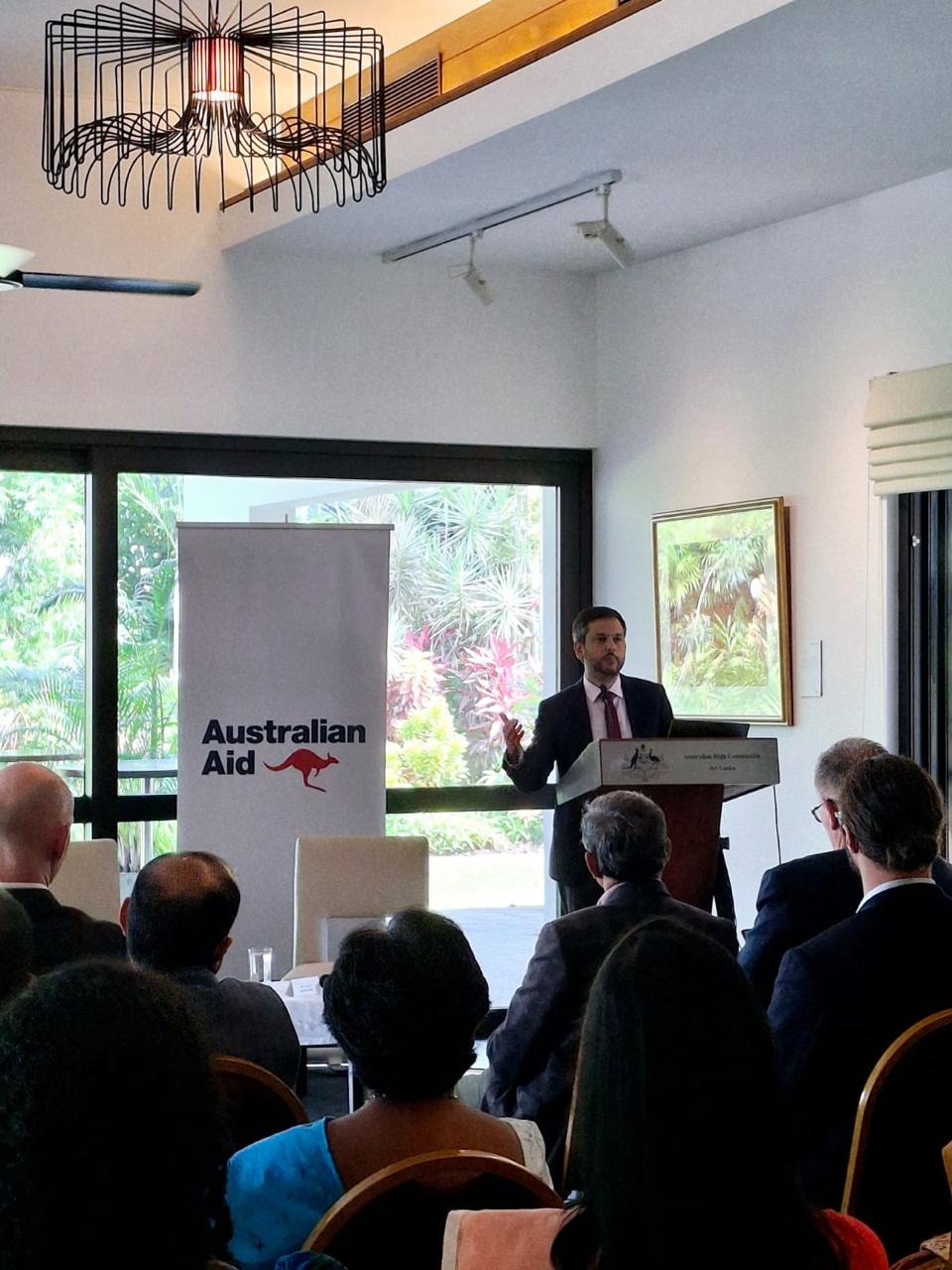
Constantino Xavier delivering the Closing Remarks.






The Centre for Social and Economic Progress (CSEP) is an independent, public policy think tank with a mandate to conduct research and analysis on critical issues facing India and the world and help shape policies that advance sustainable growth and development.