

Tiffin Talk India’s I New Free Trade Agreements: Missing Investment Protection Rules
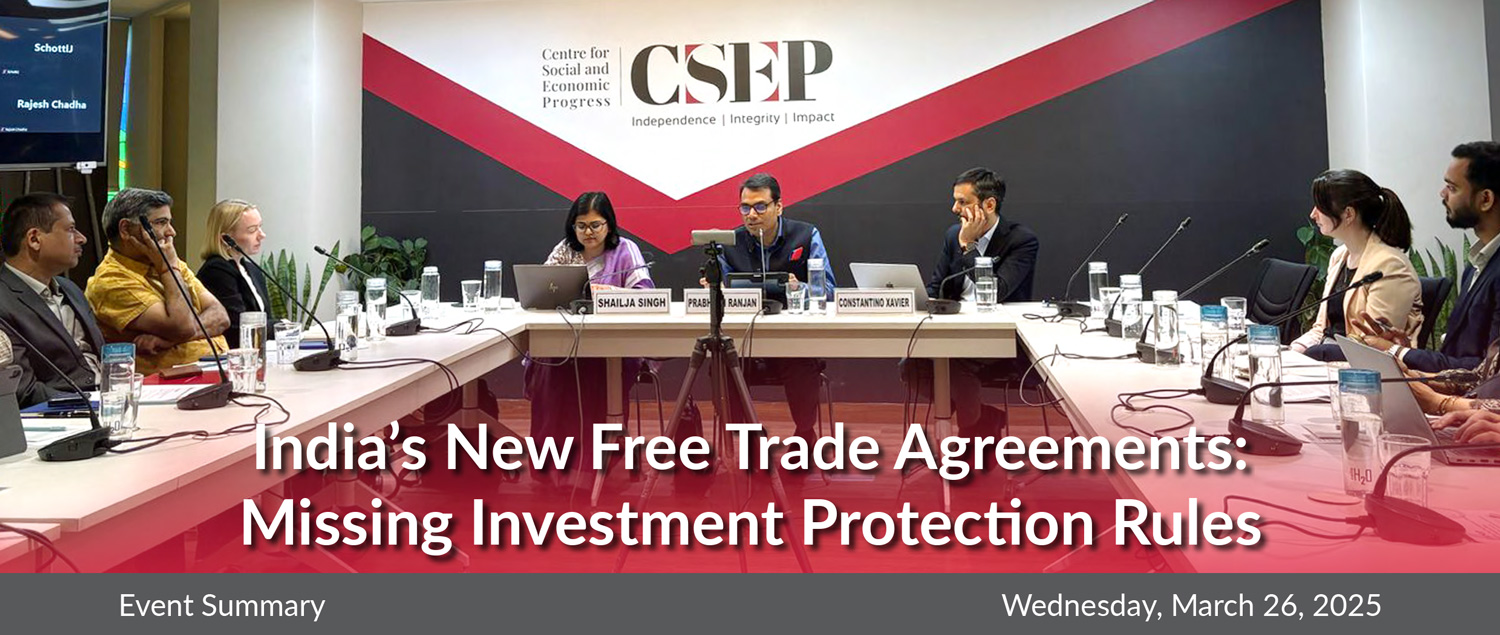
- CSEP hosted its 32nd Foreign Policy and Security Studies Tiffin Talk on “India’s New Free Trade Agreements: Missing Investment Protection Rules” with Prabhash Ranjan, Professor and Associate Dean (Research), Jindal Global Law School, O.P. Jindal Global University.
- The discussion focused on India’s evolving stance on Free Trade Agreements (FTAs) specifically in its approach to investment protection. While FTAs traditionally included provisions for investment security, recent agreements have taken a different path. This roundtable examined India’s FTA strategy, its historical trajectory, and the implications of its approach to investment protection.
- The discussant was Shailja Singh, Legal Consultant and Associate Professor, Centre for Trade and Investment Law (CTIL), Indian Institute for Foreign Trade. The talk was moderated by Constantino Xavier, Senior Fellow, CSEP.
- The discussion included participants from Indian government institutions, various foreign diplomatic missions and embassies, media, academic institutions and think tanks from India and abroad.
- This series of closed-door research seminars is curated by Constantino Xavier, Senior Fellow, CSEP and Shivshankar Menon, Distinguished Fellow, CSEP. It focuses on contemporary, evidence based research with policy relevance to bridge Delhi’s scholar-practitioner divide.
Evolution of India’s FTAs and Investment Protection
India’s evolving approach to Free Trade Agreements (FTAs) has seen a notable shift, particularly in its treatment of investment protection. The speaker discussed how India’s engagement with FTAs can be divided into distinct phases. Between 2000 and 2013, the country actively pursued FTAs, signing agreements with Singapore, Korea, Malaysia, and Japan. However, from 2014 to 2020, India took a step back, refraining from entering new FTAs. We saw India pulling out of trade agreements such as the Regional Comprehensive Economic Partnership (RCEP) agreement. The post-pandemic period saw renewed momentum, with agreements signed with the United Arab Emirates (UAE), Mauritius, Australia, and European Free Trade Association (EFTA) countries, alongside ongoing negotiations with the European Union (EU) and the United Kingdom (UK).
A key concern raised by the speaker was that investment protection provisions, once a standard part of FTAs, are now absent in India’s recent agreements. Traditionally, investment protection was covered under bilateral investment treaties (BITs), allowing individual investors to file disputes against sovereign nations through Investor-State Dispute Settlement (ISDS) mechanisms. However, India has moved away from this model, leading to increased uncertainty for foreign investors.
This departure from legal protections mirrors a broader international trend, one that began in the 1980s with the inclusion of investment protection in agreements like NAFTA. However, by 2017, global trade policy began to separate FTAs from investment protection, as seen in the Canada-EU Comprehensive Economic Trade Agreement (CETA), where the latter was excluded due to legal requirements imposed by the European Court of Justice. As a result, countries have adopted either a “split” approach, signing separate investment treaties, or a “decoupling” approach, avoiding them altogether and embracing a de-legalised model of investment relations.
The speaker noted that India’s FTA 2.0 strategy clearly falls in line with this trend of de-legalisation. Its agreements with EFTA, Australia, and Mauritius completely exclude investment protection, while the UAE agreement adopts a partially decoupled model by including trade protections in the FTA and leaving investment to a separate treaty. India has also unilaterally terminated several BITs, reflecting its desire for greater regulatory autonomy. While this gives the Indian government more control, it diminishes legal protections for investors and increases uncertainty.
India’s Defensive Stance on Investment Protection
The speaker highlighted that India’s current investment strategy is largely defensive. Even though the country actively seeks foreign direct investment (FDI), it hesitates to provide international legal safeguards for those investments. The government’s Model BIT is viewed by many as heavily skewed in favour of the state, offering limited rights to investors. While there have been indications that reforms to this model may be forthcoming, there remains scepticism about whether these changes will meaningfully reassure investors.
Participants highlighted that, India’s large market continues to attract FDI despite these concerns, much like China. Companies like Vodafone have maintained operations even after high-profile disputes, suggesting that market size can sometimes outweigh legal uncertainties. Participants noted that India’s efforts to benefit from the “China+1” diversification strategy have not yielded substantial results, partly due to the lack of a stable and predictable investment regime. Cases such as Vodafone, Cairn Energy, Nissan, and White Industries have highlighted how sudden policy shifts, and the absence of legal recourse can negatively impact investor confidence. Participants noted that many investors are now routing investments through jurisdictions with stronger legal frameworks, reinforcing the significance of investment treaties even if their direct impact on FDI remains modest.
The discussion emphasised that investment treaties play a limited but significant role in facilitating FDI. Many investors have rerouted their investments through jurisdictions that maintain investment treaties, demonstrating the importance of these agreements in global investment flows.
Challenges and International Perceptions of India’s FTA Strategy
Participants noted that India’s approach has raised concerns among its key trade partners, particularly in negotiations with the EU and UK. The EU has been particularly firm in demanding an Investment Court System as part of its FTA negotiations. India, however, remains reluctant, making it unclear how the two sides will reconcile their differences. It was noted that India’s hesitation extends to its stance at the WTO, where it maintains a conservative position on investment issues. While FTAs have evolved to include non-trade issues, including investment protection, India continues to disengage from such provisions.
Another crucial issue was whether India’s current stance is driven by a broader trend of economic nationalism or a deliberate strategy to maintain regulatory autonomy. Some participants argued that India’s resistance to ISDS mechanisms stems from a fear of investor claims, while others pointed out that India has not faced many ISDS disputes recently. The real challenge may lie in the lack of coordination between Indian ministries, which creates uncertainty in investment policy.
The US-India trade relationship was also discussed, with participants questioning whether a Bilateral Trade Agreement (BTA) could be an alternative to an FTA. The US has historically preferred sectoral-specific trade agreements, as seen in its deal with Japan. However, a BTA that reduces tariffs only for the US could conflict with WTO guidelines. This raises concerns about whether India risks undermining its commitment to multilateral trade principles.
The discussion highlighted that other countries have responded cautiously to India’s stance. While some investors remain engaged due to India’s market potential, the absence of formal investment protections creates long-term risks. The discussion also explored whether India’s position is purely defensive or a strategic move to protect domestic industries from foreign competition.
Future Outlook: Rethinking Investment and Trade Relations
A key takeaway from the discussion was that India’s approach to investment protection needs re-evaluation. Participants highlighted the interconnected nature of trade and investment, emphasising that a clear, balanced investment regime is necessary for India to integrate into global value chains. Some key suggestions included:
- Revisiting the content of India’s investment agreements, ensuring a balanced approach that protects both the state’s interests and investor rights.
- Considering standalone BITs as an alternative to including investment protection in FTAs.
- Ensuring policy stability to build investor confidence and create a predictable investment climate.
- The private sector’s role in shaping policy was also debated, with some questioning whether domestic industries prefer less foreign competition, influencing India’s cautious stance on investment treaties.
The discussion concluded with reflection was on the global trend of de-legalisation in international trade. Moving forward, India must find a middle ground between regulatory autonomy and creating a stable investment environment that supports its economic ambitions. Participants noted that India’s evolving trade and investment posture reflects a broader desire for economic self reliance, but this must be carefully weighed against the imperatives of attracting and retaining foreign investment. As India moves forward in its negotiations with key partners like the EU and UK, it faces the challenge of reconciling its regulatory priorities with the global demand for investment security. The need of the hour is to strike a thoughtful balance between sovereignty and legal assurance—a step that could significantly bolster India’s global economic standing.

The Centre for Social and Economic Progress (CSEP) is an independent, public policy think tank with a mandate to conduct research and analysis on critical issues facing India and the world and help shape policies that advance sustainable growth and development.