

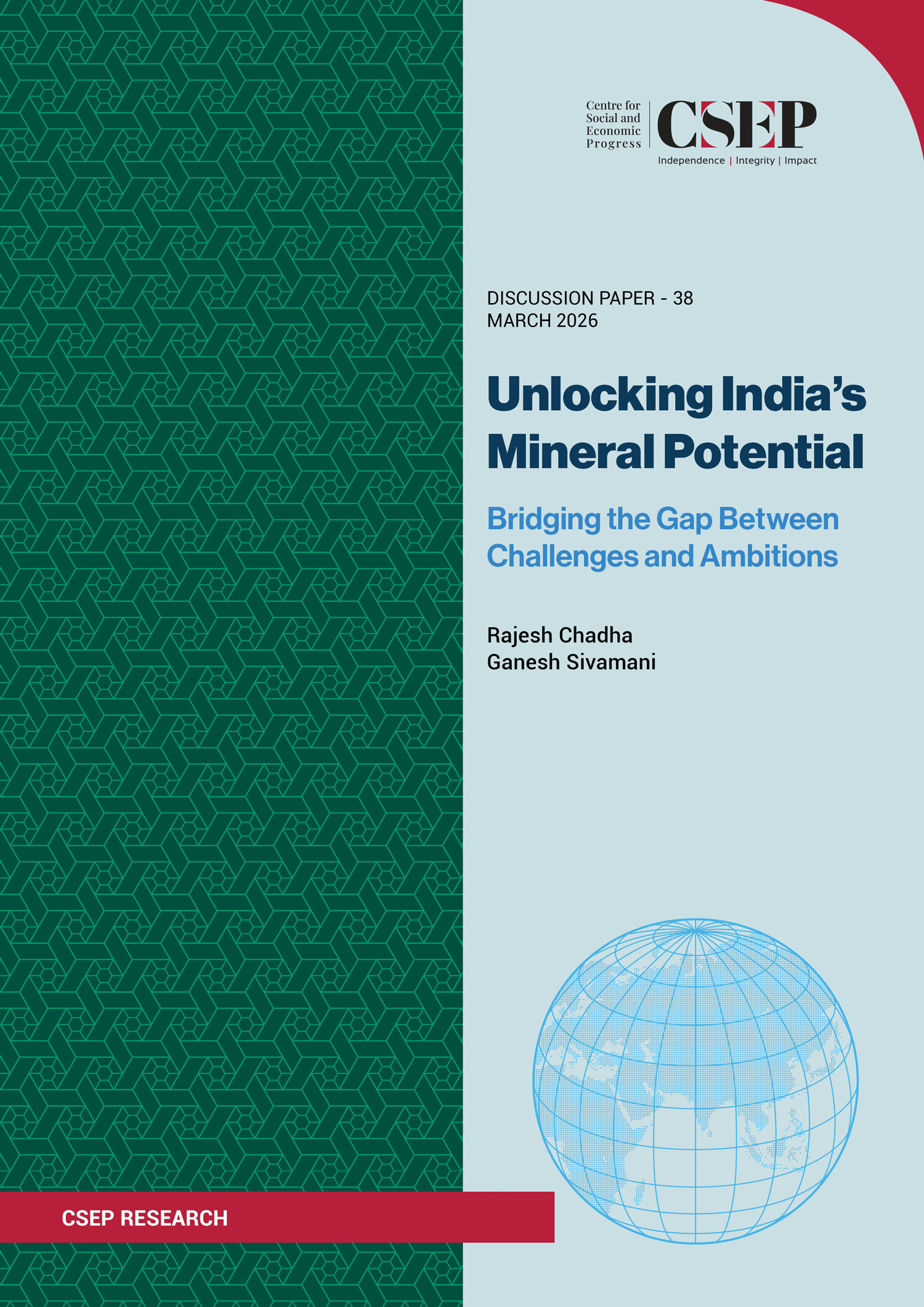
Unlocking India’s Mineral Potential: Bridging the Gap Between Challenges and Ambitions
Reading Time: 5 minutes
DOWNLOADS
Executive Summary
As India transitions to a net-zero emission economy and seeks to secure its energy sovereignty, the mining sector is transforming from one that supplies basic commodities to one that underpins the green transition. The deployment of renewable energy technologies, electric mobility, and advanced manufacturing relies heavily on a secure supply of minerals in general, and critical minerals in particular. The mining sector has fiscal linkages with the government and non-fiscal linkages with the rest of the economy. The mining sector can catalyse the country’s economic growth and the well-being of local communities through its backward and forward linkages with other sectors of the economy. A recent CSEP study found that the non-fuel minerals sector has high output and labour multipliers, indicating that the climate transition can be a source of inclusive economic growth. Today, minerals and their derivatives make up almost all the built-up world around us. However, unlocking India’s mineral potential requires navigating several complex historical challenges.
A paradox often discussed with natural resource endowments is that while they have the potential to contribute to countries’ economic growth and development, these may not be realised economically, equitably, or sustainably. The resource curse, also known as the paradox of plenty, refers to a situation in which a country or jurisdiction underperforms economically despite possessing valuable natural resources.
In India, evidence of the resource curse paradox is visible at the sub-national level. Despite collecting substantial mineral royalties, Odisha and Chhattisgarh perform relatively poorly on the Sustainable Development Goals (SDGs) and the Human Development Index (HDI) and have per capita incomes below the national average.
While mining provides the raw materials needed to run modern society and has provided a positive impetus to economic growth through downstream sector linkages and job creation, it has also led to several negative externalities. These adverse impacts include imbalances in the local climate—depletion of biodiversity of flora and fauna, air, soil, and water pollution—and other ecological disruptions affecting all life forms. Mining-induced displacement and resettlement (MIDR) may not be a statistically significant category within the broader development-induced displacement and resettlement, but it entails high social exploitation costs.
Regulatory Evolution
The Mines and Minerals (Development and Regulation) (MMDR) Act, 1957, enacted by the Union government, is currently the principal legislation governing the mining sector in India. Various amendments have been made to the MMDR Act since, with the goal of creating a fair and open mining policy regime that attracts more investments. The amendments in 2015 instituted auctions as the sole method for granting mineral concessions, aiming to increase transparency in the process.
In June 2023, India released its first list of 30 critical minerals crucial to economic development and national security. The period from 2023 to 2025 marked a transition from policy formulation to implementation, driven by the urgent need to secure mineral supply chains for India’s energy transition. Building on the amendments to the MMDR Act in 2023, the government announced a National Critical Mineral Mission (NCMM) in 2025 to strengthen the entire mineral value chain, from domestic exploration to overseas acquisition of mineral assets. The new Exploration Licence (EL) regime achieved its first major success in late 2025, with preferred bidders announced for seven deep-seated mineral blocks, including gold and rare-earth elements.
Since 2011–2012, the share of mining in the country’s gross value added (GVA) has steadily declined, and value added has grown only at around 1.7% compound annual growth rate (CAGR) until 2021–2022, compared to 5.5% CAGR for the whole economy. Due to various barriers in the mining sector, India has historically struggled to attract substantial foreign direct investment (FDI). Only around 29% of India’s obvious geological potential (OGP) has been explored as of 2023. Unlike the needs for bulk commodities, critical mineral discoveries require long-term and high-risk capital investments for deep-seated exploration. Globally, junior explorers drive such exploration activities but have been deterred by the lack of a seamless transferability of the EL to a Mining Lease.
The Path Forward
Tensions are severe between India’s growing commodity demand and a woeful legacy of social conflicts and environmental mismanagement. The mining potential of India cannot be unlocked solely through geological discoveries or regulatory reforms; it requires strategic thinking that brings together the state, industry, and society. These changes can be thought of along two pillars:
- Attracting investment: Regulatory changes are needed to spur the investment the sector needs. India must offer more incentives, or the right policy environment, as in Australia and Canada, to ensure that more capital flows into domestic exploration and mining. These enhanced exploration efforts would also be a component of intergenerational equity, converting India’s theoretical geological potential into known resources, adding to the stock of capital available to future generations.
- Attaining the social licence to operate (SLO): The mining industry must earn its SLO. As the CSEP Sustainable Mining Attractiveness Index (SMAI) study (2023) demonstrates, the correlation between mineral wealth and human development remains incongruent in many districts. The next wave of mining projects (especially those for critical minerals) must be operationalised, shedding the conflicts of the past generations, and companies must adopt higher global environmental, social, and governance (ESG) standards as an innate part of their operational strategies.
Responsible mining practices must not be seen as a regulatory burden or ethical preference, but rather a prerequisite for India’s domestic manufacturing and energy security.
Keywords: Responsible mining; critical minerals; energy minerals; social licence to operate (SLO); mining sector India; MMDR; resource curse; intergenerational equity; economic multipliers; district mineral foundation (DMF)
Q&A with authors
What is the core message of your paper?
As India transitions to net-zero emissions by 2070, the mining sector is shifting from supplying basic bulk commodities to the minerals required for clean energy technologies. The core message of this paper is that India’s growing commodity demand conflicts with a legacy of social and environmental mismanagement, particularly in the mining sector. To unlock its vast mineral potential, India needs to focus on two broad pillars: attracting high-risk capital investment for deep-seated mineral exploration and ensuring the mining industry earns its Social Licence to Operate (SLO). Responsible mining must not be viewed as a regulatory burden but as a fundamental prerequisite for India’s domestic manufacturing and energy security.
What presents the biggest challenge?
The biggest challenge lies in navigating the historical legacy of the mining sector’s negative externalities, which has created a trust deficit among communities. Mining has led to severe environmental degradation, including air and water pollution, biodiversity loss, and land degradation. Furthermore, mining-induced displacement and resettlement have high social exploitation costs, particularly for vulnerable communities. This legacy of environmental mismanagement and community ill-treatment has eroded the trust necessary to operationalise new projects. Overcoming this requires adopting more stringent standards for responsible mining.
What presents the biggest opportunity?
The greatest opportunity for India is to leverage the mining sector’s economic linkages and catalyse economic growth and well-being for local communities. Using the CSEP Environmentally Extended Social Accounting Matrix (ESAM), we found that non-fuel minerals have relatively high output and labour income multipliers. For instance, an additional demand of ₹1 lakh in metallic minerals leads to an economy-wide output increase of over ₹5 lakh. If the sector is managed responsibly, the extraction of minerals required for the green transition can drive employment and broader economic growth.
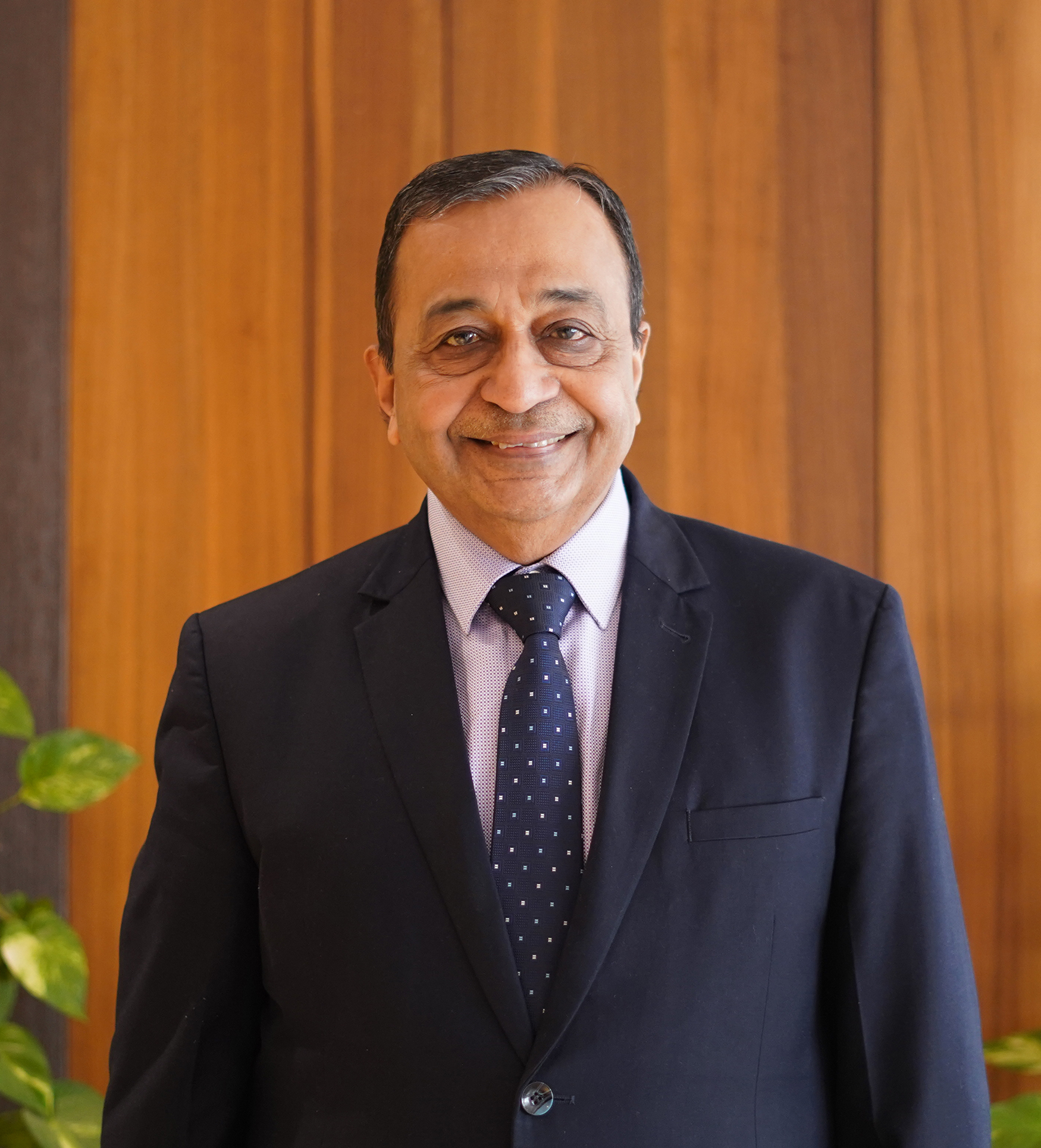
Rajesh Chadha

Ganesh Sivamani


Find on this page

The Centre for Social and Economic Progress (CSEP) is an independent, public policy think tank with a mandate to conduct research and analysis on critical issues facing India and the world and help shape policies that advance sustainable growth and development.