
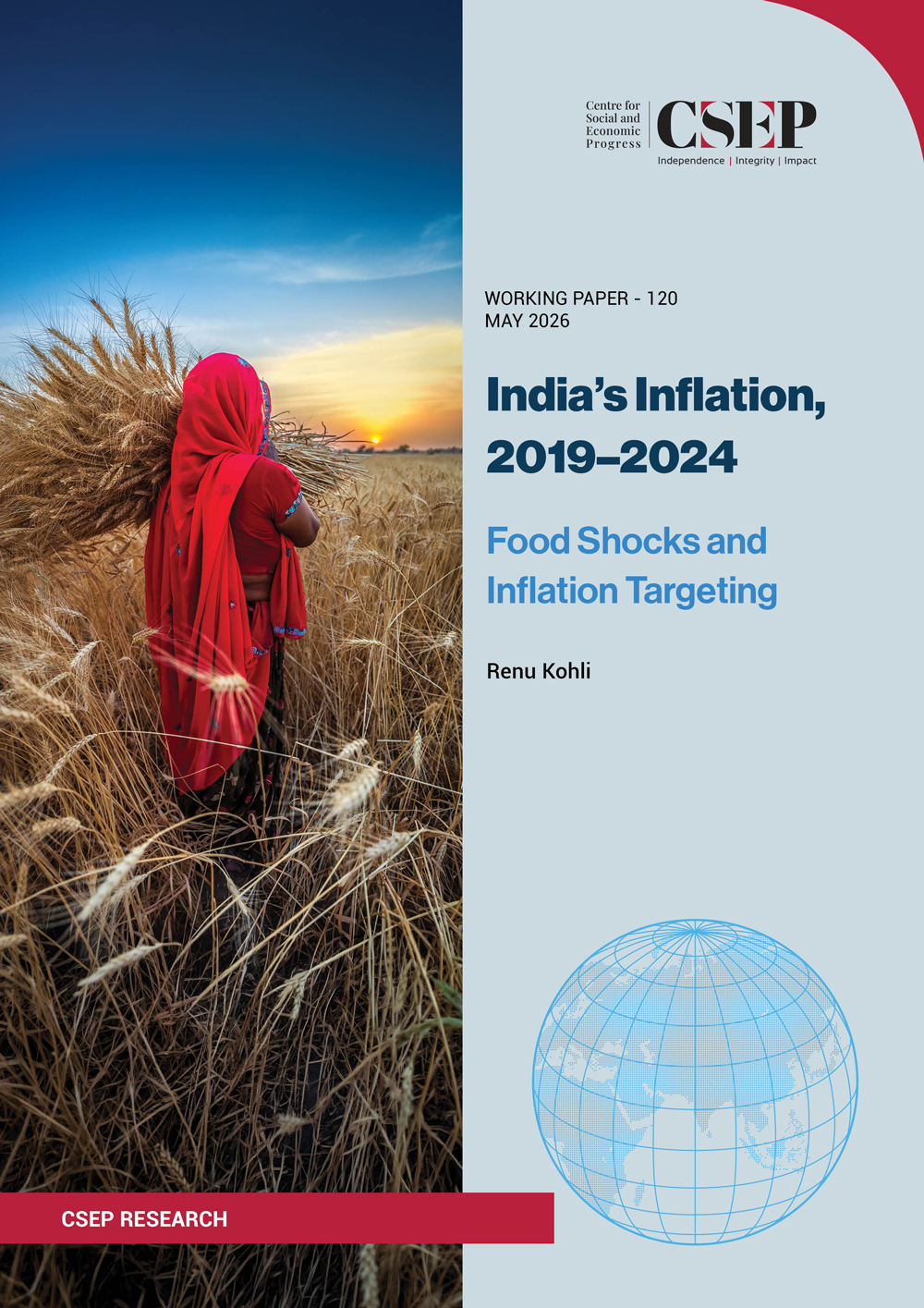
India’s Inflation, 2019–2024: Food Shocks and Inflation Targeting
Reading Time: 4 minutesDOWNLOADS
Executive Summary
This paper documents India’s prolonged inflation episode of 2019–2024—the first major test of its flexible inflation targeting (FIT) regime, adopted in 2016. Unlike the global inflationary surge of 2021–2022, which was largely transient and tied to pandemic disruptions and commodity shocks, India’s inflation was predominantly driven by persistent, domestically originating food supply shocks that both preceded and outlasted the global episode. The paper reviews this phase and identifies significant changes in climate, food supply, and inflation attributes. It details inflation management, highlighting the sequential deployment of a primary supply-side-led strategy with monetary policy in a delayed, secondary role. The paper also identifies the challenges posed to FIT from increased government dependency, diminishing efficacy of supply measures, and strains upon the central bank’s operational autonomy and credibility. The paper serves as a critical examination of the FIT framework’s resilience in a climate-vulnerable, food-dependent economy and cautions that the challenges observed may be a precursor to more systemic issues as climate risks intensify.
The Nature of the Inflation Episode (2019–2024)
The analysis documents the distinct characteristics, which include the following:
- Dominance of Food Inflation: Unlike in many other parts of the world, where food price surges were concentrated in 2021–2022, India’s food inflation both preceded and outlasted global shocks and was the principal driver of headline inflation, which repeatedly crossed the 6 per cent upper tolerance band.
- Climate-Induced Supply Shocks: The persistence of food price pressures was directly linked to a series of severe weather anomalies. These included crop failures in vegetables (late 2019), successive heatwaves damaging wheat crops for three years (2022–2024), and deficit rainfall affecting rice production (2023). The paper flags unprecedented events like simultaneous disruptions to both winter and summer crops, amongst others.
- Departure from Historical Patterns: Inflation dynamics differed in this period as food supply shocks lost their traditional mean-reverting character: Price spikes did not normalise as before, the magnitude and frequency of price surges rose, and downward corrections were less pronounced, indicating an entrenchment of price pressures.
- Divergence of Headline and Core Inflation: After rising mostly due to cost-push and reopening demand pressures, core inflation corrected sharply from mid-2023 to a historic low of around 3 per cent by May 2024, creating a wide gap between headline and core measures, with a difficult choice for monetary policy that was constrained by high food inflation and elevated household inflation expectations.
Inflation Management: A Supply-Side-Led Strategy
The policy response detailing highlights a clear and consequential sequencing:
- Dominance of Government Interventions: The primary strategy for inflation control was government-led, with extensive and aggressive supply-side actions, while monetary policy played a secondary and delayed role.
- Delayed Monetary Policy Tightening: The Monetary Policy Committee (MPC) initially adopted a “look-through” approach to the food price shocks in 2019–2020. This was followed by an explicitly accommodative stance during the pandemic. A decisive pivot to monetary tightening only came in May 2022, nearly a year after many other emerging economies had begun their tightening cycles and after inflation expectations had become entrenched at high levels.
- Fiscal Interventions: Fiscal tools were critical, particularly in mitigating the impact of fuel price shocks with lower levies and a freeze on retail pump prices.
- Diminishing Returns: Despite overactive supply management, food inflation remained stubbornly persistent. While these may have prevented sharper spikes, they failed to break the inflationary inertia and, in some cases, created market inefficiencies, increased volatility, and distorted price signals. This points to diminishing returns of the strategy.
Challenges and Strains on the Flexible Inflation Targeting Framework
The core of the analysis focuses on how this episode strained the FIT regime, uncovering some critical vulnerabilities:
- Weakened Resilience to Shocks: Tentative econometric evidence suggests that headline inflation became more, not less, sensitive to food supply shocks during 2019–2024 compared to the preceding five years. Although inflation expectations remained sticky and did not fully de-anchor, the framework’s ability to insulate the economy from supply shocks likely weakened.
- Credibility Strains: The framework’s credibility was stretched by large and persistent forecast errors, sourced primarily to non-transience of food price shocks and misunderstandings of the transmission process. This, combined with inflation remaining above the tolerance band for three consecutive quarters (triggering a statutory explanation to the government), fuelled perceptions of the central bank falling “behind the curve.”
- Reduced Central Bank Autonomy: The heavy reliance on government actions to control inflation created a dependency that blurred the lines of operational autonomy. Successive requests for fiscal response to combat the fuel price rise effectively conditioned the success of monetary policy on the efficacy and timeliness of government decisions. The external reliance risks undermining the institutional independence crucial for an effective inflation-targeting central bank.
- Institutional Strains: The prolonged period of high food inflation, coupled with low core inflation, led to internal disagreements and reignited public debate about the suitability of headline CPI as the nominal anchor in an economy so susceptible to volatile food prices.
Future Outlook: The Intensifying Climate–Food–Inflation Nexus
The paper concludes by arguing that the 2019–2024 experience should not be viewed as an anomaly but a likely preview of future challenges. It presents evidence of deviating patterns in the climate–food–inflation relationship, characterised by the following:
- More frequent and intense climate events, i.e., rising temperatures and erratic rainfall.
- Simultaneous and overlapping crop failures, creating compound risks to food security.
- An increasingly strained policy environment that relies on restrictive measures with diminishing returns.
This evolving context suggests that climate-linked supply shocks will become a more frequent and systemic driver of inflation, posing a persistent threat to the FIT framework.
Key Takeaway
The primary lesson from India’s 2019–2024 inflation episode is that a monetary policy framework, even a flexible inflation-targeting one, faces profound challenges when confronted with persistent, structurally driven food supply shocks. The paper concludes that the conventional monetary response—to “look through” such shocks—is untenable when they become recurrent and entrenched. Reliance on ad hoc supply-side controls is not a sustainable substitute for fundamental structural reforms in agricultural markets. Looking ahead, the paper argues that the 2019– 2024 experience may be a preview rather than an anomaly. Temperatures are rising more frequently to record levels; rainfall anomalies are becoming more regionally differentiated; and simultaneous disruptions to both winter and summer crops—unprecedented in the past two decades—point to a structural intensification of the climate–food–inflation nexus. Unless monetary frameworks are adapted or rethink responses to persistent supply shocks are rethought, alongside lasting changes to agricultural markets that reduce dependence on ad hoc supply controls, the strains observed in this inflation bout could deepen as climate volatility advances.

Renu Kohli



Find on this page

The Centre for Social and Economic Progress (CSEP) is an independent, public policy think tank with a mandate to conduct research and analysis on critical issues facing India and the world and help shape policies that advance sustainable growth and development.