

Quality Control Orders in India’s Chemical Sector: Supply-Chain Pressures and Firm-Level Outcomes
Reading Time: 4 minutes

DOWNLOADS
Executive Summary
Towards the end of 2025, there was a policy decision to revoke several Quality Control Orders (QCOs), and it received mixed responses from the industry. While for some, it signals policy uncertainty, for others, it is a welcome step as it reduces the excessive compliance burdens.
Nevertheless, the revocation represents a policy move in the right direction and is likely to encourage a more streamlined approach toward QCOs in the pipeline. Such reassessment could be led by the same factors that led to the recent withdrawals, enabling a more calibrated and evidence-based framework.
The decision to revoke QCOs was largely driven by concerns around their application to intermediate goods, which was one of the key observations in Prabhakar (2025). While the likely supply chain disruptions arising from QCOs on intermediate goods have been recognised, it is important to empirically substantiate this concern. Moreover, many QCO-affected sectors are characterised by high firm concentration, making it possible that QCOs could further aggravate this concentration. These issues require deeper investigation. In this context, this paper makes an important contribution by providing firm-level evidence on the supply-chain and competition implications of QCOs.
- The paper uses firm-level data and maps existing QCOs to both the outputs produced by firms and the inputs used in production over the full panel period from financial year (FY) 2015 to FY 2024.
- It focuses on chemical-using firms to analyse the impact of QCOs on regulated inputs and outputs, and their effects on firms’ gross value addition, production, and profits.
- The analysis disaggregates these impacts across firm sizes to capture heterogeneity in the effects of QCOs.
Supply-Chain Implications
QCOs have increasingly shaped India’s manufacturing supply chains, particularly by targeting intermediate goods, an issue that has driven strong industry pressure and led to the revocation of several QCOs. About 46% of QCOs in force by December 2024 applied to intermediate inputs, raising concerns about downstream production disruptions. Against this backdrop, this paper focuses on one critical manufacturing input, i.e., chemicals.
Using panel data from the Annual Survey of Industries (ASI), this study identifies firms using chemical inputs and assesses the impact of QCOs on both inputs and firm output. Over the past decade, around 2,731 firms have reported using chemical inputs. Chemical inputs are most intensively used within the chemical sector itself, followed by rubber and plastics, pharmaceuticals, and electronics.
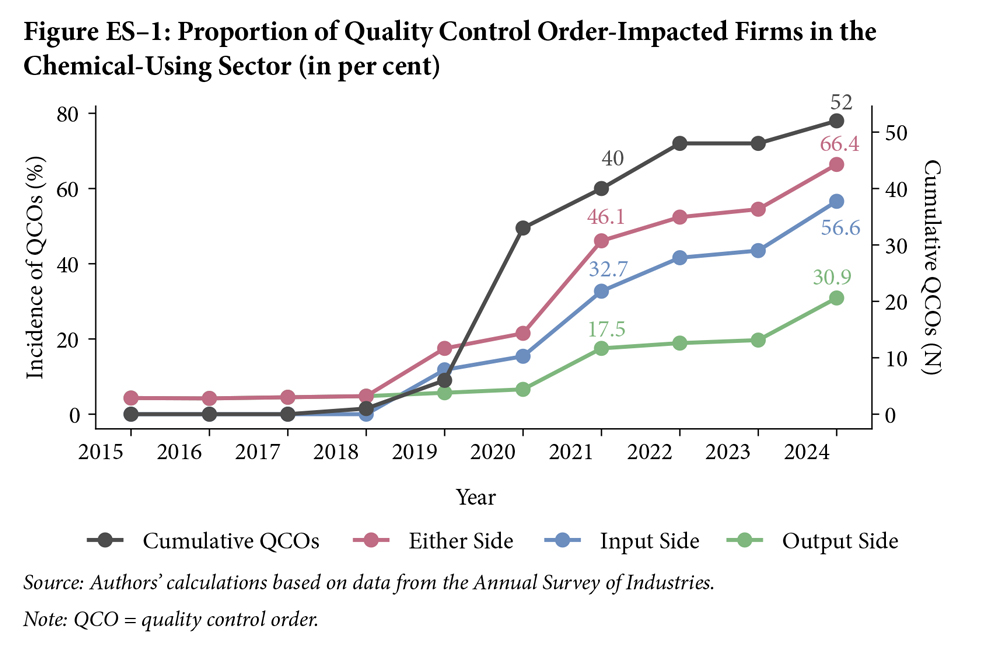
The analysis shows a sharp expansion of QCO coverage after 2018. Chemical-related QCOs increased from virtually none before 2018 to 52 by 2024, resulting in 56.6% of chemical-using firms being affected on the input side and 66.4% on either the input or output side.
Regression Results: Understanding the Impact of Quality Control Orders on Firm Performance
The impact of QCOs is assessed using three performance indicators—gross value added (GVA), profits, and production—across two broad dimensions: the overall impact and heterogeneous effects differentiated between small and large firms. The key results are as follows:
Overall Impact
- Production value increases by 9.6% as a consequence of QCOs on inputs, which may be reflective of higher prices of output, as firms pass on some of the increased input costs to consumers.
- Firms exposed to QCOs on inputs experience a 37% decline in GVA.
- Overall, the results suggest that in the case of input QCOs, firms expand production even as efficiency deteriorates.
- Output-side QCOs show no statistically significant effects on GVA, profits, or production, indicating that they do not improve firm-level production as intended by these regulations.
Heterogeneous Effects
- The combined effect of input and output QCO exposure is negative and statistically significant for small firms across all three outcomes, i.e., production, GVA, and profits.
- The combined effects for large firms are positive in magnitude for production, at 12.3%, and are not statistically significant for GVA and profits.
- Among larger firms, exposure to input QCOs is associated with an increase in production value by 9.6%, reflective of higher product prices passed on to consumers. Consequently, there is a sharp decline in GVA, which falls by 37%.
- For smaller firms, while input QCOs have no significant impact on production and GVA, they lead to a significant decline of 47.6% in their profitability due to high-cost burdens.
- Output QCOs hit smaller firms even harder across margins, with GVA declining by 44% and profits by 58.9%, while remaining insignificant for larger firms’ efficiency and profitability.
The key takeaway from the results is that input-side QCOs lead to an increase in production, but are associated with significant declines in efficiency, as reflected in reduced GVA. Output-side QCOs, in contrast, show no meaningful impact on firm performance across outcomes. The effects are highly uneven across firms and also vary according to whether a QCO is on the input side, the output side, or both. Larger firms expand output but with a decline in GVA, while smaller firms face sharp declines in all firm-level performance indicators.
Overall, QCOs appear to increase production without improving value added and firm-level competitiveness, with disproportionately adverse effects on smaller firms.
Policy Suggestions
To address these distortions, the QCO framework must be reformed along two dimensions: introduction and implementation. New QCOs should be imposed strictly on quality grounds, with clearly articulated objectives. Intermediate goods should be regulated with particular caution, given their systemic role in production. Before imposing QCOs, policymakers must assess domestic production capacity and ensure adequate testing and certification infrastructure.
Revamping the QCO regime requires consistent, evidence-based reassessment of existing QCOs and thorough examination of upcoming ones. Reducing the regulatory burden on Micro, Small and Medium Enterprises (MSMEs) and safeguarding supply-chain efficiency are essential for strengthening competitiveness and enabling India’s integration into Global Value Chains (GVCs).

Prerna Prabhakar

Nancy Gupta



Find on this page

The Centre for Social and Economic Progress (CSEP) is an independent, public policy think tank with a mandate to conduct research and analysis on critical issues facing India and the world and help shape policies that advance sustainable growth and development.