
A Race to Rare Earth: Where Does India Stand?
Reading Time: 5 minutesBackdrop
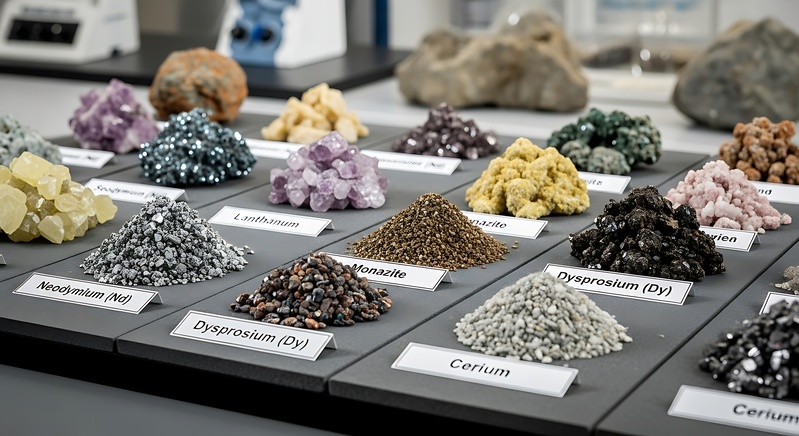
India’s ambitions in the rare earth ecosystem have received a decisive push with the Union Budget 2026–2027’s announcement of Dedicated Rare Earth Corridors across coastal Odisha, Kerala, Andhra Pradesh, and Tamil Nadu to integrate mining, processing, research, and manufacturing. With an outlay of Rs. 7,280 crore and a target of building 6,000 MTPA capacity for Rare Earth Permanent Magnets (REPMs), this initiative aims to tap India’s sizeable reserves (including 13.15 million tonnes of monazite) to reduce import dependence of Rare Earth Elements (REEs) that feed into critical sectors such as electric mobility, electronics, semiconductors, battery storage, robotics, turbines, aerospace, and defence (PIB, 2026).
States’ Responses
States are aligning with this national policy push by developing end-to-end rare-earth value chains. Andhra Pradesh plans to invest Rs. 50,000 crore over the coming decade and is drafting a comprehensive rare earth policy to enable industrial development, mineral allocation, and attract strategic investors through public–private partnership models. The state has already identified Srikakulam, Anakapalli, and Machilipatnam for the establishment of industrial clusters (Kumar, 2026). Japanese company Proterial has proposed an investment of Rs. 2,250 crore to establish a 1.2 kilotonnes per annum (ktpa) sintered neodymium–iron–boron (NdFeB) permanent magnet manufacturing facility in Andhra Pradesh (Sharma, 2026). Kerala aims to develop the ‘Southern Kerala Economic Corridor’ across Thiruvananthapuram, Kollam, and Alappuzha, with a budget of Rs 100 crore, leveraging Thiruvananthapuram’s deep-sea port and Kollam’s rich rare-earth deposits (Mathew, 2026). Tamil Nadu is also strengthening its rare earth ecosystem by expanding beach sand mineral mining and monazite processing through a proposed joint venture between IREL (India) Limited and Tamil Nadu Minerals Ltd (Shivakumar, 2026). IREL already operates a Rare Earth Extraction Plant in Odisha, and now the Gopalpur coastal region has been identified as the launchpad for the REPM corridor.
Challenges and Opportunities
These initiatives are necessary and timely. Yet beneath the optimism lie structural, technological, and environmental challenges the country must address from the very beginning.
Although India has significant upstream reserves and downstream demand, the missing link lies in the midstream. While IREL produces rare earth oxides, the country lacks advanced technological know-how for further value addition in metal and alloy making and, eventually, in magnet manufacturing.
Leveraging International Partnerships
Although India has significant upstream reserves and downstream demand, the missing link lies in the midstream. While IREL produces rare earth oxides, the country lacks advanced technological know-how for further value addition in metal and alloy making and, eventually, in magnet manufacturing. To upgrade its domestic manufacturing base and upskill its workforce, India is actively engaging with technologically advanced countries such as the USA, Japan, the UK, Germany, Australia, and the UAE for technology partnerships, joint ventures, and investments. India and Japan are negotiating an agreement under which Japan would provide hard-rock rare-earth extraction technology in exchange for a stable offtake to Japan (Arora, 2026). IREL is also exploring collaborations with South Korea, given the latter’s expertise in high-precision magnet manufacturing for automotive and electronic applications. In addition to these ongoing efforts, India should place greater emphasis on building new partnerships and operationalising existing ones to deliver more tangible outcomes. The US–India Trust Initiative, to secure the critical minerals supply chain, including rare earth, should be leveraged more effectively. Along with government-led initiatives, more business-to-business collaborations need to be encouraged to enhance private-sector participation.
Cost-Competitiveness
Amidst China’s tightening export controls and dominance in rare-earth processing, the REPM corridor could reduce India’s import dependence to some extent. Nonetheless, full import substitution would only be possible when domestic industries build a fully integrated ecosystem, manoeuvring the oxide-metal-alloy magnet-making technology while also leveraging global price competitiveness. In the recently proposed government scheme for the manufacturing of sintered REPM, the provision of capital subsidies and sales-linked incentives—encompassing investments in plant and machinery, R&D, and technology transfer—is expected to enable industries to scale and grow (Ministry of Heavy Industries, 2025). The scheme also facilitates partial supply of raw materials from IREL to selected beneficiaries, thereby securing upstream supply. However, ensuring stable downstream demand is equally important for the expansion of the midstream industries. Here, long-term offtakes with anchor downstream industries would help create a demand-side pool.
Environmental Implications
Another facet of REE mining is its massive environmental externality and the risks of putting the economy over the environment in this haste. Rare-earth extraction from monazite involves radioactive elements such as uranium and thorium, producing hazardous tailings, while processing involves chemically intensive operations that can have a long-term adverse impact if not managed sustainably. The proposed corridors intersect with India’s coastlines, which are already ecologically fragile.
While this entire REPM corridor warrants a holistic environmental and social impact assessment, bypassing or diluting regulatory oversight to fast-track the process won’t really help to sustain a robust social license to operate.
REE mining is governed under the Atomic Energy Act, 1962 and the Atomic Minerals Concession Rules, 2016. The Coastal Regulation Zone (CRZ) rules provide an additional layer of environmental protection. CRZ does not prohibit REE mining; rather, it regulates it. However, the recent removal of public consultation for atomic and strategic minerals mining, which also includes REE mining, is already creating social dissonance, especially among the fisherfolk across the coastal belt. While this entire REPM corridor warrants a holistic environmental and social impact assessment, bypassing or diluting regulatory oversight to fast-track the process won’t really help to sustain a robust social license to operate. Adequate rigour should be given to the environmental cost associated with REE mining.
Given the environmental implications of rare earth mining, India should look to alternative technologies and recycling, both of which are at a nascent stage. Japan offers a useful model. Prompted by the 2010 Chinese rare-earth export embargo, Japan reduced its reliance on rare-earth imports through material efficiency, recycling, supply diversification, stockpiling, and technological innovation. For example, Proterial has developed heavy-rare-earth-free neodymium sintered magnets for EV motors that are both cost-effective and high-performance (Proterial, 2025). India should similarly prioritise next-generation technologies, particularly because it currently lacks extractable high-value heavy REE such as Dysprosium and Terbium. Encouragingly, Indian deep-tech startups like Simple Energy, Chara Technologies, and Motorama are exploring rare-earth-free motor technologies (Deep, 2025). At present, recycling efforts are limited, with only a few players, including IREL, and private firms such as Attero, and Lohum, operating in this space. Strategic investments in advanced technologies and a robust circular economy policy framework are needed to scale these innovations and strengthen India’s global competitiveness.
India should adopt a more forward-looking competitive strategy centred on diversified supply sources, demand visibility, an innovation-led ecosystem, and robust environmental and social safeguards to ensure long-term credibility.
Concluding Remarks
REEs are indispensable to technologies that will shape the future, from each microchip in semiconductors to powering big AI data centres. Matching China’s cost-competitiveness will be challenging in the short run. Instead, India should adopt a more forward-looking competitive strategy centred on diversified supply sources, demand visibility, an innovation-led ecosystem, and robust environmental and social safeguards to ensure long-term credibility. Such an approach can make the emerging Indian rare-earth market more investor-friendly. India has taken an important first step. The real test will be whether it can translate this ambition into a globally competitive, sustainable, and future-ready rare earth ecosystem.
The author would like to thank Rajesh Chadha, Senior Fellow, CSEP and Karthik Bansal, Associate Fellow, CSEP, for their valuable feedback.
FOOTNOTES
References
Arora, N. (2026, March 3). Japan in talks with India to explore for rare earths, sources say. https://www.reuters.com/world/china/japan-talks-with-india-explore-rare-earths-sources-say-2026-03-03/
Deep, P. (2025, November 16). How Indian EV makers are racing to go rare earth-free amid China’s chokehold. The Indian Express. https://indianexpress.com/article/business/how-indian-ev-makers-are-racing-to-go-rare-earth-free-amid-chinas-chokehold-10360603/
Kumar, S. (2026, 29 April). Rare earth corridor gains momentum as Andhra targets ₹50,000 cr investment. Business Standard. https://www.business-standard.com/economy/news/rare-earth-corridor-gains-momentum-as-andhra-targets-50-000-cr-investment-126042801411_1.html
Mathew, J. (2026, June 19). Kerala plans three-district economic corridor to promote space, rare earth, fisheries sectors. Fortune India. https://www.fortuneindia.com/economy/kerala-plans-three-district-economic-corridor-to-promote-space-rare-earth-fisheries-sectors/144043#google_vignette
Ministry of Heavy Industries. (2025, December 15). Scheme to promote manufacturing of sintered rare earth permanent magnet. The Gazette of India. https://heavyindustries.gov.in/sites/default/files/2025-12/scheme_notification_0.pdf
Press Information Bureau. (2026, February 2). India’s rare earth strategy: Manufacturing, corridors, and global integration. Government of India. https://www.pib.gov.in/PressNoteDetails.aspx?NoteId=157165&ModuleId=3®=3&lang=1
Proterial. (2025, July 22). Proterial develops high-performance heavy-rare-earth-free neodymium sintered magnet for electric vehicle driving motors. https://www.proterial.com/e/press/2025/pdf/20250722eb.pdf
Sharma, N. (2026, June 17). Japan company to set up rare earths magnet unit in Andhra Pradesh. The Economic Times. https://economictimes.indiatimes.com/industry/indl-goods/svs/metals-mining/japan-company-to-set-up-rare-earths-magnet-unit-in-andhra-pradesh/articleshow/131753414.cms?from=mdr#:~:text=Japan%20company%20to%20set%20up%20rare%20earths%20magnet%20unit%20in%20
Shivakumar, C. (2026, February 1). Tamil Nadu leads India's rare earth revolution with new IREL mines, processing plant. The New Indian Express. https://www.newindianexpress.com/states/tamil-nadu/2026/Feb/01/tamil-nadu-leads-indias-rare-earth-revolution-with-new-irel-mines-processing-plant


Find on this page

The Centre for Social and Economic Progress (CSEP) is an independent, public policy think tank with a mandate to conduct research and analysis on critical issues facing India and the world and help shape policies that advance sustainable growth and development.