

Mapping India and China’s Clean Energy Trade in South Asia: Bangladesh
Reading Time: 4 minutesEditor's Note
This blog is the first in a two-part series examining trends in clean energy component imports across Bangladesh, Sri Lanka, and Nepal. It outlines the evolution of clean energy manufacturing ecosystems in China and India and then analyses Bangladesh’s imports of solar photovoltaic, wind turbine, and rechargeable lithium-ion battery components between 2014 and 2024. The second part extends the analysis to Sri Lanka and Nepal while exploring the broader implications of these trade patterns for India and the region.
Over the past two decades, China has emerged as the world’s leading manufacturer of CE technologies. China’s focus on CE in the 10th (2001–2005) and subsequent five-year plans emphasised strengthening clean manufacturing, innovation, research, and development. Consequently, the solar, battery, and electric vehicle (EV) sectors benefited the most from this policy, becoming China’s fastest-growing exports.
South Asia is witnessing rapid economic growth, accompanied by increasing demand for energy. To meet these energy demands as well as mitigate dependence on imported fossil fuels, which exposes them to price volatility and scarcities during periods of global shock, these countries have set ambitious renewable energy (RE) targets. Sri Lanka aims to install 4.7 gigawatts (GW) of solar capacity and increase wind capacity by nearly 7 times by 2030. Bangladesh targets to install 5 GW of solar and add 5 GW of wind capacity by 2030, representing an almost 80-fold increase. Nepal seeks to add 28.5 GW of non-fossil power capacity by 2035, of which 15% will be derived from solar and wind. However, with little to no domestic manufacturing capacity in these countries, the clean energy (CE) transition remains largely based on imports.
Against this backdrop, understanding the role of India and China in supplying clean energy components to South Asia provides important insights into the region’s evolving dynamics and energy transition.[1],[2]
Clean Energy Manufacturing in China and India
Over the past two decades, China has emerged as the world’s leading manufacturer of CE technologies. China’s focus on CE in the 10th (2001–2005) and subsequent five-year plans emphasised strengthening clean manufacturing, innovation, research, and development. Consequently, the solar, battery, and electric vehicle (EV)[1] sectors benefited the most from this policy, becoming China’s fastest-growing exports. Today, China is the largest manufacturer of green technologies—90% of the world’s batteries, over 80% of all solar components, and nearly 60% of all wind turbines globally.
Meanwhile, India is also making progress in developing its own domestic CE supply chains, but remains dependent on China for the supply of components essential to CE manufacturing. In an effort to build self-reliance and become a net exporter, the Indian government introduced the Approved List of Models and Manufacturers (ALMM) in 2019—a regulatory framework to promote manufacturing and establish safeguards against low-quality imports to support domestic manufacturing.
Meanwhile, India is also making progress in developing its own domestic CE supply chains, but remains dependent on China for the supply of components essential to CE manufacturing. In an effort to build self-reliance and become a net exporter, the Indian government introduced the Approved List of Models and Manufacturers (ALMM) in 2019—a regulatory framework to promote manufacturing and establish safeguards against low-quality imports to support domestic manufacturing. Its ambit has been steadily widening with the recent extension of the framework to solar ingots and wafers. It has also aimed to incentivise consumption of locally made products through mandatory procurement of domestic components under schemes such as the Rooftop Solar Programme and PM-KUSUM. In addition to this, Production Linked Incentive (PLI) schemes, tariffs, and quality control instruments have been imposed to improve cost competitiveness.
Bangladesh’s Clean Energy Imports
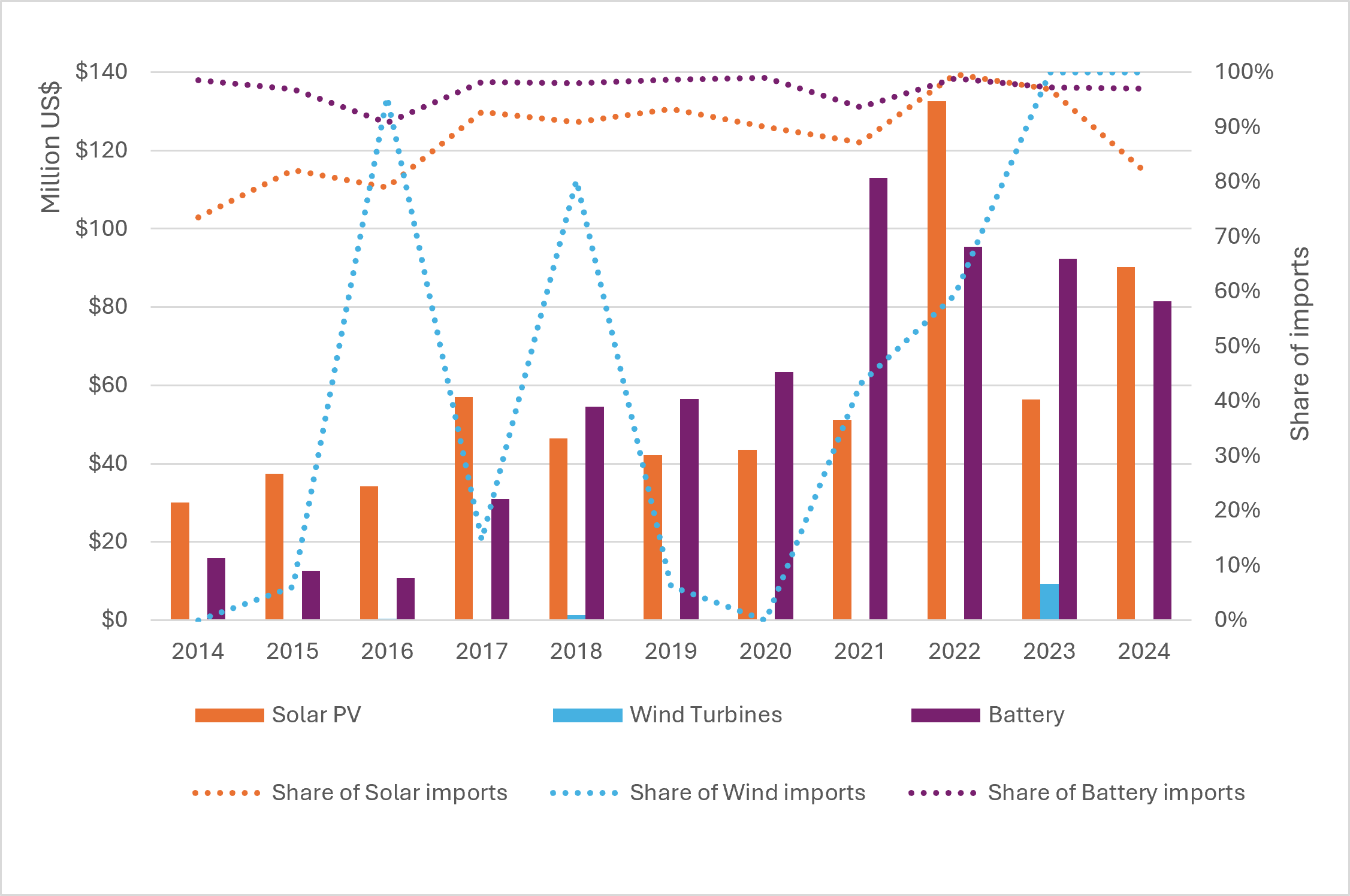
Trade data from the United Nations Commodity Trade Statistics Database (UN Comtrade) show that China has been Bangladesh’s principal supplier of solar PV, wind turbines, and battery components over the past decade. The import share of solar PV components increased steadily from 73% in 2014 to a peak of 98% in 2022.
Figure 1: Bangladesh’s Imports of Solar PV, Wind Turbine, and Battery Components From China
Source: UN Comtrade Database: Commodity codes 854140, 854142, 854143, 850231, 850760 (Bangladesh’s imports from China, Hong Kong SAR, and Macao SAR).
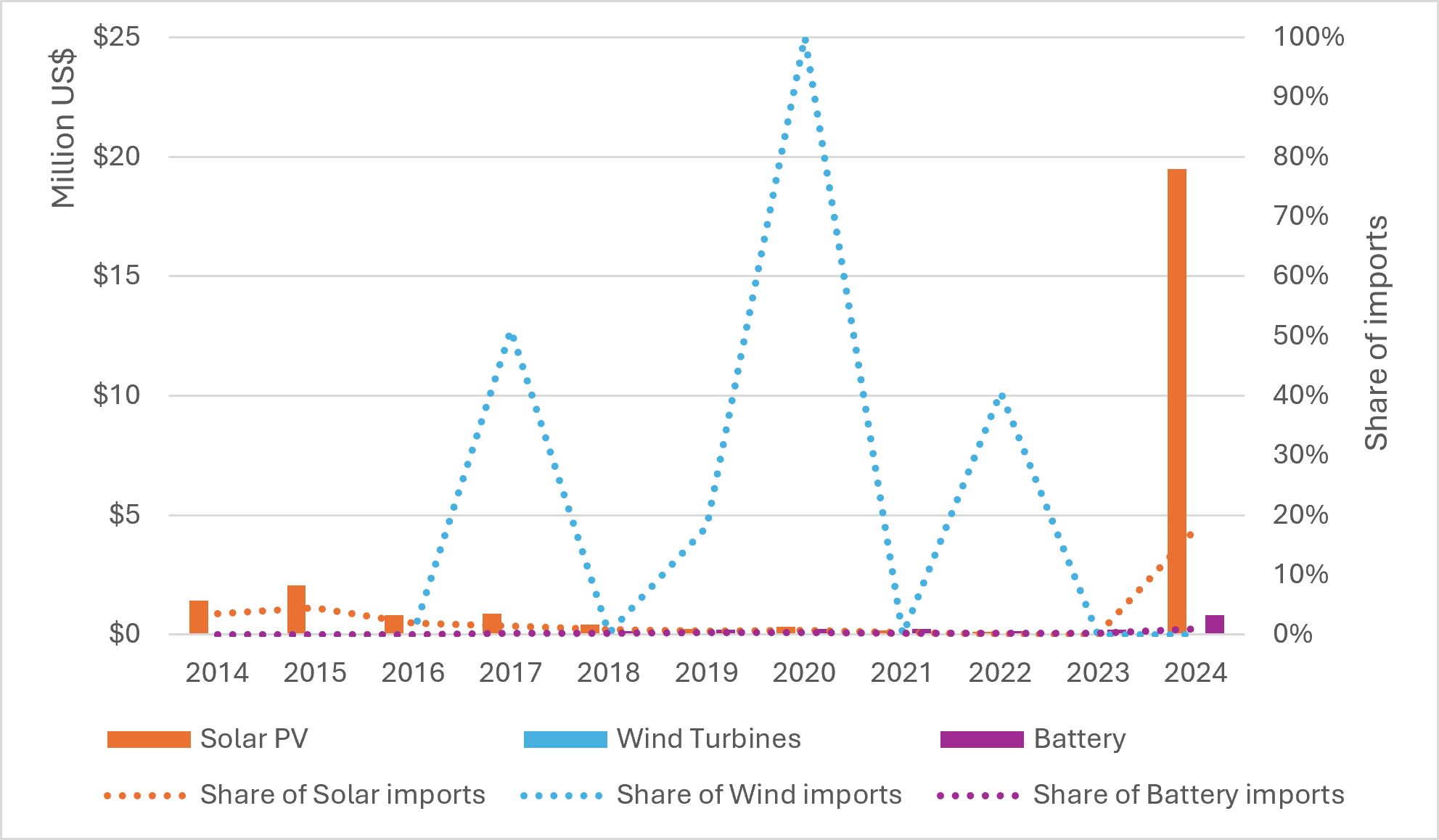
By contrast, imports from India remained negligible for most of the decade, but its share rose sharply in 2024 and amounted to ~20% (Figure 1). During the same year, in the battery sector, imports from India were low, amounting to less than US$1 million annually (Figure 2), while those from China amounted to over US$80 million.
Figure 2: Bangladesh’s Imports of Solar PV, Wind Turbine, and Battery Components From India
 Source: UN Comtrade Database: Commodity codes 854140, 854142, 854143, 850231, and 850760.
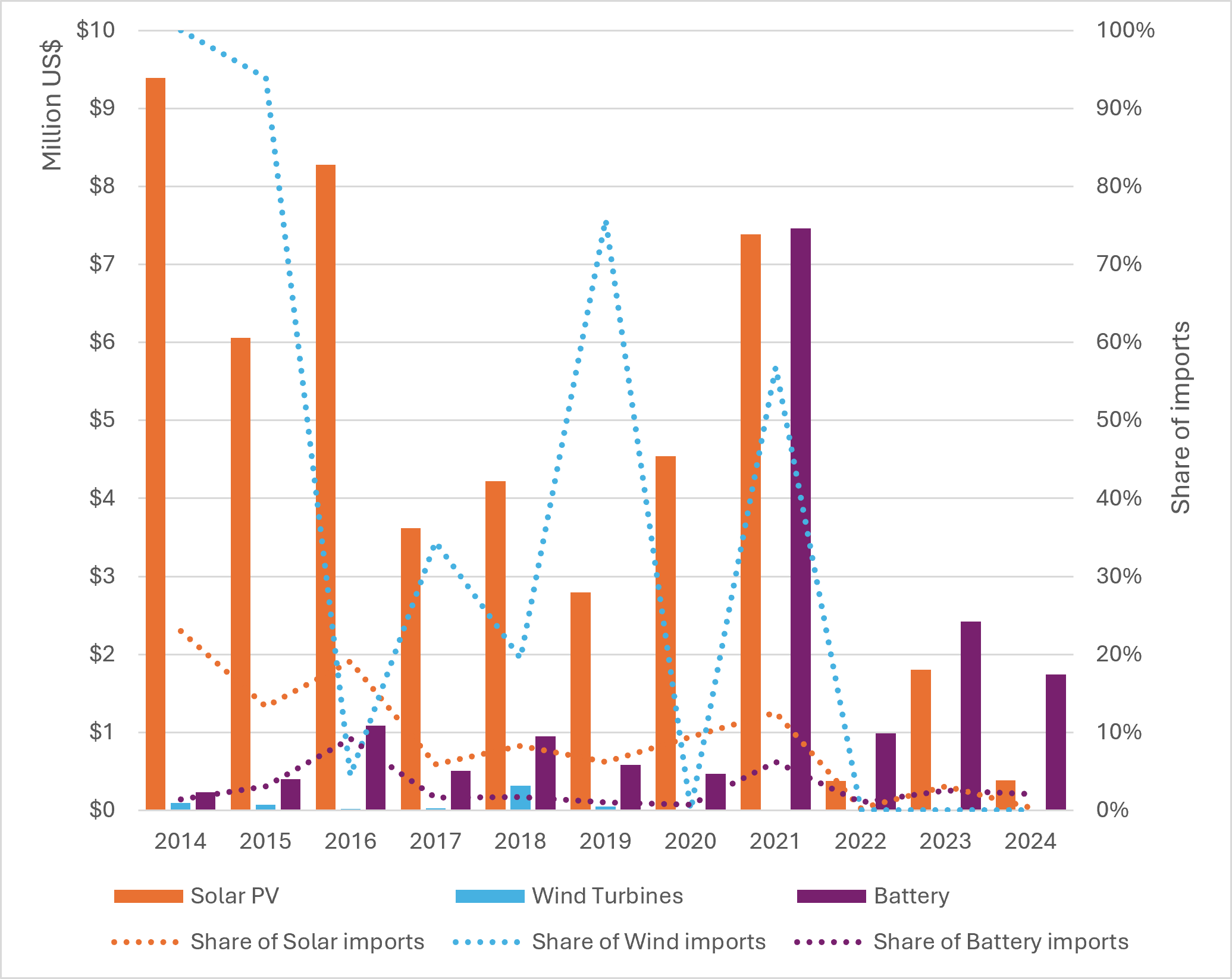
Wind turbine imports exhibit a divergence from the other two components. While China and India competed in this segment over the years since 2020, China has come to dominate the market (Figures 1 and 2). Notably, in 2014 and 2019, there were sizeable imports from other players such as the United Kingdom (Figure 3).
Figure 3: Bangladesh’s Imports of Solar PV, Wind Turbine, and Battery Components, Excluding China and India
 Source: UN Comtrade Database: Commodity codes 854140, 854142, 854143, 850231, and 850760.
Understanding the CE transition in South Asia is essential to assessing both the region’s climate trajectory and the changing roles of major technology suppliers. Trade data underscore China’s entrenched dominance as Bangladesh’s primary supplier of CE components.
Looking Ahead
Understanding the CE transition in South Asia is essential to assessing both the region’s climate trajectory and the changing roles of major technology suppliers. Trade data underscore China’s entrenched dominance as Bangladesh’s primary supplier of CE components. Imports of Chinese wind turbine components surged from zero to 100% between 2020 and 2023. However, in 2024, there was a notable increase in imports of solar components from India, taking about 20% of market share. This recent shift may be a microcosm of Bangladesh’s efforts towards de-risking supply chains. It may also be reflective of India’s manufacturing progress driven by a CE-focused policy framework. The next section of the blog examines similar CE trade trends in Sri Lanka and Nepal. It highlights the regional implications for India, explores the reasons behind low CE trade competitiveness, and outlines potential strategies for improvement.
The author would like to thank Pooja Ramamurthi, Constantino Xavier, Jabin T. Jacob, Rahul Tongia, and Prerna Prabhakar for their valuable feedback and insightful suggestions, which informed the analysis presented in this blog.
FOOTNOTES
[1] Pakistan is excluded from this analysis as low India–Pakistan trade due to strained bilateral relations is not conducive to a meaningful comparison with China’s trade with Pakistan.
[2] The trade analysis is based on the following Harmonized System (HS) codes: 85414200, 85414300, and 85414090 for solar photovoltaic (PV) components; 850231 for wind turbines components; and 850760 for battery components. Since the trends are captured by six-digit HS codes there may be inclusion errors due to capturing trade data for products included in an HS code but not used in clean energy manufacturing, and exclusion errors as a result of not accounting for certain HS code products required for clean energy manufacturing. All references to China in this blog are to Mainland China, Hong Kong Special Administrative Region (SAR), and Macao SAR conjunctively.
[3]These have been referred to as the ‘New Three’ (新三样), alluding to the previous three export drivers of the Chinese economy: furniture, clothing, and home appliances.

Find on this page

The Centre for Social and Economic Progress (CSEP) is an independent, public policy think tank with a mandate to conduct research and analysis on critical issues facing India and the world and help shape policies that advance sustainable growth and development.