
Framing India’s China Strategy on Climate and Clean Energy
Reading Time: 7 minutes
DOWNLOADS
Executive Summary
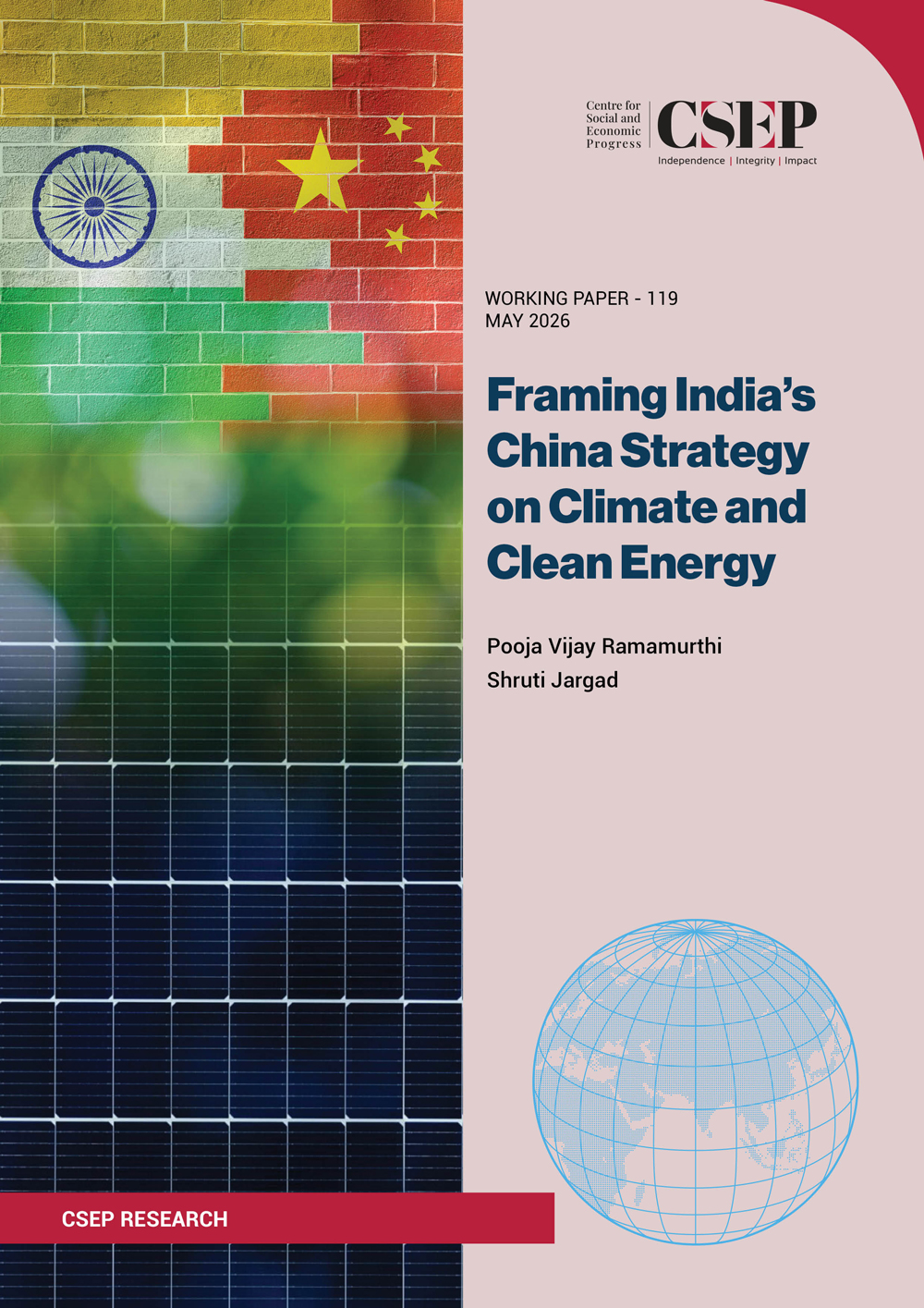
The paper addresses a critical but underexamined dimension of India’s climate strategy—whether and how India should engage with China on climate and clean energy amid geopolitical rivalry and economic asymmetry. While India has adopted ambitious mitigation and adaptation goals, achieving these objectives depends not only on domestic policy but also on international partnerships for technology, finance, and knowledge flows. China occupies a uniquely complex position as it is India’s largest supplier of green technologies while also being a strategic competitor with whom diplomatic engagement remains limited.
India’s heavy dependence on Chinese clean-energy supply chains exposes it to vulnerabilities such as trade disruptions, price volatility, and strategic leverage, all of which can impact the pace of India’s energy transitions. At the same time, as important Global South actors, India and China share overlapping interests in shaping international climate norms, finance, and governance. Given the tension between the need for sovereignty and continued trade dependence, this paper seeks to provide evidence based insights into whether, where, and how India might reimagine climate engagement with China in the context of today’s geopolitical realities.
Situating India–China Climate Engagement in Current Geopolitical Realities
This paper situates India–China climate relations within existing scholarly and policy debates. It highlights a key gap in the literature: most analyses of climate cooperation with China focus on the Global North, offering limited guidance for India’s distinct geopolitical and developmental position. Studies on India–China relations largely concentrate on multilateral negotiations or comparative climate governance, while analyses of bilateral engagement are outdated and reflect a different geopolitical era. We show that post-2015, China’s rise as a dominant green-technology supplier, widening economic asymmetries, and escalating border tensions fundamentally altered the context for cooperation. Climate cooperation has increasingly become securitised, supply chains have been politicised, and there is a need for renewed trust-building. While some scholars argue that climate and clean energy can be “low-hanging fruit” for cooperation, this paper demonstrates that this is true only in areas that are neither economically competitive nor geopolitically strategic. This requires India to develop a clear framework for engagement.
Methodology
The study employs a qualitative, mixed-source methodology combining historical mapping, document analysis, expert interviews, and policy workshops. The authors construct an original dataset of 44 official bilateral engagements between the Indian and Chinese governments from 1993 to 2020, sourced from India’s Ministry of External Affairs (MEA). These documents are systematically coded by type of engagement, implementing actors, and sectoral focus.
To supplement the secondary data and understand the potential for future India–China climate engagement, the paper draws on semi-structured interviews with diplomats, policymakers, scholars, and industry experts, as well as insights from two closed-door policy workshops with Indian and Chinese experts.
Mapping Engagement
This section presents a longitudinal mapping of India–China climate and energy engagement across three phases.
Phase I (1990s–2007) is characterised by strong multilateral alignment and nascent bilateral cooperation. India and China coordinated closely in global climate negotiations around the principle of common but differentiated responsibilities (CBDR) and development equity, while bilaterally focusing on environmental protection, minerals, renewable energy (RE), marine sciences, and hydrological data sharing. Cooperation was largely technical and exploratory, with limited institutional depth. This phase saw the signing of the vital Brahmaputra and Sutlej river data-sharing agreements.
Phase II (2008–2015) represents the high point of engagement. Climate and energy cooperation expanded rapidly through Memoranda of Understanding (MoUs), strategic economic dialogues (SEDs), joint research initiatives, and subnational sister-city agreements. Engagement diversified across mitigation and adaptation domains. Importantly, this phase involved a broader set of actors, including planning bodies, cities, research institutions, and enterprises, signalling the potential for deeper institutionalisation. However, implementation remained uneven, and cooperation was often more aspirational than actionable.
Phase III (2016–2026) marks a period of decline and breakdown. Geopolitical shocks, including Doklam, COVID-19, and the Galwan clashes, severely curtailed engagement. Structural asymmetries widened as China consolidated its dominance over green supply chains, while India’s bilateral trade deficit deepened, including in green goods. Although some dialogue mechanisms persisted until 2019, there was limited convergence on climate issues in bilateral and multilateral forums.
Reimagining Strategic Windows of Cooperation
This section argues that future India–China climate engagement must be narrow and pragmatic, focused on areas that do not involve economic competition or geopolitical leverage. However, the institutional channels pursued should be broad, extending beyond bilateralism and multilateralism to include engagement in minilateral initiatives and development banks. The key approaches that could enable improved climate cooperation are as follows:
- Identifying narrow technical areas of mutual interest
Cooperation is most viable in non-sensitive, functional areas such as energy efficiency standards, disaster-risk resilience, sustainable agriculture, waste-to-energy systems, urban planning, and governance challenges associated with just transitions away from coal, rather than in sectors where China holds clear technological dominance. Shared challenges in hard-to-abate sectors such as steel and cement, as well as biodiversity conservation, pollution management, and low-carbon urban planning, offer low-risk entry points through scientific exchange and revived agreements. - Sharing governance and policy experiences
Despite differing political systems, both countries rely on decentralised and subnational climate governance, creating scope for mutual learning on local capacity building and accountability. Cooperation is especially relevant for managing a just transition away from coal, where India can learn from China’s monitoring and implementation capabilities, while China can draw on lessons from India’s grassroots green innovation. - Coordinating on climate norms for the Global South
India and China have historically shaped global climate outcomes through aligned positions and can continue to influence norms, standards, and taxonomies for the Global South. Their complementary strengths, China’s technological scale and India’s normative legitimacy, can support cooperation on climate finance, green goods, resilient infrastructure, and disaster response. This coordination can allow India and China to play complementary roles in the developing world without deepening strategic dependence. - Diversifying channels of coordination
Multilateral and minilateral platforms such as Brazil, Russia, India, China, and South Africa (BRICS), the Shanghai Cooperation Organisation (SCO), and Brazil, South Africa, India, China (BASIC), and institutions such as the Asian Infrastructure Investment Bank (AIIB), Asian Development Bank (ADB), and New Development Bank (NDB) provide avenues for India–China climate engagement amid bilateral constraints. These forums can facilitate joint investments, technology exchange, and private sector dialogue. - Improving engagement between civil society and subnational actors
Track 1.5 and Track 2 dialogues involving think tanks, universities, and industry groups can sustain cooperation even when formal diplomacy is constrained. Joint research, sister-city partnerships, and subnational exchanges on air quality, urban resilience, and sustainable mobility can foster trust and generate practical policy insights at the local level. - Gaining insights from countries currently engaging with China
Countries such as Indonesia and the Philippines demonstrate that substantial Chinese green investment can coexist with geopolitical volatility through carefully structured partnerships. India can draw lessons from these cases on managing Chinese foreign direct investment (FDI), technology transfer, and critical mineral investments while safeguarding strategic and economic interests.
The paper concludes that India can pursue a strategically calibrated approach, focused on narrow and implementable areas, diversified institutional channels, and selective norm-shaping, to build trust and strengthen climate and energy engagement.
Keywords: China, geopolitics, green trade, climate diplomacy, energy transition, geoeconomics
Q&A with authors
What is the core message of your paper?
This paper explores whether and how India should engage with China on climate and clean energy. Given India’s heavy dependence on green energy supply chains from China, common climate adaptation issues from a shared Himalayan ecosystem and the possibility of coordination on Global South climate reforms at international forums, India-China engagement will be key. However, bilateral cooperation today remains sporadic and limited.
The first message of this paper is that India must develop a pragmatic approach to climate and clean energy engagement with China, which reflects today’s geopolitical realities. To enable this, the paper maps historical engagement, providing lessons from the past and then explores avenues to reimagine engagement in the future.
Three decades of engagement show nascent cooperation until 2007, followed by a flurry of bilateral engagement between 2009–2015 before tapering off. This past diplomatic engagement was broad, with actors from government, private, subnational and civil society involved. Yet, there was little on-ground implementation.
Therefore, the second message is that India needs a calibrated strategy built on initially engaging in narrow low-risk, actionable entry points. These include energy efficiency, sustainable agriculture, waste management, urban resilience, sustainable food systems and just transition governance exchanges. Simultaneously, India should diversify engagement channels towards subnational level exchanges and minilateral platforms like BRICS and multilateral development banks like ADB.
The last message is that today, it appears difficult for India and China to engage on areas which are geopolitically and economically competitive including EVs, batteries, wind and solar components and critical minerals. However, these are the areas where India faces supply chain vulnerabilities and in the near future, there is potential for government and private sector actors from both countries to negotiate frameworks that enable bilateral and technical flows.
What presents the biggest challenge?
Given that India and China contribute jointly to 38% of global climate emissions and that both countries have ambitious net-zero goals, coordination, collaboration and cooperation will be pragmatic for both countries. The period between 2009-2015 indicates that robust diplomatic engagement between India and China is possible. However, since then, a trust deficit, border skirmishes and trade asymmetries between countries has resulted in the imposition of trade and non-trade barriers, restricting green technology and financial transfers.
Today, after a period of limited diplomacy, we see a thawing of relations with India cautiously putting in place financial relaxations on Chinese investments. Despite the thawing of relations providing avenues for cooperation, deep institutional mistrust and disrupted established dialogue mechanisms will be challenging to immediately revive. This trust deficit can only be built in a gradual manner, through narrow, actionable focussed sectors that are ‘low politics’.
Further, while private sector investments are key to enabling financial and technical cooperation between the two countries, companies from both countries will be cautious to invest unless climate cooperation can be de-risked from broader bilateral geopolitical tensions.
What presents the biggest opportunity?
Revived engagement on clean energy and climate issues provides opportunities for both India and China. For India, engagement could mean enabling key technology and financial transfers from China, leading to building domestic capabilities and increasing foreign investments into green sectors.
China currently faces a slowing economy with a desire for new markets resulting from fierce internal domestic competition of private firms, leading to overcapacity in the green energy sector. India’s large population and ambitious energy transition goals, provides Chinese firms with economic incentives to enter the Indian market. At a regional scale, India and China have the opportunity to coordinate on climate issues facing countries in the Bay of Bengal and Himalayan eco-systems, especially around joint climate resilience issues.
Finally, as both these countries are the leading voices in the Global South on climate change, their coordination can influence international standards and norms on climate finance, carbon markets, green taxonomies and loss and damage metrics. There is a an opportunity to leverage complementary strengths. For instance, China brings technological scale and manufacturing capacity, while India offers normative legitimacy and credibility as a developmental partner.
Finally, smaller platforms like BRICS, SCO, and multilateral development banks such as the AIIB and NDB have an opportunity to play a role in facilitating engagement between India and China beyond the bilateral. India’s BRICS Presidency can be one such instance, where India and Chinese climate engagement can be a priority.

Pooja Ramamurthi

Shruti Jargad



Find on this page

The Centre for Social and Economic Progress (CSEP) is an independent, public policy think tank with a mandate to conduct research and analysis on critical issues facing India and the world and help shape policies that advance sustainable growth and development.