

Impact of Mainstreaming E20 on India’s Crude Oil Imports
Reading Time: 6 minutesIndia’s Crude Oil Import Dependence
As India shifts towards E20 petrol blending, a key question arises: How much of its crude oil dependence can ethanol blending realistically reduce?
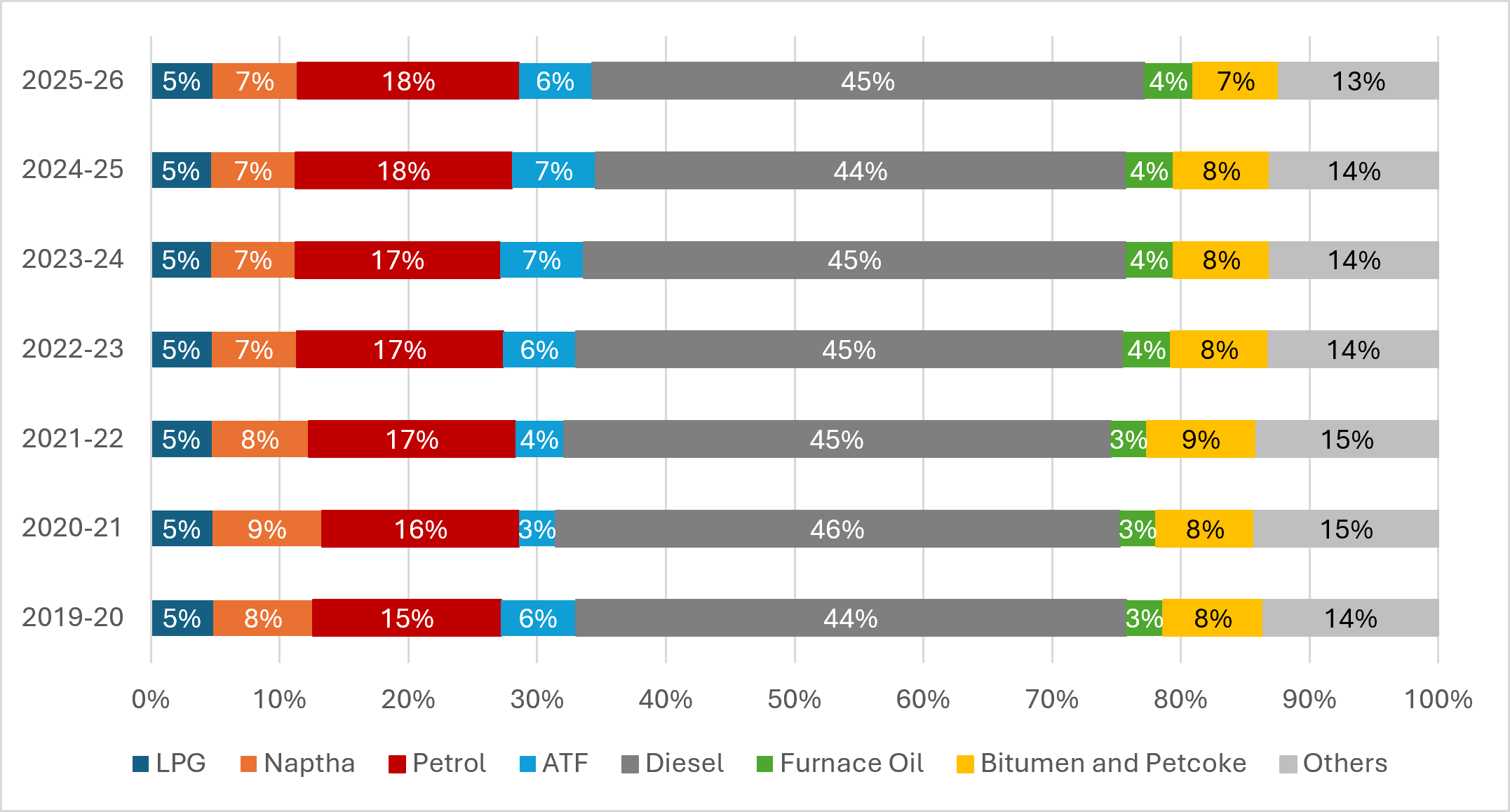
Petrol, the only fuel E20 affects, accounts for just 15–18% of the products obtained from a barrel of crude oil, while diesel alone claims 44–45%
The National Policy on Biofuels, 2018 set an indicative target of 20% ethanol blending in petrol by 2030. Feedstock diversification and fresh investments under the Ethanol Blended Petrol Programme advanced this to Financial Year (FY) 2025–26, with the nationwide mandate coming into effect from April 2026. E20, as it is branded, is intended to reduce crude oil imports, achieve energy security, increase farmers’ income, and enable cleaner fuel combustion. Of these goals, reducing crude oil imports has carried the most policy weight, as government reports credit E20 with saving an estimated US$24 billion (₹1.97 lakh crore) in foreign exchange to date. However, the arithmetic behind this claim remains unclear.
India satisfies around 90% of its crude oil needs through imports, which cost US$137 billion in 2025 alone. The country refines crude oil into various petroleum products, such as diesel, petrol, LPG, aviation turbine fuel (ATF), bitumen, and others. Petrol, the only fuel E20 affects, accounts for just 15–18% of the products obtained from a barrel of crude oil, while diesel alone claims 44–45% (Figure 1).
Figure 1: Shares of Petroleum Products in Total Crude Oil Processed in India
Source: Authors’ analysis based on data sourced from the Petroleum Planning & Analysis Cell.
Note: Share values may not add up to 100 due to rounding.
The Diesel–Petrol Asymmetry
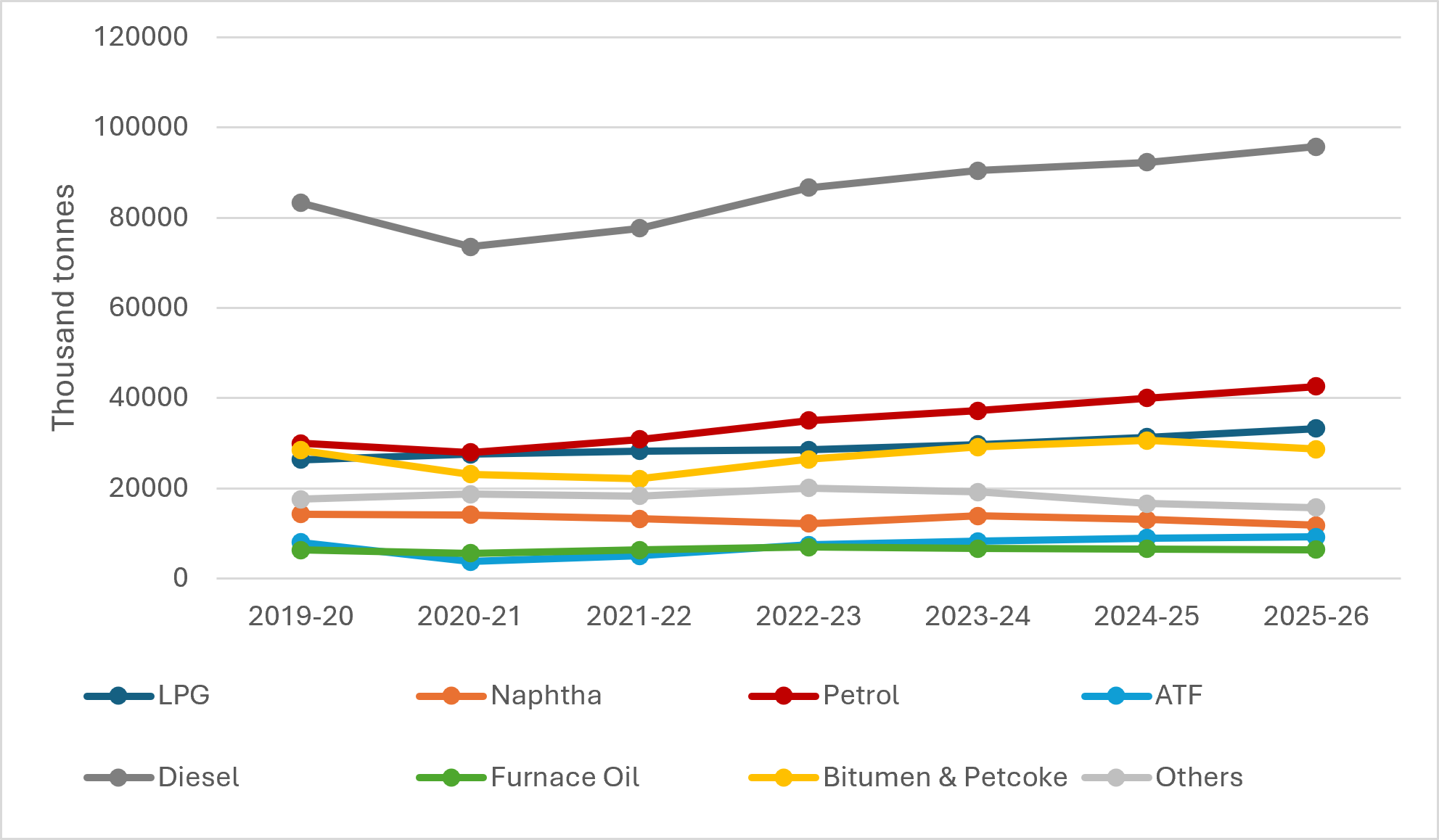
The distinction between diesel and petrol also matters on the demand side. India’s petroleum market has shown a consistent difference: diesel consumption between FY 2020–21 and FY 2024–25 was 503 Million Metric Tonnes (MMT) compared with 200 MMT of petrol (Figure 2). Diesel powers freight, agriculture, and industrial logistics, while petrol serves primarily as a personal mobility fuel, with a narrower use case. This gap is expected to persist, as diesel is projected to account for half of the country’s oil demand through 2030, driven almost entirely by road diesel. Yet the smaller petrol market has become the key target of India’s biofuel strategy. This raises a technical question: Even if E20 reduces petrol demand, can refineries simply redirect crude oil to produce larger quantities of other petroleum products?
Figure 2: Consumption of Petroleum Products in India Since FY 2019–20
Source: Authors’ analysis based on data sourced from Petroleum Planning & Analysis Cell.
Note: Diesel includes High Speed Diesel and Light Diesel Oil.
The Refining Constraint
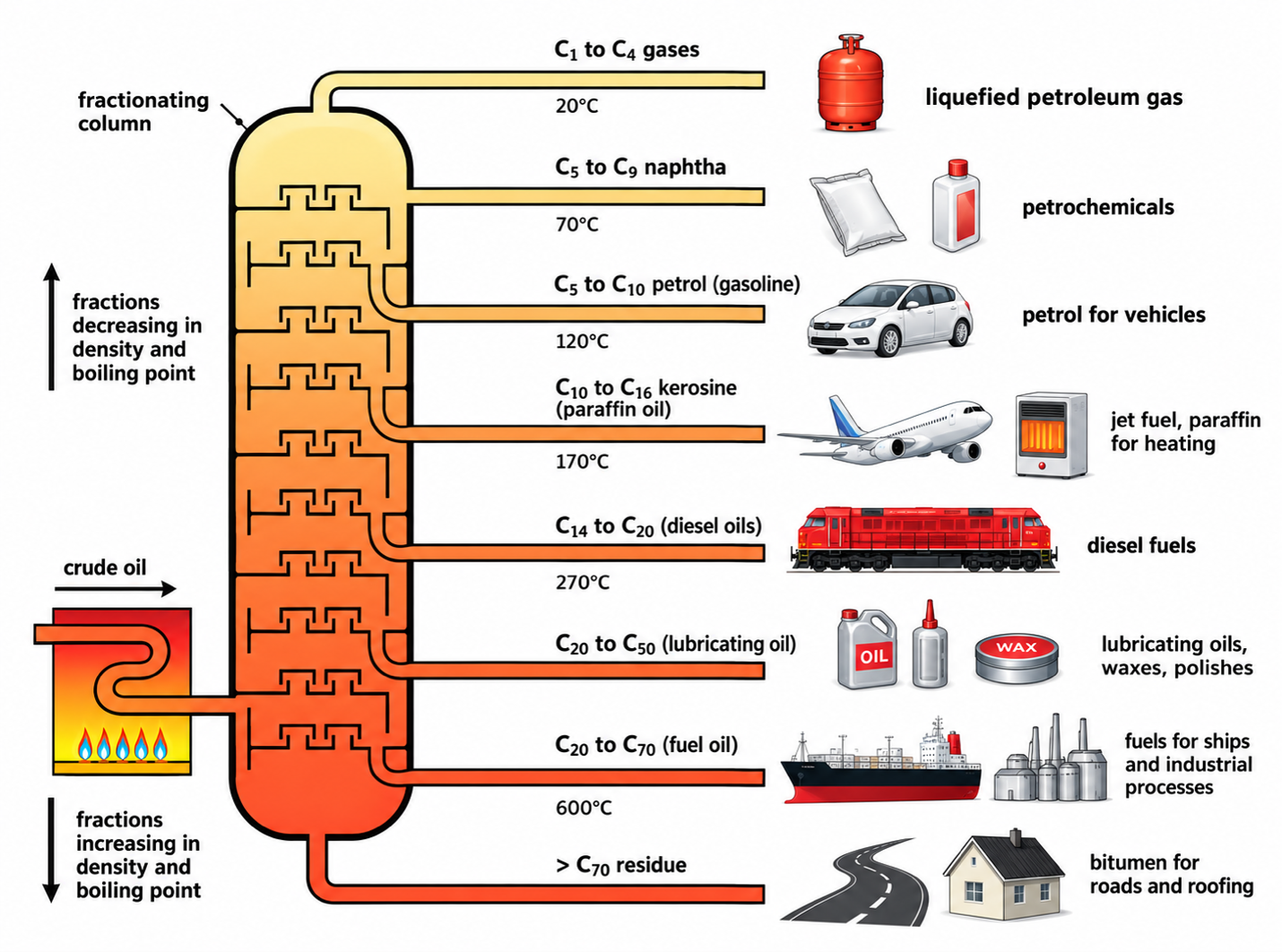
Refiners separate crude oil into fractions through distillation based on boiling points, then process them into a range of petroleum products (Figure 3). Fluid Catalytic Crackers (FCC) and hydrocrackers allow refiners to reshape their outputs by converting heavier, lower-value hydrocarbons into lighter, more valuable products. This conversion can increase middle distillate yield by only 2–3%. The same FCC can also produce huge amounts of light olefins like propylene, mainly for petrochemical use. However, this flexibility applies to the heavy fraction before it becomes a specific fuel, not to petrol that has already been separated out.
This refining constraint sets an upper bound on E20’s impact on crude oil imports through petrol savings; it does not, by itself, show how much petrol is actually saved.
Figure 3: How A Typical Crude Oil Refining Process Takes Place
Source: Marquard & Bahls.
Note: This is a simplified representation of crude oil refining to produce petroleum products.
How Much Is E20 Really Reducing Petrol Consumption?
To assess the impact of E20 blending on India’s petrol consumption, FY 2018–19 is chosen as the reference year for a counterfactual experiment. Ethanol blending stood at approximately 5% that year, providing a low-blend benchmark against which the effect of a hypothetical 20% blend mandate can be isolated.
Calculating the Consumption Levels
National petrol consumption stood at 28,284 Thousand Metric Tonnes (TMT) in FY 2018-19. Survey results split this between four-wheelers (4W) and two-wheelers (2W) at 41% and 59%, respectively, corresponding to 11,597 TMT consumed by 4W and 16,688 TMT by 2W. Annual vehicle-kilometres travelled are estimated at 11,680 km for a 4W and 6,205 km for a 2W, based on daily averages of 32 kilometres (km) and 17 km, respectively. Combined with fuel economy values of 19 km per litre (kmpl) for a 4W and 64 kmpl for a 2W, this implies annual petrol consumption of 614.74 litres per 4W and 96.96 litres per 2W.
The E20 mandate alters fuel consumption in two ways. The first is the substitution effect, wherein the petrol share is limited to 80%. The second is a fuel efficiency (fuel economy) effect, as petrol cannot be substituted with ethanol on a 1:1 basis because latter has lower energy content.
Accounting for the Impact of 20% Blending on Vehicle Fuel Efficiency
The E20 mandate alters fuel consumption in two ways. The first is the substitution effect, wherein the petrol share is limited to 80%. The second is a fuel efficiency (fuel economy) effect, as petrol cannot be substituted with ethanol on a 1:1 basis because the latter has lower energy content. Fuel efficiency losses are estimated at 6–7% for 4W and 3–4% for 2W, relative to a vehicle originally designed for petrol without ethanol and calibrated for E10. Combining both effects, the 2018–19 petrol consumption figures are adjusted using factors of 0.860 for 4W and 0.833 for 2W.
Annual per-vehicle petrol consumption falls from 614.74 litres to 528.81 litres for 4W and from 96.96 litres to 80.79 litres for 2W, reductions of approximately 14% and 17%, respectively. At the national fleet level, the experiment produces a consumption of 23,882 TMT, a total reduction of 4402 TMT or 15.56% from the original level.
What is the Significance of 15.56%?
The 15.56% reduction in petrol consumption can be expressed in physical and monetary terms. The estimated 4402 TMT of petrol saved equals approximately 5.87 billion litres, based on a mid-point density of 750 kg/m3. In FY 2018–19, the average retail price was approximately ₹68 per litre of petrol, so E20 blending would have translated to a monetary saving of ₹39,916 crore. At the current price of ₹102 per litre, the total savings could reach ₹59,874 crore. However, is this a real monetary saving for the country?
The more consequential question is not about how much petrol is saved at the pump, but what happens to the displaced portion of the barrel
These results are not synonymous with a reduction in crude oil demand or input cost. The postulate that a litre of petrol substituted by ethanol equates to a litre of avoided crude oil import treats petrol as crude oil’s only output, which it is not (as explained). Therefore, the more consequential question is not about how much petrol is saved at the pump, but what happens to the displaced portion of the barrel. Lower petrol demand can lead to additional naphtha production, as naphtha has a lower boiling point (Figure 3). Large oil-producing companies are pursuing crude-to-chemicals (C2C) technologies with a potential 70-80% chemical yield, though this is not a go-to opportunity for a crude-importing country like India. Therefore, the question remains whether blending petrol alone can reduce crude oil imports. The elephant in the room, in fact, is diesel, the other motor fuel.
Unlike ethanol blending, which has increased quite steadily in recent years, biodiesel blending has remained short of the 5% target. This undermines India’s commitment to a green energy transition and to reducing crude oil import dependence.
Why Is India Not Focusing on Biodiesel Production?
Unlike ethanol blending, which has increased quite steadily in recent years, biodiesel blending has remained short of the 5% target. This undermines India’s commitment to a green energy transition and to reducing crude oil import dependence. The 2003 National Biodiesel Mission emphasised non-edible oils such as jatropha curcas to achieve the target; however, it met obstacles including incorrect land estimations, expensive inputs, a lack of technological solutions, and a long payback period. The National Policy on Biofuels, 2018, identified waste oils such as used cooking oil and acid oil as potential feedstock, but this faced a collection problem, as supply was fragmented across multiple sources. The effect of the feedstock shortage is evident in the utilisation data: India’s nameplate biodiesel production capacity is 520 million litres, yet actual utilisation is merely 34.6%.
One may argue that electric vehicle (EV) adoption will phase out internal combustion engine vehicles, including diesel ones, and that biodiesel will lose relevance. However, because petrol prices are higher than diesel, an EV is more cost-competitive against a petrol vehicle than a diesel one.
Looking Beyond Petrol
Crude prices are volatile and often affected by geopolitical upheaval, making demand reduction a strategic imperative. While E20 can keep petrol demand in check, the 15.56% reduction shown by the counterfactual experiment covers only a small part of the total crude oil processed. Diesel, along with other fuels, is what drives India’s import bill. Therefore, India’s biofuel strategy must be evaluated against the entire fuel barrel, not just the portion being substituted. Progress on biodiesel alone can potentially yield greater dividends for the economy. Considering the challenges in its production, the country should invest in research and development to realise a scalable, sustainable biofuel industry.


Shyamasis Das



Find on this page

The Centre for Social and Economic Progress (CSEP) is an independent, public policy think tank with a mandate to conduct research and analysis on critical issues facing India and the world and help shape policies that advance sustainable growth and development.