

After the Elections: What Next for India in Nepal, Bangladesh and Myanmar?
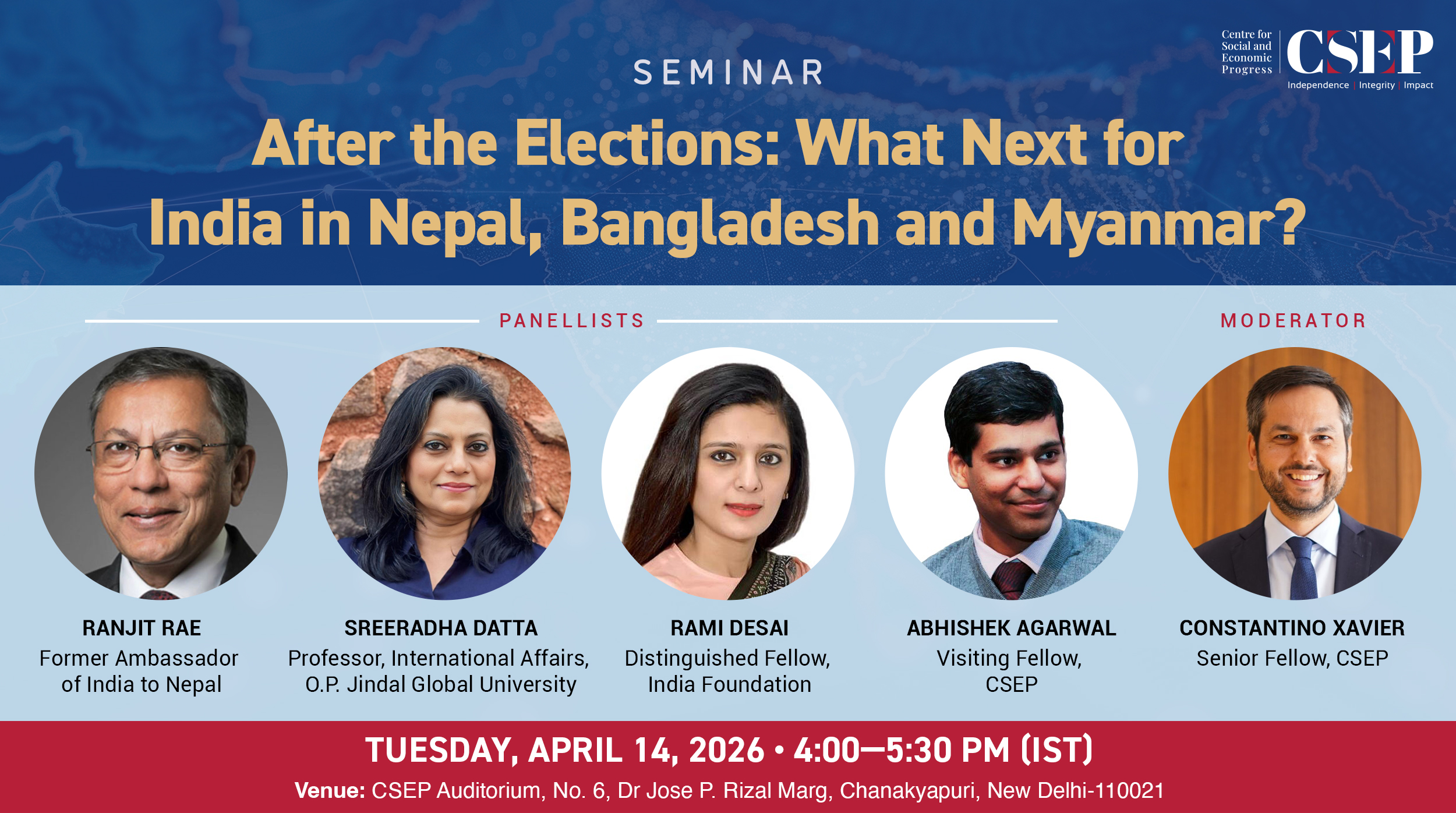
The Centre for Social and Economic Progress (CSEP) is delighted to invite you to a seminar titled “After the Elections: What Next for India in Nepal, Bangladesh and Myanmar?” on Tuesday, April 14, 2026, from 4:00 to 5:30 pm (IST) at the CSEP Auditorium, 6, Dr Jose P Rizal Marg, Chanakyapuri, New Delhi – 110021.
Amid a wave of recent elections across India’s neighbourhood—reshaping political leadership, recalibrating bilateral ties, and raising new questions around regional security and economic cooperation—this discussion will examine what lies ahead for India’s engagement with Nepal, Bangladesh, and Myanmar.
The seminar will feature a panel discussion with Ranjit Rae, Former Ambassador of India to Nepal; Sreeradha Datta, Professor, International Affairs, O.P. Jindal Global University; Rami Desai, Distinguished Fellow, India Foundation; and Abhishek Agarwal, Visiting Fellow, CSEP. The discussion will be moderated by Constantino Xavier, Senior Fellow, CSEP.
Please note that this is an in-person event only. If you are in Delhi on the day, we invite you to join us for what promises to be a thought-provoking discussion. The event will be available on the CSEP website and YouTube channel upon completion.
About the event
India’s neighbourhood has recently experienced a series of elections that have significant implications for its future economic and security interests. In Bangladesh, the BNP has formed a new majority government, which now promises normalisation of bilateral ties as Prime Minister Modi speaks of a “new chapter.” In Nepal, a new political party has come to power, prompting New Delhi to engage with a new generation of leaders. Meanwhile, elections in Myanmar reinforced the military’s dominance amidst rising internal conflict and concerns about China’s influence. At home, upcoming regional state elections in West Bengal and Assam will also shape India’s Neighbourhood First policy and the sub-regional BBIN economic cooperation agenda. Additionally, the war in Iran now threatens further regional turbulence, affecting political economy and energy security. How will this context influence India’s economic and security interests in these three and other neighbouring countries? This panel of experts will discuss these recent developments and identify challenges and opportunities for India to accelerate the implementation of its regional connectivity and security strategy.
Panellists
Ranjit Rae
Ranjit Rae is a former Indian Ambassador to Nepal (2013-17). He has also served as the Head of Division dealing with Nepal and Bhutan in the Indian Ministry of External Affairs. During his two tenures, he has had a ringside view of momentous developments in the contemporary history of Nepal, ranging from the royal coup of February 2005 and the peace process between the Maoists and political parties to the Great Nepalese Earthquake of 2015 and the adoption of the new Constitution of Nepal later that year. Rae has also been associated with UN Peacekeeping Operations both at the UN headquarters and in the field. He has also served as Ambassador to Vietnam and Hungary and has held important positions in the Ministry of External Affairs and the President’s Secretariat. His first book, partly a memoir, Kathmandu Dilemma: Resetting India-Nepal Ties, was published in 2021. His first job was as a Lecturer of Economics at St Stephen’s College, Delhi University.
Sreeradha Datta
Sreeradha Datta teaches International Affairs, at O.P Jindal Global University presently. She is also a non-resident Senior Fellow with Institute of South Asian Studies, National University of Singapore. Earlier she was Senior Fellow and Centre head, Neighbourhood Studies Vivekananda International Foundation, New Delhi. She has also served as director, Maulana Abul Kalam Azad Institute of Asian Studies, Kolkata, Government of India, and has held fellowships with Institute for Defence Studies and Analyses, New Delhi, Government of India. She holds a Ph.D. from Jawaharlal Nehru University, New Delhi. She is also the Director of, Centre for Analytical Research and Engagement, a research centre within Jindal University
Rami Niranjan Desai
Rami Niranjan Desai is an author, anthropologist and researcher with subject expertise in the north east region of India and India’s neighborhood. She has studied at King’s College, London where she received her degrees in Anthropology of religion and Theology. Rami has spent over two decades studying insurgency, ethnic armed organisations, religion and identity issues. Her vast repository of work is based on her groundbreaking fieldwork over the years in the northeast region and in India’s neighborhood such as Myanmar. As Distinguished Fellow at India Foundation she focusses on current affairs, the northeast region of India and the neighbourhood. She also curates India Foundation’s flagship event India Ideas Conclave and podcast Insight while leading other significant initiatives.
Abhishek Agarwal
Abhishek Agarwal is a Visiting Fellow at CSEP. A co-creator, nurturer and eager learner, Abhishek actively sows and nurtures ideas that develop into significant programs and reforms in infrastructure governance and cooperation management. Key past initiatives include PM GatiShakti, Integrated Infrastructure Planning, Infrastructure Digitalization, De-risking & Resilience, Alternate Financing Mechanisms, Smart Cities, RURBAN, City-Regions (Growth Hubs), District Area Development Approach, Leveraging Tourism, Vibrant Village Program, and Hierarchical Spatial Governance.
Multi-sectoral collaborations, member of various committees, appraising ~1700 mega-projects ($640bn) and convergence framework for 5000 micro projects and facilitating bilateral and multilateral engagements are key recent highlights.
Past associations include NITI Aayog, GIZ, UNDP, Odisha, Tamil Nadu, Rajasthan, IL&FS, GIFT City, Gujarat Tourism Opportunities (GUJTOP), Gujarat Industrial Infrastructure Projects Limited (GIIPL), and partnerships with various Industrial Development Authorities and Municipal Corporations.
Abhishek is an alumnus of the prestigious International Visitors Leadership Program (IVLP) of the Department of State (Govt. of US) for ‘Cooperation on Infrastructure for the Indo-Pacific’.
Moderator
Constantino Xavier
Constantino Xavier is a Senior Fellow at CSEP, New Delhi, where he directs the program in Foreign Policy and Security Studies. He is also a non-resident fellow in the Foreign Policy program at the Brookings Institution, in Washington DC, and visiting professor at Ashoka University’s Department of International Relations.
His research expertise is on India’s role as a regional power in South Asia, the Bay of Bengal and Indian Ocean regions, especially relations with Nepal, Bangladesh, Sri Lanka and Myanmar. His studies under the CSEP Sambandh Initiative on Regional Connectivity have had wide impact with governments, industry and other stakeholders invested in enhancing India’s geoeconomic integration with neighbouring countries and regions, from the Gulf to Southeast Asia.
Dr Xavier’s broader work explores how India navigates the geopolitics of a changing regional and global order by balancing national security interests and growing economic interdependence. He also focuses on India’s relations with the European Union and other Indo-Pacific powers across the Global South. At CSEP he is currently leading research projects on India’s regional connectivity partnerships, climate cooperation, critical minerals security and China’s role in South Asia.
All content reflects the individual views of the speakers. The Centre for Social and Economic Progress (CSEP) does not hold an institutional view on any subject.
Please contact Gurmeet Kaur at GKaur@csep.org for general queries and Ayesha Manocha at AManocha@csep.org for media queries.





The Centre for Social and Economic Progress (CSEP) is an independent, public policy think tank with a mandate to conduct research and analysis on critical issues facing India and the world and help shape policies that advance sustainable growth and development.