

India in International Climate Finance Cooperation Frameworks
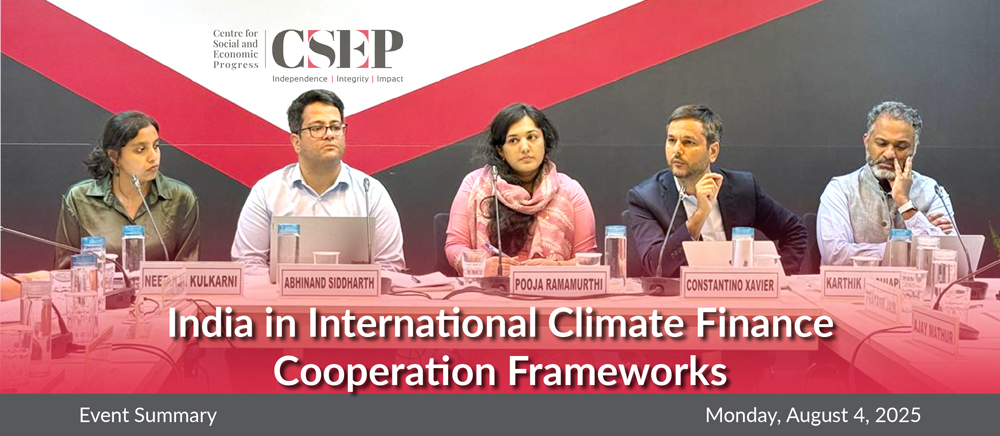
- On 4 August 2025, the Centre for Social and Economic Progress (CSEP) hosted a roundtable on “India in International Climate Finance Cooperation Frameworks” as a part of the Global Climate Cooperation Programme of the Foreign Policy and Security Series vertical.
- The roundtable brought together stakeholders from the government, multilateral institutions, think tanks and civil society to discuss how India engages with international climate finance cooperation frameworks.
- Presentations were made by Constantino Xavier, Senior Fellow, CSEP; Karthik Nachiappan, Non-Resident Fellow, CSEP; Abhinand Siddharth S, Research Associate, CSEP; and Neeraja Kulkarni, Research Analyst, CSEP. The presentations were followed by discussions amongst the stakeholders, which Pooja Ramamurthi moderated.
- The roundtable discussions aimed to identify pathways for India to strengthen its role in international climate finance diplomacy, especially in the context of its development ambitions and climate obligations.
- The discussion was framed around three core areas.
- India’s interaction with Multilateral Development Banks (MDBs), particularly the World Bank Group and Asian Development Bank (ADB);
- Strategic engagement with Climate-Focused Financing Mechanisms such as the Green Climate Fund (GCF) and COP processes;
- India’s limited but growing participation in Consultative Climate Financing Networks like the Network for Greening the Financial System (NGFS) and the Green Swan Conference.
Reassessing the Role of MDBs in Climate Finance
Participants discussed the evolving mandates of MDBs and the limitations they face in addressing the climate finance needs of the Global South. Initially designed for development finance, MDBs are now under pressure to scale climate investments without compromising their primary objectives and AAA ratings. Despite recent calls to optimise balance sheets, expand capital bases, and re channel Special Drawing Rights (SDRs), progress remains slow and fragmented. When it comes to Bretton-Woods institutions, including the World Bank, criticism often centres on the unequal distribution of governance power among member states.
When it came to India’s Engagement with MDBs, members discussed how India has developed pragmatic relationships, particularly with the ADB, which is seen as more aligned regionally and less prescriptive in its conditionalities compared to the World Bank. However, the high cost of capital—up to 7.4%—and an overemphasis on sovereign guarantees remain deterrents. In terms of structural and capacity constraints, while India has managed to mobilise some climate finance, actual disbursements are insufficient. One participant noted that capacity limitations at the state and sub-national levels were flagged as a persistent bottleneck, especially in preparing bankable climate projects. Participants also highlighted India’s ongoing push for MDB reforms through the G20. The discussions stressed the need for systemic reforms, including capital base expansion and better alignment with climate goals, without sidelining development mandates.
India’s Climate Finance Diplomacy at COPs and the GCF
Participants reflected on India’s positioning and limited representation within global climate negotiations, emphasising strategic participation at COP29 and upcoming COP30. While India has historically emphasised Common but Differentiated Responsibilities (CBDR), concerns were raised about limited gains in climate finance outcomes, particularly on public capital transfers, private capital leverage, and institutional reform.
Concerning the New Collective Quantified Goal (NCQG), participants noted that the process has been fraught with delays and shifting burdens. While the EU and Canada have taken on greater responsibilities, the absence of US leadership has weakened collective momentum. India’s experience with the GCF remains mixed: although some projects have been successfully financed, India’s access and influence within the Fund’s governance structures are limited.
A recurring theme during the discussions was the lack of a universally accepted definition of climate finance. India has proposed its definition at COP forums, but this has not gained global traction. The inability to differentiate clearly between development and climate finance has further complicated access and accounting. In light of constraints in defining climate finance, and limitations at the UNFCCC, participants suggested exploring “minilateral” climate coalitions where India could engage strategically with like-minded countries to pursue targeted finance and technology partnerships.
Subnational Action and Institutional Strengthening
A strong emphasis was placed on the role of subnational actors—states, cities, and local development banks—as increasingly crucial in climate action. However, subnational capacity to access and utilise climate finance remains weak. On the role of public development banks, participants highlighted institutions like the National Bank for Agricultural and Rural Development (NABARD) as key intermediaries, especially in operationalising rural adaptation financing. NABARD’s shift from integrating climate finance into development and its grassroots outreach makes it a critical node in India’s climate finance ecosystem. Yet, the lack of widespread climate awareness among bankers and communities limits fund absorption.
The discussions also noted that climate finance must follow a bottom-up approach to ensure improved alignment with India’s granular needs. This includes better taxonomies, targeted training, and capacity-building mechanisms for domestic financial institutions. Strategic clarity, awareness campaigns, and project preparation facilities at the subnational level were viewed as urgent needs.
Quality over Quantity in Climate Finance
Another recurring theme was the disproportionate focus on the volume of climate finance, with inadequate attention to its quality. Much of the financing has been mitigation-focused and debt based, often at market rates. This has raised concerns about affordability, especially in low-income states and sectors that urgently require adaptation support. A participant highlighted that genuine concessionality in financing remains elusive. Risk mitigation instruments and guarantee mechanisms were flagged as underdeveloped and poorly integrated with Indian needs. The public sector remains the largest investor in clean energy, highlighting the need for enhanced private sector mobilisation.
With increased focus on Article 6 of the Paris Agreement on the market mechanisms, discussions centred on the lack of clarity around adequate implementation. A participant noted that while derisking public finance is often cited as a solution, its operationalisation remains unclear in the Indian context.
Building Strategic Capacity and Domestic Ecosystem
There was a shared understanding among the participants that enhancing India’s influence in global climate finance requires robust domestic institutions capable of formulating and implementing a coherent strategy. Institutional inconsistencies, particularly between regulatory authorities (Reserve Bank of India, Securities and Exchange Board of India, Insurance Regulatory and Development Authority of India), were flagged as barriers to a unified climate finance agenda.
While India has lagged in engagement with technical frameworks such as the NGFS, recent steps by the RBI were appreciated. However, a participant highlighted that a broader involvement of other financial regulators is critical, primarily as they govern large pools of capital. Discussions also called for improved coherence between climate negotiations and financial policy frameworks. National adaptation planning, regulatory tracking, and climate risk assessments must be integrated with India’s international economic engagement.
One participant noted that the US’s retreat from climate leadership does not impede climate finance negotiations but presents an opportunity for India to continue its lead, representing the Global South. Leveraging platforms like the Coalition for Disaster Resilient Infrastructure (CDRI) and International Solar Alliance (ISA) can also position India as a credible climate financier in South Asia and Africa.
The Path Ahead
The roundtable concluded with a shared understanding that India stands at a critical juncture in international climate diplomacy. The path ahead demands:
- Strategic clarity on India’s role in multilateral frameworks and new minilateral opportunities;
- Institutional reform and capacity building across national and subnational levels;
- Focus on quality and concessionality of finance, not just volume;
- Address the adaptation finance gap, enhancing the role of the public sector while encouraging the private sector to mobilise mitigation finance;
- Leverage of existing initiatives (e.g., ISA, CDRI) to enhance India’s climate credibility;
- Deeper regulatory engagement in frameworks like NGFS to unlock domestic and international finance flows.
As India prepares for COP30 and beyond, it must balance ambition with pragmatism, aligning development goals with a robust climate finance architecture that can absorb, implement, and influence at scale.






The Centre for Social and Economic Progress (CSEP) is an independent, public policy think tank with a mandate to conduct research and analysis on critical issues facing India and the world and help shape policies that advance sustainable growth and development.