
India’s Clean Energy Future: Navigating Trade, Supply Chains, and Strategic Cooperation
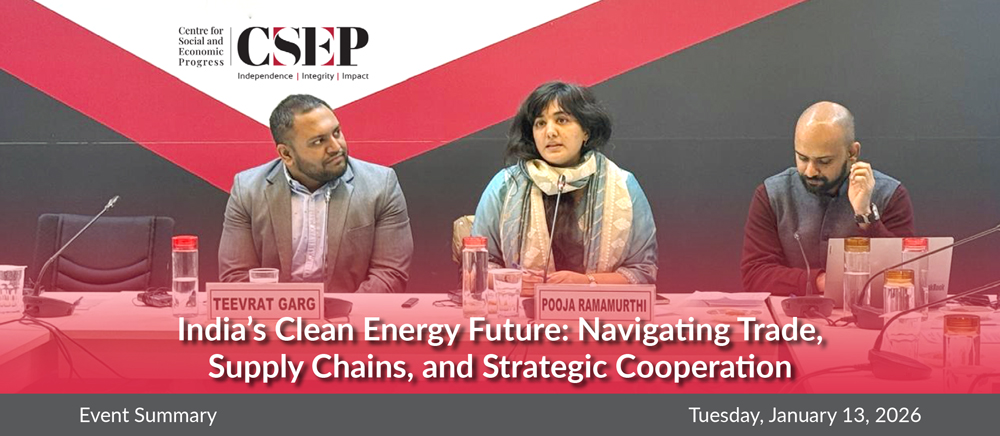
- The Centre for Social and Economic Progress (CSEP) and the University of California, San Diego (UCSD) hosted a half day convening on India’s Clean Energy Future: Navigating Trade, Supply Chains, and Strategic Cooperation. The convening built on the work at UCSD on the Agenda on Renewable Energy Trade between India and China (ARETIC) initiative’s research on India–China clean energy trade and CSEP’s analysis of strategies for India’s and China’s climate diplomacy.
- The discussions focused on whether India had green sectors with a global comparative advantage, the means to strengthen India’s supply chain resilience and innovation capacity as well as what India’s approach should be to engage with China on clean energy supply chains.
- The lead presenters were Teevrat Garg, Associate Professor of Economics, School of Global Policy and Strategy, UCSD and Pooja Ramamurthi, Fellow, CSEP.
- The discussion included participants from foreign diplomatic missions, academic institutions, government of India and think tanks.
Shaping Green Trade in a Changing World
In an increasingly fractious world, economics and geopolitics cannot be viewed through segregated lenses. Green trade is one such sector where the weaponisation of supply chains has impacted the energy security of countries around the world including India. Over the past two decades, China has dominated green manufacturing, including solar modules, wind turbines, batteries, and the processing of critical minerals that underpin these technologies. Addressing the challenge requires global partners to diversify clean energy supply chains not only to mitigate reliance on a single source supplier for inputs but also to tackle the larger issue of growing economic protectionism within interdependent systems. In this context, there is an urgent need to better understand how India can shape and navigate its green trade supply chains.
Chinese supply chains offer a cheaper, immediate solution to India’s large domestic supply gap for clean energy inputs. Discussants noted that the risk of weaponisation of China’s monopoly of green supply chains along with the growing trade imbalances between India and China necessitate an alternative approach. However, domestic manufacturers struggle with high costs and limited economies of scale. To address these challenges, a discussant suggested that a baseline mapping of intermediate and final goods of the India-China clean energy supply chain can be done to prepare a foundation for targeted policies and a data-driven strategy. Such a baseline mapping presents a significant research opportunity for scholars. Another discussant highlighted that in promoting domestic manufacturing capacity, subsidies must be relied upon as opposed to tariffs as they have emerged as a less disruptive tool. It was highlighted that technical gaps in value-chain tracking are being bridged by the harmonisation of HS8-level trade codes in India, and comparative advantages in sectors like wind and green hydrogen can be fostered and leveraged.
Several discussants noted the necessity to bridge the financing gap to build domestic clean energy supply chains. Currently Indian banks can cumulatively lend only up to ₹12 lakh crore in green finance. It was suggested that the government could mobilise institutional funds such as the corpus of the Employees’ Provident Fund Organisation (EPFO) for investments. Similarly, the Indian Renewable Energy Development Agency Limited (IREDA) and Pension Fund Regulatory Development Authority (PFRDA) regulations could also be amended to enable the IREDA and PFRDA to divert capital toward financing renewable energy projects. A subject expert suggested that like in the United States, Australia, and China, a bond market for financing the clean energy sector could be developed in India too. There was agreement amongst participants that mobilising other sources of financing would be beneficial to investors who can benefit from the high returns that the renewable energy sector is delivering while simultaneously address the financing gap for the sector.
Concomitantly, investing in research and development of material substitution in green components such as rare earth magnets needed for electric vehicles (EVs) can develop a domestic market that is de-risked from Chinese supply chains. This will not only help in faster decarbonisation but also help create local economic value.
Building a Resilient Clean Energy Ecosystem
The discussion highlighted two significant challenges. First, India is facing challenges in supply chain diversification and second, promoting domestic competitiveness. India’s shortfall in clean energy component manufacturing is rooted in weak institutional and regulatory measures which have hindered domestic manufacturers from achieving economies of scale. Solar cell manufacturing illustrates this clearly; While the minimum viable scale is about 20 GW, India’s capacity remains near 2 GW. This gap has contributed to India losing a US$3 trillion market to China. However, discussants noted that China is not India’s only competitor in the clean energy manufacturing sector. Southeast Asian countries are also building manufacturing capacities.
China’s experience shows that building a clean energy manufacturing ecosystem begins with creating demand at scale. A key instrument was demand aggregation. A notable example is the large-scale public procurement of electric buses, which made battery manufacturing commercially viable by guaranteeing sustained domestic demand. China reinforced these gains through plug-and-play industrial ecosystems that lowered entry barriers and accelerated expansion. A subject expert observed that by supporting Medium, Small and Micro Enterprises (MSMEs) which account for 30% of India’s energy demand in their green transition, the government can also generate a large-scale, demand-driven market that incentivises domestic manufacturers. Identifying effective policies to accelerate this transition offers scope for future research.
On the domestic front, discussants posited that India may adopt a cross sectoral policy where renewable energy manufacturing overlaps with other industries including defence. It could also promote competitiveness in sunrise sectors and use aggregated demand in sectors where India has a comparative advantage such as in battery manufacturing from recycled feedstock and the sustainable extraction of beach sand minerals. On the international front, a few participants suggested that India should develop a cooperative framework for interaction with countries such as Japan and Philippines that are also moving away from a single source dependence on China. The deliberations underscored that India should also deepen strategic partnerships, especially with Latin American countries and Australia, vis-à-vis critical mineral supply chains.
Engaging With China
India-China climate cooperation has witnessed three phases. The first phase witnessed cooperation on multilateral forums. The second phase was the peak of cooperation and saw a high level of bilateral engagements. The last and current phase is characterised by geopolitical asymmetric in trade dominance and climate leadership, leading to limited alignment in international climate negotiations.
Despite poor relations India and China can continue to work on climate change on narrow areas. Discussants observed that the two countries could expand cooperation on energy efficiency, developing climate norms, and local governance among other things as these areas are low stakes and of mutual interest.
There was a broad consensus that China can offer India a higher level of technology readiness, an inflow of capital, and help improve domestic competition. Therefore, discussants highlighted that India must find an institutional framework that accommodates domestic and international politics at all levels of government within its climate engagement with China. Contextual and granular solutions could be identified for balancing the entry of Chinese enterprises in the Indian market with economic and security concerns. A subject expert added that India’s approach to Chinese restrictions should be calibrated and sector-specific, guided by the criticality of industries rather than blanket bans. Identifying these critical industries represents a key area for future policy research, requiring a data-driven and holistic analysis of various sectors. On this note, it was suggested by a discussant that Press Note 3 – on Foreign Direct Investment (FDI) entry norms – be reviewed to account for the changing relationship between the two countries.
Amidst a contentious geopolitical landscape, India and China can develop a new Global South diplomacy. Even amid strategic rivalry, pragmatic cooperation could help anchor bilateral relations.






The Centre for Social and Economic Progress (CSEP) is an independent, public policy think tank with a mandate to conduct research and analysis on critical issues facing India and the world and help shape policies that advance sustainable growth and development.