
India’s Heritage Diplomacy: The Case of Archaeology and Conservation
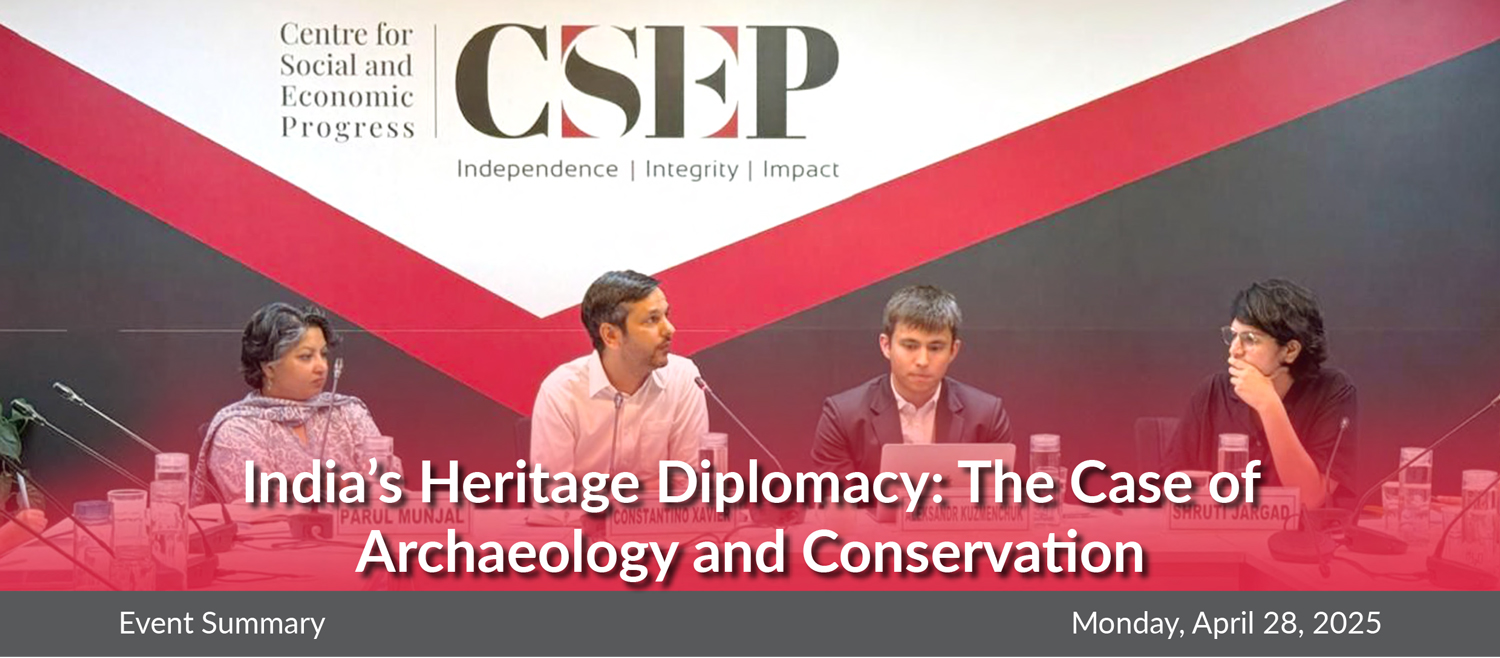
- CSEP hosted its 33rd Foreign Policy and Security Studies Tiffin Talk Research Seminar on “India’s Heritage Diplomacy: The Case of Archaeology and Conservation” with Aleksandr Kuzmenchuk, Fulbright-Nehru Student researcher at Ashoka University, and Constantino Xavier, Senior Fellow, CSEP.
- The discussion focused on India’s archaeology and conservation initiatives abroad in the last decade. The speakers presented a novel database of 20 initiatives and 4 potential initiatives, across 12 countries and 3 continents, that seeks to map India’s investments in conservation of archaeological and heritage sites as part of its heritage diplomacy. The roundtable discussed the various dimensions of India’s heritage diplomacy as well as its possible implications.
- The discussants for the event were Tim Winter, Research Leader of the Inter-Asia Engagements Cluster at the Asia Research Institute, National University of Singapore; Parul Munjal, Director of the INTACH Heritage Academy and Arunima Gupta, Researcher at the Centre for Soft Power and a Fellow at the BlueKraft Digital Foundation. The talk was moderated by Shruti Jargad, Research Analyst, CSEP.
- The discussion included participants from Indian government institutions, various foreign diplomatic missions and embassies, media, academic institutions and think tanks from India and abroad.
- This series of closed-door research seminars is curated by Constantino Xavier, Senior Fellow, CSEP and Shivshankar Menon, Distinguished Fellow, CSEP. It focuses on contemporary, evidence based research with policy relevance to bridge Delhi’s scholar-practitioner divide.
India’s Heritage Diplomacy: A Snapshot
With India’s civilisational identity and history becoming more important to its foreign policy, the significance of understanding this policy as both a form of India’s developmental partnership assistance and a vehicle of soft power becomes crucial. The speakers presented a database that aims to assess India’s progress compared to its commitments and compare India’s initiatives with those of other countries as far as the conversation of tangible heritage is concerned.
Offering a comparative lens, a speaker highlighted how China is considered a pioneer in this area as it astutely incorporated its conservation drives under the Belt and Road Initiative rubric. India, especially since 2014, has been promoting the narrative of its resurgence as a civilisational state and attempts at establishing historical linkages have grown.
India’s aspiration to aid the restoration and revitalisation of the Prambanan temple in Java, as outlined by Prime Minister Modi during Republic Day 2025 with the Indonesian President by his side, highlights its normative value in India’s evolving discourse. Institutional accommodation in terms of opening a new division, Development Partnership Assistance-IV, in the Ministry of External Affairs shows the government’s resolve in that regard. The speakers showcased that despite this, over the last 10 years India has undertaken only 21 main initiatives, a number that appears relatively modest when weighed against India’s ambitions. Examples range from Cambodia’s famous Angkor Wat temple complex to Timbuktu in Mali.
Beyond Soft Power
It was argued by the speakers that such conservation efforts have aided in enhancing India’s soft power and diplomatic relations with South and Southeast Asian nations, where they are concentrated. It was nonetheless highlighted that heritage diplomacy is not just about soft power. The presenters pointed out that the geographical footprint of the restoration/conservation sites has focused on India’s immediate and extended neighbourhood, which is consistent with India’s foreign policy priorities. One speaker showcased it has intricate links with development assistance as well.
India has approached heritage diplomacy as a tool of soft power in a post-colonial way of maintaining continuity by respecting and prioritising the local needs of the host country. One participant described how the Global South is today an exporter of cultural aid, not just an importer. It was mentioned that heritage diplomacy is not just about cultural diplomacy or soft power but also an analytical framework.
Several policy implications were highlighted by the speakers, including that India will likely see increased demand for archaeology and conservation initiatives abroad in the future. To aid this, the speakers suggested that India may 1) expand financial capacity and technical expertise to better sustain and support the initiatives; 2) de-governmentalise heritage diplomacy through greater involvement of the private sector and NGOs like the Indian National Trust for Art and Cultural Heritage (INTACH); 3) foster more domestic and international research and partnerships on heritage diplomacy; 4) prepare for possible politicisation and backlash from host societies and more.
Pushing the Boundaries of Heritage Diplomacy
Discussion highlighted that heritage conversation involves both spatial and social development, including improving the local infrastructure, providing opportunities to the locals, attracting tourism and building capacity. One panellist noted that global heritage diplomacy has moved beyond conservation. It now constitutes multi-sector forms of aid, some through bilateral channels and many multilaterals as well. One participant noted that these forms of aid are highly political in nature and some of them highlight the link between heritage and human rights.
Touching on creative economies a participant highlighted how these ancient sites were not just areas of worship but served as centres for economic activities, encyclopaedias of knowledge, platforms for performing arts, and forums of many social interactions. The need for promoting such ecosystemic functions of heritage sites was also touched upon.
Three broad areas where this could see some tangible results were identified. The first was the domain of textiles, which participants mentioned has witnessed multi-directional cross fertilisation of cultural knowledge across centuries between India and other regions of the world.
For instance, the popular Ikat technique has its origins in present day Indonesia. The scope for reclaiming such stories and working with local artisans for conversation for such heritage practices was emphasised.
Participants focused on the immense potential gastronomy has to foment both entrepreneurial passions as well as foster creative economies. An interesting example mentioned using spices as a form of ancient wellness practice in Indonesia’s Borobudur Temple. The discussants suggested optimising gastro-diplomacy as an essential part of India’s cultural diplomacy toolkit.
Performing arts and literature form the third realm. Various theatrical forms, narrative traditions and other forms of cultural practices were associated with such archaeological sites which are unfortunately dying a slow death. The discussion suggested that measures to resuscitate them should be an integral part of heritage diplomacy initiatives.
Avenues for Further Research
Participants questioned the term ‘civilisation’, wondering if it carried an underlying hegemonic connotation along with a possibility of eliciting a negative reaction from the host countries. Another participant questioned who the audience for these conservation efforts was. Are they for the local population of the host country or for Indian tourists visiting such countries? Some participants argued that limited material changes on ground in terms of both the number and intensity of operations suggest that this rhetoric is mostly for domestic constituencies and narrative building.
Questions about intangible heritage, which lies outside the ambit of this research project, and its significance was also posed which could serve as an interesting entry point for further research. It was emphasised that India should use storytelling and promote what it is doing for heritage conservation using both traditional means of diplomacy as well as new age technology like Artificial Intelligence. A participant noted that India should innovatively engage in heritage diplomacy by drawing attention to the exemplary endeavour of Virtual Angkor, a collaborative project between archaeologists, historians, and virtual history specialists hailing from the US, Australia, and Cambodia. As was observed by one participant, conservation of heritage is ultimately a form of social and cultural resilience. The trajectory India decides to follow with respect to heritage diplomacy will eventually depend on how India wants to position itself in the next few decades.

The Centre for Social and Economic Progress (CSEP) is an independent, public policy think tank with a mandate to conduct research and analysis on critical issues facing India and the world and help shape policies that advance sustainable growth and development.