

Is India Building a New Architecture of Global Payments? A Geopolitical Reading of UPI’s Cross-Border Expansion
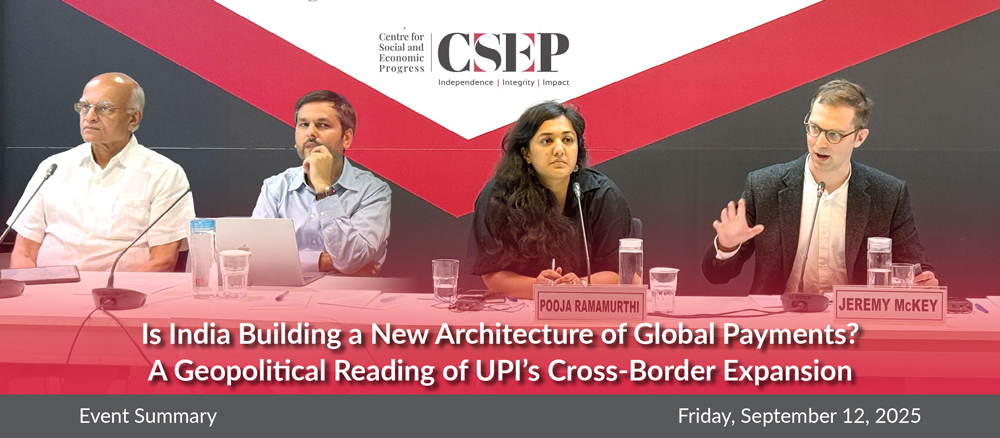
- The Centre for Social and Economic Progress hosted the 35th edition of its Foreign Policy and Security Tiffin Talk series on “Is India Building a New Architecture of Global Payments? A Geopolitical Reading of UPI’s Cross-Border Expansion” with Jeremy McKey, Policy Fellow, Allen Lab for Democracy Renovation, Harvard Kennedy School.
- The discussion contrasted Western financial dominance embedded in legacy payment infrastructures with India’s pursuit of fintech sovereignty through the Unified Payment Interface (UPI). It highlighted UPI’s evolution from a domestically driven inclusion tool to a strategic instrument shaping cross-border economic interdependence.
- Despite challenges pertaining to interoperability, transparency, and liability, the discussion concluded that embedding payment infrastructure within broader strategic planning and bidirectional, rules-based integration is essential for India’s resilient financial autonomy.
- The discussant for the seminar was Kunal Raj Barua, Senior Manager, Aapti Institute. The talk was moderated by Pooja Ramamurthi, Fellow, CSEP.
- The discussion included participants from embassies, media, academic institutions, and think tanks from India and abroad.
- This series of closed-door research seminars is curated by Constantino Xavier and Shivshankar Menon. It focuses on contemporary, evidence-based research with policy relevance to bridge Delhi’s scholar-practitioner divide.
Adoption and Internationalisation of UPI
Cross-border transactions are a complex web, which traditionally rely on correspondent banks, clearing houses, and messaging systems such as the Society for Worldwide Interbank Financial Telecommunication (SWIFT). Western countries have repeatedly leveraged this financial infrastructure to achieve geopolitical outcomes, demonstrating that it is not neutral. The development of indigenous payment systems must be seen not merely through the lens of economic efficiency, but as a strategic asset to reduce reliance on foreign-dominated networks.
In this context, India’s push to internationalise UPI has been supported by practical drivers such as remittances, tourism, and inter-regional and intra-regional competition. The UPI has been subsidised and promoted by the Indian Government, with the Prime Minister linking UPI to national strength. UPI’s expansion has the possibility to displace traditional financial incumbents, with the primary “losers” likely to be credit card networks (Visa, Mastercard) and money transfer organisations which rely on high fees. Correspondent banking networks also face disruption although banks are expected to retain a foundational role by providing necessary liquidity for real-time settlements and cross-border clearing obligations.
The discussant pointed out that the origins of UPI were primarily domestic rather than geopolitical, as it focused on financial inclusion and reducing transaction costs. Noting that India has shifted to negotiating the terms of its economic interdependence in a more sophisticated manner, a participant highlighted India exporting a “closed system” – one governed by standards and rules set by the government and public institutions. This contrasts with the fragmented, proprietary systems dominated by private firms (Visa, Mastercard). The Indian model provides the blueprints and guardrails which can be adapted to develop local solutions for the Global South while recipient countries retain sovereignty over the implementation of UPI.
While the internationalisation of UPI delivers economic efficiencies (lower costs, faster payments, improved access), control over payment infrastructure is inherently strategic and can create new forms of dependencies and risks. In a multipolar era, the ability to maintain independent financial corridors is increasingly viewed as a component of national security.
Different Models for Adopting UPI
The discussion emphasised that there is no single template for cross-border UPI adoption. As a case in point, 2024 was characterised by a wide diversity in integration models. These models could generally be categorised as substantive and symbolic. The Singapore Model, established in 2023, is an example of a substantive model, involving an interlinked fast payment system with a centralised liquidity corridor allowing for seamless, real-time international transfers.
Meanwhile, the France Model was cited as symbolic. The partnership with France in 2024 was described as experimental and involved a limited partnership between the National Payments Corporation of India (NPCI) and French fintech Lyra, which incurs higher costs associated with credit risk and is viewed as “mostly branding”.
A hub and spoke trend emerges from India’s UPI strategy, where India, along with Thailand, Malaysia and Singapore, is emerging as a key hub for cross-border retail payment linkages. However, discussants noted that compared to China’s advanced integration, India’s current footprint resembles a hub or star with fewer active spokes.
Challenges to UPI’s Cross-border Adoption
Simultaneously, there has been a pivotal shift from bilateral agreements to multilateral initiatives. One such initiative is Project Nexus, which is hosted in Singapore and expected to go live in 2026. It aims to interlink domestic instant payment systems globally. However, there is limited evidence and data available regarding the specific terms of these agreements, making this sector an opaque policy arena. One of the participants resonated with this point and highlighted a large gap between policy, practice and research knowledge. It was argued that while the financial network is lucrative, it is characterised by a lack of transparency, and the consequences of these shifts are still unknown or underrated.
True interoperability needs to be bidirectional. It is not enough for Indians to use UPI abroad. Partner countries must also be able to use their systems within India to create a truly vibrant network. As the network grows due to network externality, the need to ascertain the liability of the NPCI and other partners becomes paramount, particularly in cases of fraud or data breaches.
India is actively building a new architecture for global payments driven by a convergence of geopolitical ambition and economic necessity. By leveraging UPI, India is carving a niche for itself as a middle power capable of reshaping global infrastructure. However, as a participant pointed out, moving forward, the fragmentation of payment systems raises complex questions about the global order. The challenge will be to balance the pursuit of sovereignty with the need for transparent governance and seamless technical interoperability.






The Centre for Social and Economic Progress (CSEP) is an independent, public policy think tank with a mandate to conduct research and analysis on critical issues facing India and the world and help shape policies that advance sustainable growth and development.