
Taking Electricity Pricing From Insanity and Irrationality to Equity and Efficiency
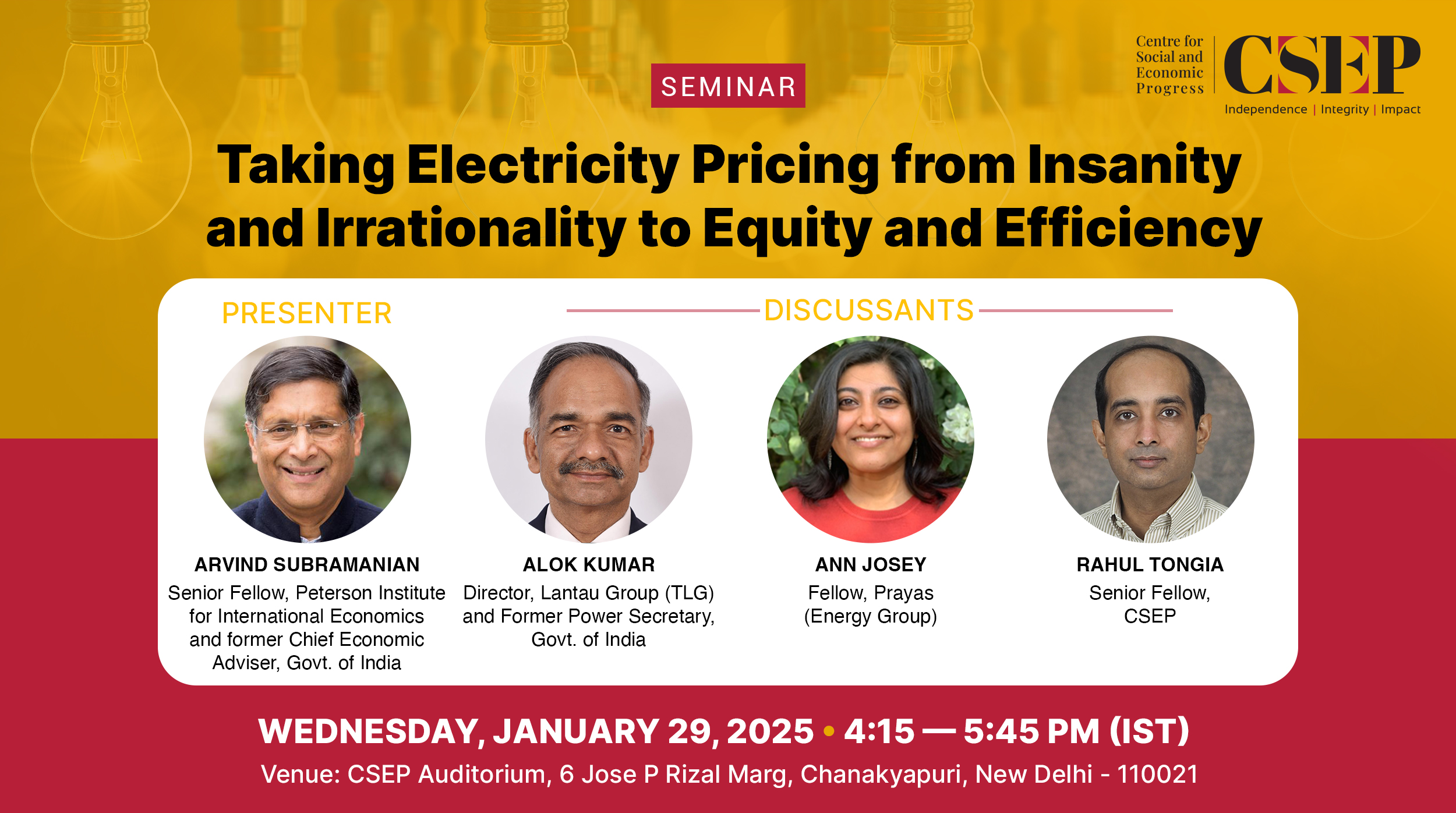
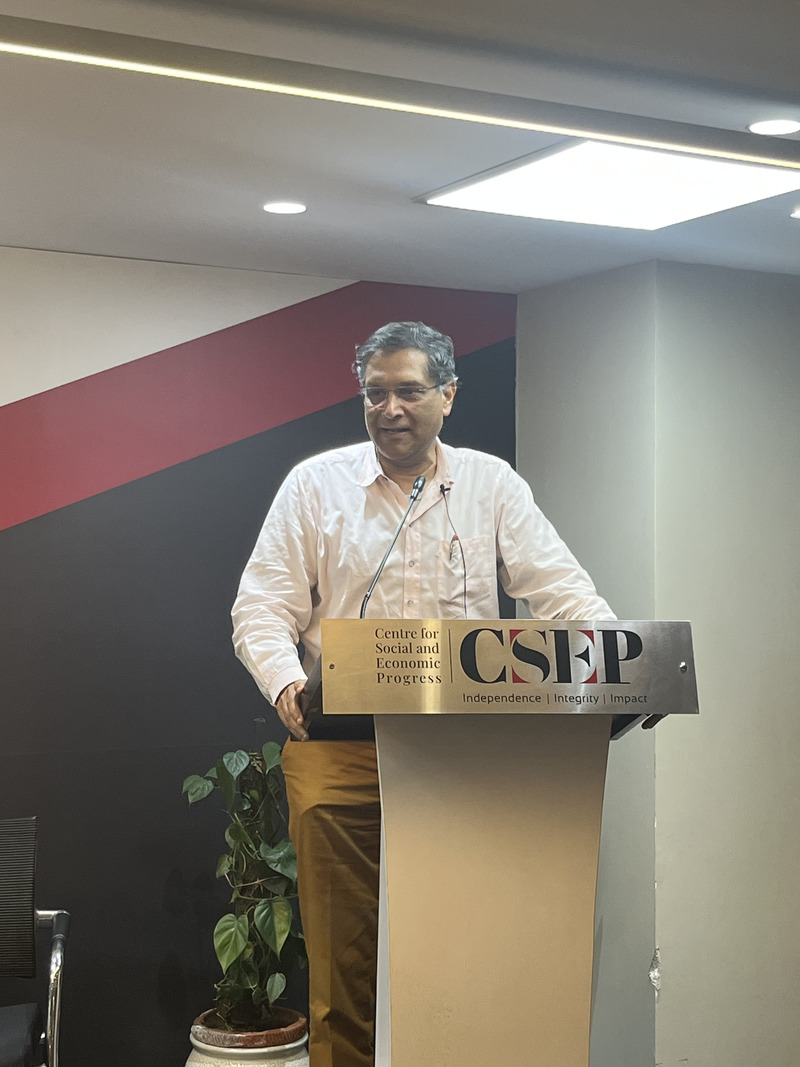
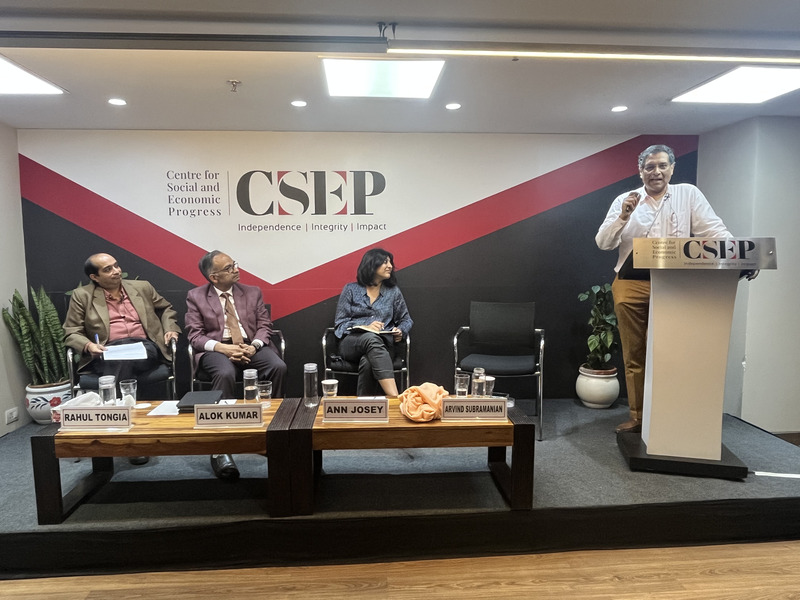
The Centre for Social and Economic Progress (CSEP) hosted a seminar titled “Taking Electricity Pricing from Insanity and Irrationality to Equity and Efficiency” on Wednesday, January 29, 2025.
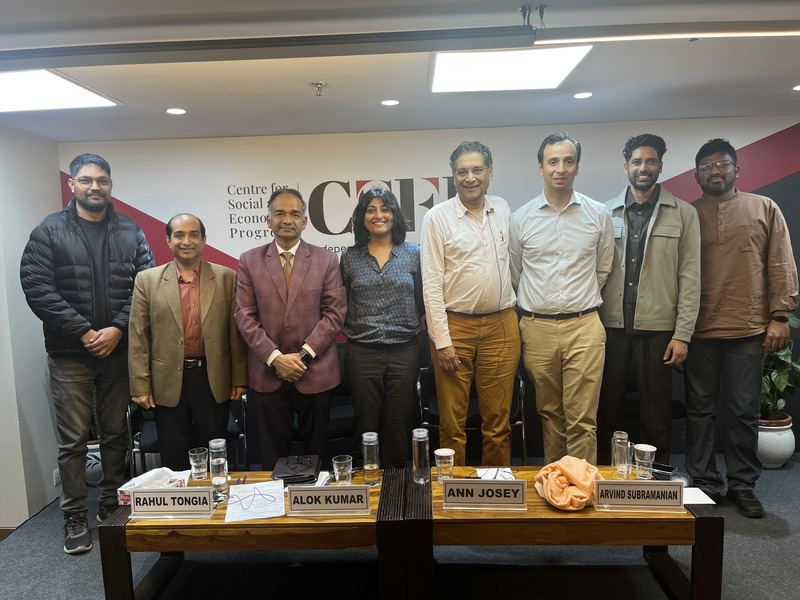
The seminar featured a presentation by Arvind Subramanian, Senior Fellow, Peterson Institute for International Economics and former Chief Economic Adviser, Govt. of India, based on his joint work with Navneeraj Sharma, Abhishek Anand and Praveen Ravi. This was followed by a discussion with Alok Kumar, Director, Lantau Group (TLG) and Former Power Secretary, Govt. of India; Ann Josey, Fellow, Prayas (Energy Group); and Rahul Tongia, Senior Fellow, CSEP.
About the event
India’s power distribution sector has faced persistent financial distress for decades, prompting repeated bailouts and (mostly failed) reform attempts. A key problem is electricity pricing. Even allowing for some equity and populism in pricing, the current system is deeply flawed. Taking account of broader changes that have occurred in the economy, including globalisation, the availability of more fiscal instruments, and the push toward renewables, we advance five principles that should guide pricing: radical simplicity, nobody paying for the inefficient cost of supply, everybody (except the poor) paying for efficient cost; nobody paying to compensate for subsidies to the poor; and prices reflecting efficient costs (even temporally). We provide evidence in favour of these principles and highlight the costs of deviating from them. The Centre may need to provide sticks and carrots to nudge all state regulators to adopt these principles which would enhance India’s competitiveness, reduce financial strains in the Discoms, and accelerate the renewables transition.
Presenter
Arvind Subramanian
Arvind Subramanian, Senior Fellow at the Peterson Institute for International Economics, has been associated with the Institute since 2007. He was the Dennis Weatherstone Senior Fellow at the Institute during 2013–14 and was on leave for public service from 2014 to August 2023.
Previously, he was Senior Fellow at the Watson Institute for International and Public Affairs at Brown University, Distinguished Non-resident Fellow at the Center for Global Development, Professor at Ashoka University, New Delhi, and Visiting Lecturer at the Harvard Kennedy School. He served as the Chief Economic Adviser to the Government of India between 2014 and 2018. He currently advises the Government of the Indian state Tamil Nadu on macroeconomic and sectoral issues.
As Chief Economic Adviser during 2014–18, Subramanian oversaw the publication of the annual Economic Survey of India, which became a widely read document on Indian economic policy and development. For example, the 2018 Survey had 20 million views from over 190 countries in its first year of publication. Major initiatives carried out during his tenure included a uniform nationwide goods and services tax (GST), a bankruptcy code to tackle the Twin Balance Sheet challenge, a financial and digital platform for connectivity (the so-called JAM trinity), and universal basic income schemes.
While at the Institute, Subramanian wrote two critically acclaimed books: Eclipse: Living in the Shadow of China’s Economic Dominance, published by PIIE in September 2011, and India’s Turn: Understanding the Economic Transformation, published by Oxford University Press in 2008. Foreign Policy magazine named him one of the world’s top 100 global thinkers in 2011. He has written extensively for many academic journals on growth, trade, development, aid, India, Africa, and the World Trade Organization. His op-eds and essays have been cited and published in the Economist, Financial Times, Foreign Affairs, Washington Post, New York Times, Wall Street Journal, Newsweek, New York Review of Books, and the Business Standard, and he is a regular columnist for Project Syndicate.
Before joining PIIE, Subramanian was the Assistant Director in the research department of the International Monetary Fund. He served at the General Agreement on Tariffs and Trade (GATT) from 1988 to 1992 during the Uruguay Round of trade negotiations and previously taught at Harvard University’s Kennedy School of Government and Johns Hopkins School for Advanced International Studies.
He obtained his undergraduate degree from St. Stephens College, his MBA from the Indian Institute of Management at Ahmedabad, and his MPhil and DPhil from the University of Oxford.
Discussants
Alok Kumar
Alok Kumar is a Director at Delhi with The Lantau Group (Singapore) Pte Ltd. In addition, he is Professor of Practice in the Department of Hydro and Renewable Energy at IIT Roorkee , and also chairs the Inter-Ministerial Working Group set up by NITI Aayog to develop a power sector pathway to achieve Net Zero commitment by India. Until recently he was Power Secretary, Government of India.
He had a 35-year long career in public policy and economic development in India’s premier federal civil service (IAS), reaching the distinguished position of Secretary in the National Government with extensive experience in the electricity, renewable energy, energy transition, infrastructure development and skill development domains. He has led several large commercial organisations as CEO. He played a key role in the formulation and implementation of several national/state-level policies, programmes and regulatory interventions. He successfully managed the operations of one of the largest power systems in the world, along with steering wide-ranging sectoral reforms. He has a deep understanding of global energy transition aspects as Chair of the G20 Energy Transitions Working Group.
Ann Josey
Ann Josey is a Fellow at the Prayas (Energy Group). She works on electricity policy and regulations at the national level and in various states. She is a recognised expert on distribution companies, tariff and subsidy design, electricity markets, rural electrification and various elements of the energy transition. She works closely with central, state governments, regulatory commissions, and civil society organisations towards improving sector governance, regulation, protecting consumer interests, and understanding energy transitions.
Rahul Tongia
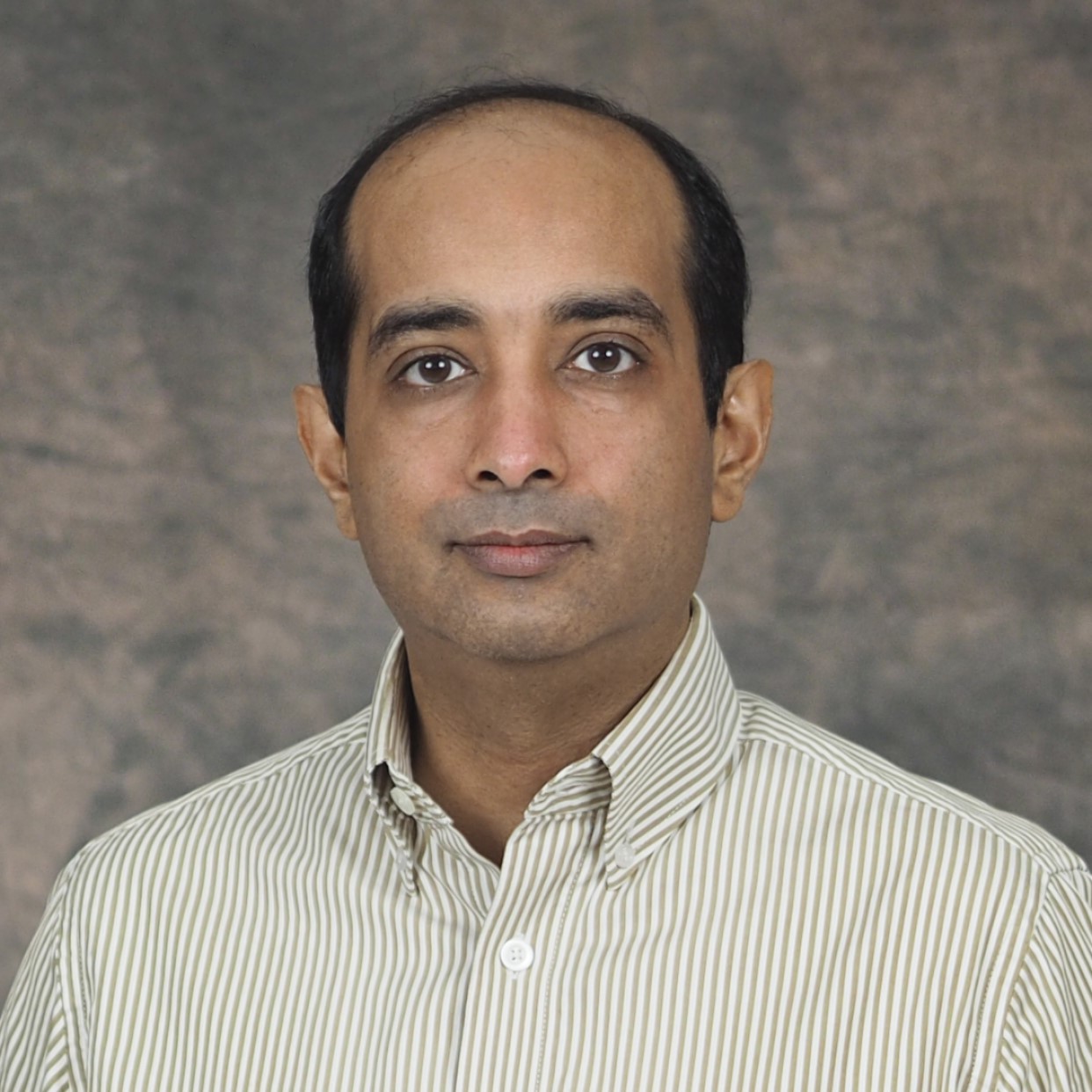
Rahul Tongia is a Senior Fellow with CSEP in New Delhi, where his work focuses on technology and policy, especially for sustainable development. He co-leads the Energy, Natural Resources, and Sustainability group at CSEP, and is also active in broader issues of technology. Tongia’s work spans the entire gamut of energy and electricity, with focuses on supply options including renewable energy (covering finance, grid integration, etc.); smart grids, which use innovative information and communications technology to improve management of the electric utility grid; issues of access and quality; and broader issues of reforms and regulations, including electricity and energy pricing. Another thread of his work focuses on climate equity and the energy transition. His book Future of Coal in India: Smooth Transition or Bumpy Road Ahead (2020) was awarded a Top Energy Policy Book to read in 2021 by BookAuthority.
He was a pioneer in establishing the Smart Grid space in India and was Technical Advisor of the Government of India’s Smart Grid Task Force, and remains Founding Advisor of the India Smart Grid Forum (ISGF). He was also on the Technology Advisory Board 2005-2008 for Southern California Edison’s award-winning smart grid rollout. He is also a Fellow of the Indian National Academy of Engineering.
Rahul Tongia is a non-resident Senior Fellow at the Brookings Institution and also Adjunct Professor at Carnegie Mellon University, having originally joined the faculty at CMU in 1998. Previous roles include Vice-Chair of the UN ICT Task Force Working Group on Low-cost connectivity-access/enabling environment and Member of the World Economic Forum’s Global Futures Council on Advanced Energy Technology.
All content reflects the individual views of the speakers. The Centre for Social and Economic Progress (CSEP) does not hold an institutional view on any subject.
Please contact Gurmeet Kaur at GKaur@csep.org for general queries and Ayesha Manocha at AManocha@csep.org for media queries.
To register for this event please visit the following URL: https://forms.gle/rg5ALkgYSeZSYGB26 →
Date & Time
04:15 PM to 05:45 PM
Location
Event Type
Event Category
Contact Person
Gurmeet Kaur
GKaur@csep.org
Presenter(s)
Arvind Subramanian
Discussant(s)
Alok Kumar
Ann Josey
Rahul Tongia
Moderator(s)
Rahul Tongia


The Centre for Social and Economic Progress (CSEP) is an independent, public policy think tank with a mandate to conduct research and analysis on critical issues facing India and the world and help shape policies that advance sustainable growth and development.