
How Cross-Border Connectivity Infrastructure is Reshaping Indian and Chinese Strategies in Post-Coup Myanmar
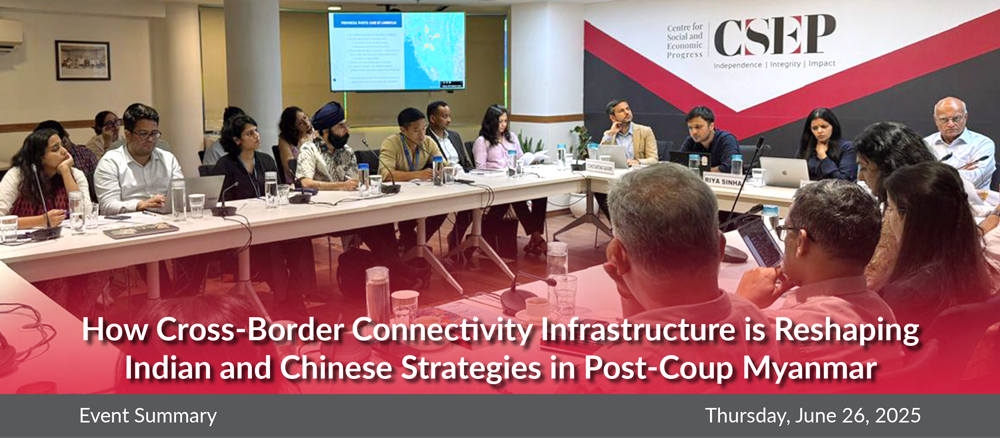
- The Centre for Social and Economic Progress hosted the 34th edition of its Foreign Policy and Security Tiffin Talk series on “How Cross-Border Connectivity Infrastructure is Reshaping Indian and Chinese Strategies in Post-Coup Myanmar” with Angshuman Choudhury, PhD candidate in Comparative Asian Studies, National University of Singapore & King’s College London.
- The presentation focused on how cross-border infrastructure projects are reshaping the strategic priorities and diplomatic approaches of India and China following the 2021 military coup in Myanmar. Amid Myanmar’s turbulent landscape, both countries are increasingly engaging with ethnic armed groups in the northern and western regions to protect their interests, while also leveraging these groups to strengthen their influence within the country. The presentation aimed to illustrate how such infrastructure initiatives can simultaneously enhance and limit the strategic manoeuvrability of regional powers—providing leverage over frontier actors while also empowering those same groups to assert influence in regional geopolitics.
- The discussion included participants from Indian government institutions, the Indian military, various foreign diplomatic missions and embassies, media, academic institutions and think tanks from India and abroad.
- The lead discussants were Shivshankar Menon, Distinguished Fellow, and Riya Sinha, Associate Fellow, CSEP. The talk was moderated by Constantino Xavier, Senior Fellow, CSEP.
- These series of closed-door research seminars are curated by Constantino Xavier and Shivshankar Menon. It focuses on contemporary, evidence-based research with policy relevance to bridge Delhi’s scholar-practitioner divide.
Myanmar’s Political Geography
Before 2021, the political landscape of Myanmar was partly fractured, but fairly uncomplicated. While small stretches were controlled by armed groups, majority of Myanmar was under the control of the Naypyidaw-based government. However, the internal conflict after the 2021 military coup has transformed Myanmar’s political landscape, including the Bamar heartland. Over four years, resistance forces – Ethnic Armed Organisations and the People’s Defence Forces – have gradually taken control over vast territories in peripheral areas, making them crucial to the political-strategic interests of Myanmar’s neighbours.
This political development has implications for India and China, who have significant investments in Myanmar. New Delhi has the Kaladan Multi-Modal Transit Transport Project (KMMTTP), which connects the Sittwe Port in Myanmar to the India-Myanmar border, providing a strategic link to North-East India. Similarly, the China Myanmar Economic Corridor (CMEC) connects the Yunnan Province in China through Muse and Mandalay to the seaport city of Kyaukpyu in Rakhine State. The speaker highlighted that both initiatives are currently operating in a vastly altered landscape. While China has struggled to maintain control over the CMEC, India is facing severe challenges in resuming the KMMTTP.
Given the high stakes involved in the continuation of these two projects, the speaker noted that India and China are currently working their way around the new ground realities. India has reached out to the Arakan Army, the Chin National Front and the Chin Brotherhood at the national and subnational levels to negotiate the continuation of the KMMTTP. This outreach has been more prominent after Operation 1027, a coordinated anti-junta military offensive conducted by the Arakan Army, Myanmar National Democratic Alliance Army and Ta’ang National Liberation Army that began in October 2023. New Delhi has also started building bridges with these groups to preserve its interests and footprint in the contested frontiers. While China was already engaging ethnic armed groups before the 2021 coup, it has signed a security agreement with the junta in Myanmar to establish a joint security company to protect Chinese assets and personnel. Beijing has also brokered ceasefire deals with warring sides in Myanmar, demonstrating its leverage over multiple factions. The speaker also highlighted how China is engaged in strategic diplomacy with the two key warring sides – the Junta and the Ethnic Armed Organisations – using a mix of inducements and coercion. While China’s support for conflict mediation is showcased through the facilitation of ceasefire meetings in Kunming and ceasefire supervision/monitoring in Lashio, its coercion is exemplified by the stoppage of civilian supplies and arms via the United Wa State Army.
Infrastructure Diplomacy
For India and China, the KMMTTP and CMEC guide large parts of their strategic posture in western and northern Myanmar, respectively. For both the countries, these projects offer a pivot to maintain and consolidate their strategic presence in Myanmar, leverage over the military regime in Naypyidaw and reinforce their spheres of influence. Meanwhile, for the Ethnic Armed Organisations, these infrastructure projects are central to deepening their own leverage over India and China in order to secure resources and financial pathways, gain an edge over the junta and attain regional relevance.
The discussion also focussed on how the CMEC and KMMTTP operate at multiple scales: national, subnational and regional. At the national level, these projects demonstrate national developmental and foreign policy aspirations of India and China. At the sub-national level, the projects are aimed at creating new economic networks and provide political-strategic leverage to provincial power centres of Yunnan and Mizoram. On the regional level, these projects create new interconnected geoeconomic networks that permit the smooth flow of goods and services across the Bay of Bengal region.
The speaker highlighted the competitive differential of the CMEC and KMMTTP. Prior to the coup, these projects demonstrated the Chinese and Indian strategic advantages in the larger Bay of Bengal sub-region, and in Myanmar. After the coup, the projects provided access to strategic frontiers and sub-national actors controlling them. As a result, the CMEC and KMMTTP can be viewed as parts of a larger competitive corridorisation push by regional powers to not only create exclusive transnational distribution networks, but also market access for landlocked underdeveloped frontiers and the central hinterlands.
Key Considerations for the Future
A participant highlighted that one of the key issues for future consideration is understanding the long-term sustainability of the cross-border infrastructure projects in a scenario of prolonged conflict or fragmented territorial control amongst varied ethnic armed groups. From a foreign policy paradigm, this would be beneficial in identifying the key actors that India could engage in the future to ensure the viability of its infrastructure projects in Myanmar.
The participants pressed a note of caution for policymakers, emphasising that there is a general tendency to overestimate the agency that India and China have in situations such as Myanmar. For instance, despite being armed by China, the Myanmar National Democratic Alliance Army and Ta’ang National Liberation Army often act independently. Similarly, a participant noted that it was easy for India to deal with Myanmar when the military controlled the Rakhine state. But, the ethnic armed groups that are currently on the rise exercise their own agency. This is exemplified with the Chin refugees crossing over into Mizoram. Understanding the agency that the ethnic armed insurgent groups wield would be important while dealing with Myanmar in the future.
The discussion concluded with a reflection on how subnational engagements may be leveraged to attain diplomatic goals. While sub-national actors (state governments) may exercise their own rights under the Indian constitution, there is need to give these actors some space to create their own pockets of influence. For instance, in the relationship between the Mizoram government and Myanmar, multifaceted factors can aid diplomatic leverage, including close ethnic tries, informal border trade and infrastructure development. Policymakers should become more inclusive and should not dismiss the role that such actors may aid in diplomatic outreach.





The Centre for Social and Economic Progress (CSEP) is an independent, public policy think tank with a mandate to conduct research and analysis on critical issues facing India and the world and help shape policies that advance sustainable growth and development.