
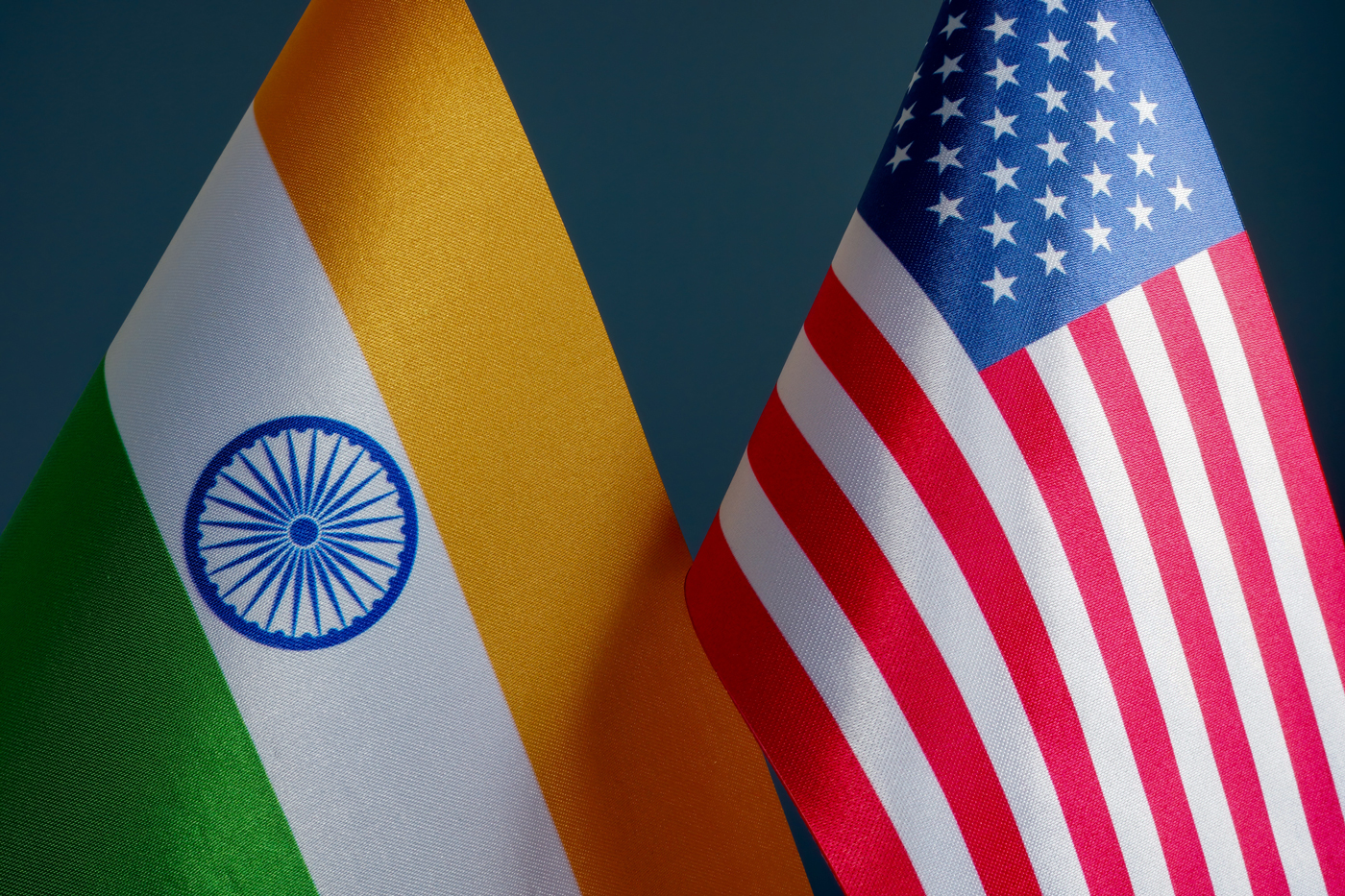
The Future of the India-US Partnership and the International Order
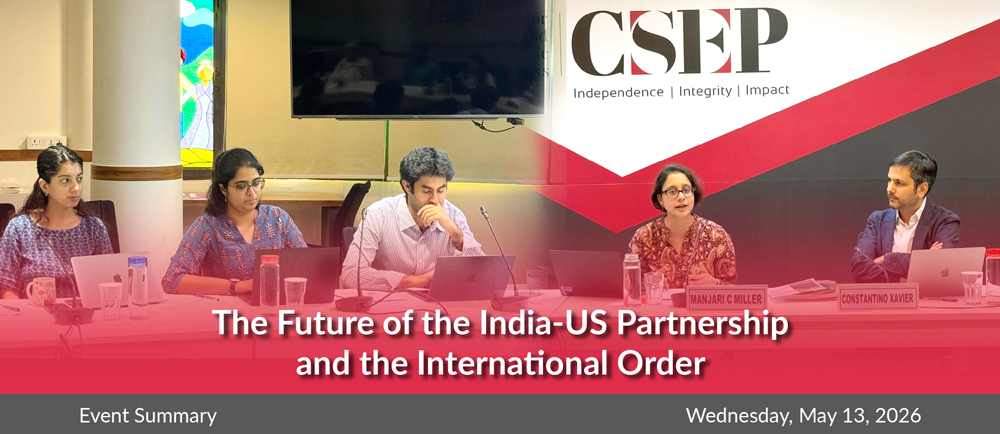
- The Centre for Social and Economic Progress hosted a closed-door roundtable with Manjari Chatterjee Miller, Senior Fellow, Council on Foreign Relations, on “The Future of the India-US Partnership and the International Order.”
- The discussion examined how India is interpreting a more fragmented global landscape, where the weakening of the old order is viewed not only with uncertainty but also as a moment of strategic possibility.
- Participants considered whether the India-US partnership remains a durable strategic bet, how technology and private-sector cooperation can sustain momentum, and how India should manage a more transactional, post-hegemonic international system.
The Centre for Social and Economic Progress was pleased to host Manjari Chatterjee Miller, Senior Fellow, Council on Foreign Relations, for a closed-door roundtable to inform ongoing research on the future of the India-US relationship and the liberal international order. Convening high-level experts across foreign policy, security, economics, technology, climate, and global governance, the discussion placed the bilateral partnership within a wider redistribution of global power. Participants examined how the relationship is being reshaped by a world in which the United States remains indispensable but less singular, China is increasingly assertive, Europe is searching for agency, and India is emerging as one of the principal poles in the international system. The conversation moved beyond whether India made a “good” or “bad” bet on Washington to ask how New Delhi can navigate a more fragmented order, protect strategic autonomy, diversify partnerships, and translate convergence into practical delivery across key sectors and regions.
The Old Order May Not Be Missed
The central context-setting theme of the discussion was that India’s response to the erosion of the liberal international order is not simply one of anxiety. While much of the Western debate frames the weakening of the post-war order as a crisis, the conversation suggested that New Delhi’s mood is more complex. There is concern about volatility, but there is also a sense that the old order did not consistently serve India’s interests, status or strategic autonomy. For India, the liberal international order was often experienced less as an open and equal system than as a hierarchy shaped by Western power, Western institutions and Western definitions of legitimacy.
This is why the emerging moment may be seen in Delhi as an opening rather than only a threat. India is not necessarily imagining a post-US world. It is imagining a post-hegemonic world in which the United States remains essential but no longer singular. The weakening of the old order creates space for India to act less as a rule-taker and more as one of several major poles shaping the rules, institutions and coalitions of the future. In this sense, the discussion captured a striking idea: things are changing, but perhaps not so much will be missed.
Participants noted that India’s long-standing emphasis on strategic autonomy, multipolarity and institutional reform now appears better suited to the emerging global environment. The decline of a single organising power may allow India to diversify its partnerships, deepen ties with Europe, Japan, Australia, the Gulf and Africa, and connect economic, security and technological statecraft more deliberately. The challenge is whether India can convert disruption into leverage without losing the benefits of its partnership with the United States.
Beyond Washington: Technology, Firms and Political Literacy
A second major theme was that the future of India-US cooperation may depend less exclusively on Washington and more on direct linkages between firms, investors, technology ecosystems and subnational or sectoral actors. Participants emphasised that if political trust becomes more brittle and formal government-to-government channels weaken, practical cooperation must continue through other routes. This is especially true in technology, where private-sector decisions, talent flows and commercial incentives often move faster than diplomatic frameworks.
The discussion highlighted the need for India to look beyond the Washington policy circuit and engage more deeply with Silicon Valley, private capital, technology companies and innovation networks. India US technology cooperation cannot rely only on leader-level alignment or national security bureaucracies. Middle-level, private-to-private and firm-to-firm channels need to be strengthened so that cooperation can continue even when political signals are unclear.
This requires better mutual understanding. Indian policymakers and firms need a more sophisticated grasp of how the US technology sector operates, where decisions are made, and how American companies assess opportunity and risk in India. At the same time, the conversation underscored that India needs to understand US domestic politics more seriously. Too much Indian analysis still treats US policy as a function of presidents alone, rather than of Congress, domestic coalitions, economic nationalism, local pressures and structural changes in American society.
The changing talent model was also identified as a potential source of opportunity. As more Indians working for US companies remain in India, and as India’s own technology ecosystem matures, the relationship may increasingly be shaped by distributed talent, global capability centres and cross-border innovation rather than traditional migration pathways alone. The implication is that the next phase of the India-US technology relationship may be built as much by engineers, firms and investors as by diplomats.
A Necessary but More Transactional Partnership
The third major theme was that India has not made a bad bet on the United States, but it must manage the relationship with greater realism. The United States remains central to India’s trade, technology, defence, investment and China-balancing strategies. Russia is not a viable substitute, and China remains adversarial despite areas of overlap on sovereignty, non-intervention and global governance reform. The structural case for the India-US partnership, therefore, remains strong.
Yet participants also emphasised that the relationship is becoming more transactional, more sector-specific and more exposed to domestic politics. US unilateralism, tariff threats, immigration pressures, industrial policy, climate divergence and uncertainty over strategic commitments all complicate the partnership. Even where interests converge, trust can lag behind. The risk is not that the relationship collapses, but that political trust weakens while practical cooperation continues unevenly across select sectors.
This makes implementation the central test. Defence, critical minerals, supply chains, technology and Indo-Pacific cooperation may continue to advance, but the partnership’s credibility will depend on whether strategic convergence can be converted into concrete delivery. Participants stressed that rhetoric should not outrun capacity. The relationship is strongest when it is managed pragmatically, with clear expectations, guardrails and a willingness to cooperate where interests align while hedging where uncertainty persists.
The conversation also pointed to a broader tension in India’s worldview. On many questions of international order, including sovereignty, intervention, institutional reform and development, India may share more with other non-Western powers than with the United States. But on security, technology and the China challenge, the United States remains indispensable. India’s task is therefore not to choose between alignment and autonomy, but to manage both at once.
Conclusion
The roundtable concluded with a clear sense that the India-US partnership remains essential but is entering a more demanding phase. India is not walking away from the United States, nor is it simply mourning the old order. It is preparing for a more fragmented, multipolar and transactional world in which American power still matters greatly but no longer structures India’s strategic imagination alone. The future of the partnership will depend on whether both countries can move beyond crisis management and convert shared interests into sustained delivery across technology, defence, trade and regional cooperation.



The Centre for Social and Economic Progress (CSEP) is an independent, public policy think tank with a mandate to conduct research and analysis on critical issues facing India and the world and help shape policies that advance sustainable growth and development.