

How Indian Diplomats Navigate National Climate Ambitions
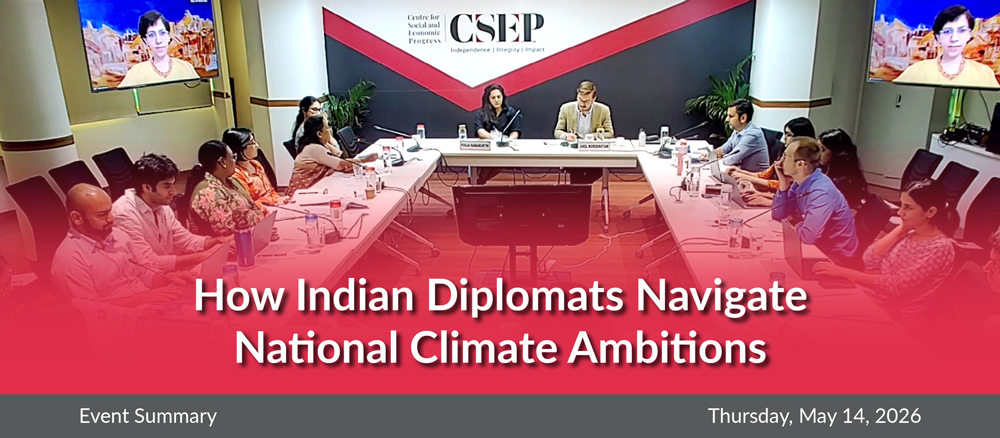
- The Centre for Social and Economic Progress (CSEP) hosted its 40th Foreign Policy and Security Studies Tiffin Talk on How Indian Diplomats Navigate National Climate Ambitions with Axel Nordenstam, Associate Fellow at the Swedish Institute of International Affairs’ Asia.
- The event featured a discussion on the presenter’s findings from his PhD dissertation, India’s Green Status Dilemma: A Practice Approach and examined how Indian Foreign Service (IFS) officials navigate the tensions created by India’s climate leadership ambitions across multilateral and bilateral diplomatic arenas.
- The discussant was Amrita Narlikar, Distinguished Fellow, Observer Research Foundation (ORF) and Honorary Fellow, Darwin College, University of Cambridge. The talk was moderated by Pooja Ramamurthi, Fellow, CSEP.
- The participants included representatives from the diplomatic community, think tankers and scholars from research institutes and universities in India and abroad.
Status Dilemmas in Everyday Diplomatic Practice
The presenter opened by framing the central puzzle of his dissertation: How do dilemmas inherent in India’s green ambitions manifest themselves in the everyday practices and social interactions of the IFS? And how do these manifestations shape the ways in which the IFS represents and advances India’s climate foreign policy at home and abroad? The hypothesis presented the concept of the “status dilemma”, described as a condition arising when a country’s bid for recognition and prestige on the global stage creates pressures it cannot fully manage. Including cases where, claiming leadership invites as much scrutiny and pushback as it does acceptance. He discussed how this dilemma is tackled behind the scenes in “engine rooms” where decisions are made by government officials, and how these decisions then play out in international negotiations. His research drew on three empirical arenas (1) the United Nations (UN) climate negotiations (Conference of Parties (COP)27 and COP28), (2) India’s G20 presidency, and (3) the lead-up to the India-European Union (EU) Summit. He traced recurring tensions, described as (1) epistemic tensions (expertise and knowledge are contested), (2) normative tensions (ideas of legitimacy collide), and (3) recognition tensions (status claims are sought, withheld, or withdrawn).
Deepening the Analysis
The discussion broadly welcomed the practice-theory approach of the research while pushing the analysis in several directions. Highlighting the importance and rarity of studies that focused on the micro-level social world of Indian diplomacy, the discussant noted that the framework of status dilemmas has the potential to be applied to other issue areas, with trade politics being a natural extension.
On the G20 presidency chapter, which was the focus area of the talk, conversation pressed for greater attention to the motivations behind India’s extensive stakeholder outreach. An example highlighted the T20 working group on Lifestyle For Environment (LiFE), which was highly participatory and reached both national and international actors. It pressed on the question of whether this was primarily a soft power exercise or reflected harder strategic reasons for building domestic buy-in across India. The discussant suggested this distinction mattered for the analysis. The discussant pushed for the research to go deeper on how different actors understand and justify climate policy. Different ministries have their own set of priorities, which often clash when India tries to form a unified position. The discussant also highlighted the significance of traditional Indian knowledge systems as both an epistemic and normative resource. The invocation of Vasudeva Kutumbhakam, a non-anthropocentric philosophical concept, was cited as an example of India deploying indigenous ideas to justify its climate leadership on its own terms.
The discussant also raised the question of the material stakes of status-seeking, not just the diplomatic costs of backlash, but the real developmental trade-offs involved. Whether these costs are separable from India’s climate positioning, or whether they are in fact one and the same dilemma, was flagged as something further research might explore.
History, Hierarchy, and Indian Climate Realism
The discussion highlighted the evolution of India’s engagement with climate multilateralism. The early COP years were described as a relatively low-key affair for India, with negotiations largely conducted at the director level. The G77 was the dominant forum, within which the Organization of Petroleum Exporting Countries (OPEC) bloc held considerable sway alongside small island developing states (SIDS). COP8, held in Delhi, was recalled as a formative moment. It witnessed a significant uptick in stakeholder engagement involving both the Ministry of External Affairs (MEA) and the Ministry of Environment, Forests and Climate Change (MoEFCC). The limited ministerial outreach to communities most affected by climate change was also noted. It was suggested that the real shift in India’s approach came when the United Kingdom (UK) used its G8 presidency to elevate climate as a central agenda item.
The discussion noted that while India is often portrayed as an obstructionist actor in climate negotiations, the reality is that India pursues more ambitious domestic climate policies than many of its critics. The presenter noted that this tension, between how India is perceived abroad and what it is actually doing at home, is itself a manifestation of the status dilemma and several audience members felt it deserved even greater prominence in the analysis. One participant noted that smaller countries often look to India to signal their own positions, making the stakes of India’s diplomatic choices higher than they might appear from a purely bilateral lens.
One participant argued against assuming the desirability and importance of specialised sector expertise. Suggesting that the generalist culture of the IFS – whereby a diplomat works across trade, security, and climate – may in fact produce more integrated thinking than siloed expertise would allow.
Implications and Future Directions
Several participants suggested that as climate becomes an increasingly domestically-owned agenda rather than an externally imposed one, the dilemma may shift in character rather than diminish. Many suggested that it would evolve as India’s developmental priorities evolved.
On future research directions, the conversation pointed toward applying the status dilemma framework more broadly (a) to other countries facing similar pressures, and (b) to other issue areas such as trade, where recognition politics and normative contestation operate along similar lines. The material benefits of status-seeking, such as access to climate finance, greater influence in multilateral negotiations and a stronger seat at the table in global governance, were also identified as underexplored terrain that could productively extend this line of work.




The Centre for Social and Economic Progress (CSEP) is an independent, public policy think tank with a mandate to conduct research and analysis on critical issues facing India and the world and help shape policies that advance sustainable growth and development.