
Resource Mobilisation for Climate Action in India: Possible Sources
Reading Time: 5 minutesDOWNLOADS
Executive Summary
Financing climate action has emerged as one of the most critical policy challenges for emerging market economies, including India. India submitted its first Nationally Determined Contribution (NDC) in 2016 and announced its commitment in 2021 to achieve net-zero by 2070. In its updated NDC in March 2026, India has committed to achieve 60% of cumulative installed electric power capacity from non-fossil fuel sources by 2035, reduce the emissions intensity of its gross domestic product (GDP) by 47% by 2035 from 2005 levels, and create an additional carbon sink of 3.5 to 4 billion tonnes of CO₂ equivalent through additional forest and tree cover by 2035. Achieving these goals will require mobilising large financial resources. While several studies have estimated India’s climate finance requirements, hardly any study has examined whether these requirements can be met from the economy’s projected resource availability under a business-as-usual (BAU) scenario, and whether additional savings will be required to finance climate action without crowding out investment in other sectors.
The study addresses this gap. It comprehensively examines all possible sources of funding, domestic and external, within a macroeconomic framework under different scenarios for financing climate mitigation action in India. Though the resource needs are estimated for four sectors—power, road transport, steel, and cement—up to 2030, the framework can be applied to different levels of climate finance requirements.
Climate finance requirements estimated by Raj and Mohan (2025) were US$467 billion for 2022–2030 (annual average of US$54 billion or 1.3% of GDP, annually) for four sectors—power, road transport, steel, and cement. While the overall climate finance requirement remains broadly the same at US$455 billion for the period 2025–2030, it will now have to be met in fewer years, thus increasing the annual requirement to US$91 billion or 1.5% of GDP.
This study focuses on two aspects. First, given that external climate finance is a critical component of India’s climate financing strategy, the study examines the climate finance needs that can be met by external sources without impinging on macroeconomic stability. Second, the study examines whether the projected domestic savings under alternative scenarios can meet the climate finance needs without crowding out investment in other sectors, and if not, how much additional savings would be required.
Key Findings
External Climate Finance
The study estimates that India’s current account deficit (CAD) can be expanded up to 2.5% of GDP without impinging on its sustainability. Compared to the BAU annual average CAD estimate of 2.0% of GDP during 2025–2030, this implies an additional headroom of 0.5% of GDP annually for external climate finance flows. Within this absorptive capacity, multilateral development banks (MDBs) are projected to provide climate mitigation finance of 0.2% of GDP annually, leaving a headroom of 0.3% of GDP to absorb climate finance from other external sources.
Domestic Climate Finance
After accounting for 0.5% of GDP from external sources, the remaining financing gap of 1.0% of GDP will need to be met domestically. Climate finance represents additional investment over and above BAU investment. A straightforward solution could be to raise the domestic saving rate commensurately to avoid crowding out of other sectors. However, in practice, saving and investment decisions differ across the household, private corporate, and government sectors, which together shape the overall saving–investment (S-I) gap in the economy. To assess the overall S-I gap, including the gap for climate action, the study, therefore, analyses S-I behaviour across all three sectors. While this study examines how different instruments could help fund climate action if the saving rate rises, its broader focus is on the economywide S-I behaviour up to 2030, which will show how far climate finance needs can be met from existing resources and how far additional savings are required to avoid crowding out of other productive sectors.
If climate finance needs are met by additional household saving of 1.0% of GDP, it would translate into government securities (0.36% of GDP), equity and bonds (0.34% of GDP), and bank credit (0.29% of GDP, of which 0.11% of GDP will be through priority sector lending).
However, in practice, there is constant interplay between saving and investment among the three sectors, viz., household, corporate, and government. The study, therefore, assesses the economy wide ex-ante S-I gap in the BAU scenario up to 2030 based on the interplay of saving and investment behaviour of all three sectors. For this purpose, the study considers three scenarios, distinguished largely by varying degrees of revival in private corporate sector investment.
In Scenario 1, domestic saving is estimated to exceed investment, including the climate finance requirement, by 0.6% of GDP. This scenario assumes that the private corporate capital expenditure (capex) will revive moderately by 20% annually during 2025–2030, which is half the growth rate observed in private capex during the last robust cycle of 2003–2008.
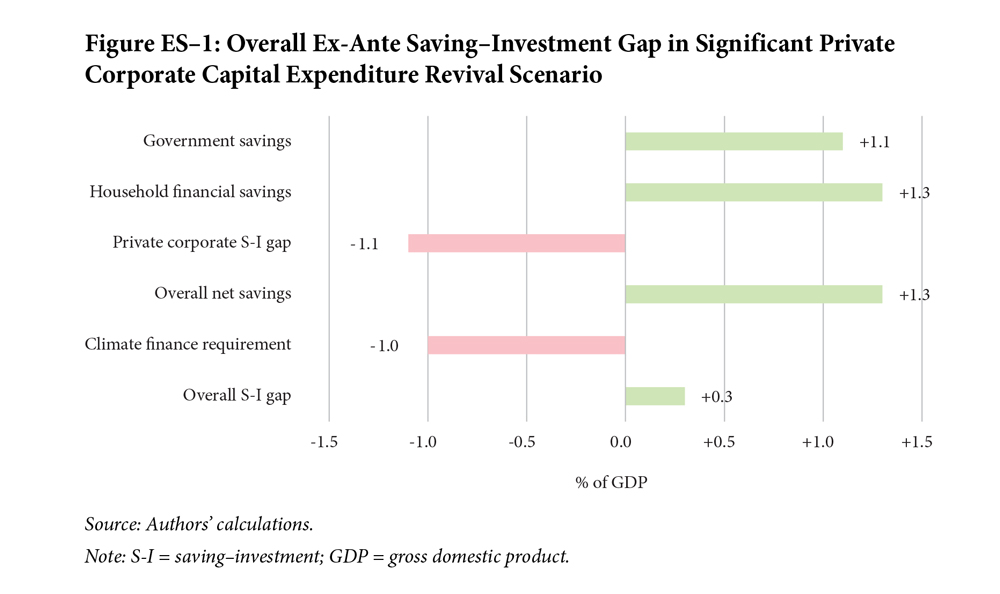
In Scenario 2 as well, domestic saving is estimated to exceed investment, leaving a surplus of 0.3% of GDP even after financing climate action (Figure ES–1). In this scenario, it is assumed that the private corporate sector’s capex will pick up significantly, growing at an annual average rate of 25% during 2025–2030, which is about 62% of the growth rate in private capex observed during 2003–2008.
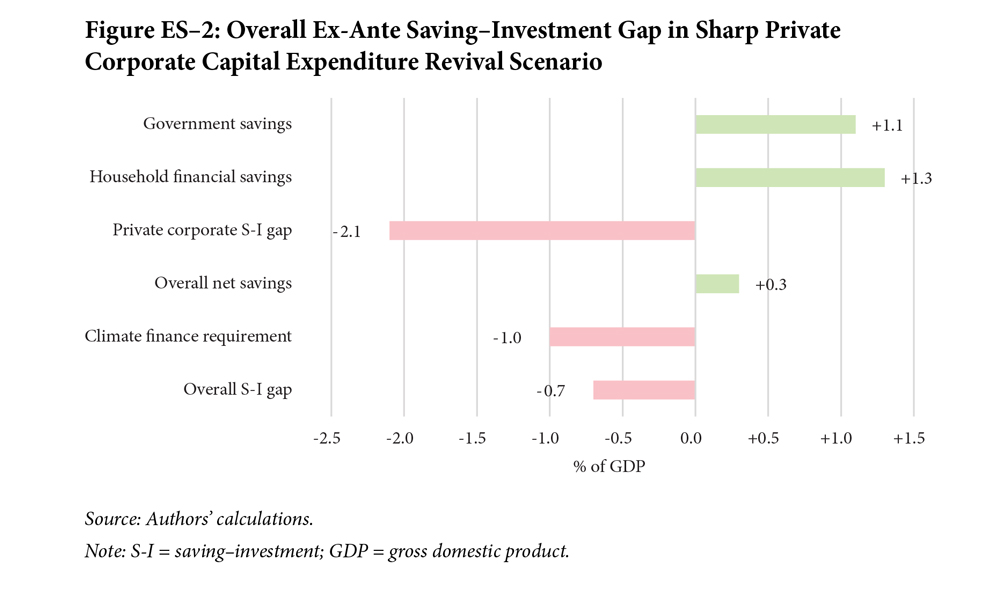
In Scenario 3, domestic saving will exceed investment in the BAU but is estimated to fall short of the climate finance needs by 0.7% of GDP (Figure ES–2). This scenario assumes that private corporate capex will revive sharply by 30% annually to peak at 16.8% of GDP by 2029–2030, which was the peak level of the private corporate capex cycle during 2003–2008. Thus, in this scenario, the saving rate will have to rise by 0.7% of GDP if crowding out of other sectors is to be avoided.
Policy Recommendations
In the case of a sharp revival of private corporate investment, there may be a need to raise the saving rate of the household sector such as by (i) deepening banking penetration; (ii) expanding social security network through life insurance policies and pension/provident funds; and (iii) improving post-tax returns on small savings. The availability of financial resources may also not automatically flow to climaterelated projects due to associated risks. Therefore, several policy interventions could be necessary to reduce such risks and mobilise private capital for climate action. These interventions, among others, could include the following:
- Ensuring policy certainty to reduce perceived risk associated with new and emerging technologies.
- Leveraging blended finance instruments to improve the risk–return profile of climate-related projects.
- Introducing a green equity framework.
- Augmenting lending capacity of development finance institutions (DFIs) engaged in climate action.
Janak Raj
Rakesh Mohan

Priti Dubey

Find on this page

The Centre for Social and Economic Progress (CSEP) is an independent, public policy think tank with a mandate to conduct research and analysis on critical issues facing India and the world and help shape policies that advance sustainable growth and development.