

Can India and Southeast Asia Find a New Economic Bridge Through Online Gaming?
Reading Time: 6 minutesWhen government officials sit at negotiating tables, they talk about trade, migration, geopolitics, and global public goods. But what if the next great diplomatic bridge is not just built in government ministries alone, but also in multiplayer virtual spaces, esports arenas and gaming studios?
Online gaming started as a simple recreational activity but has since connected billions of players around the globe, allowing them to meet, compete, transact, consume intellectual property (IP), and build communities and even careers. For India and Southeast Asia, online gaming presents a unique opportunity to forge cross-border people-to-people ties, operating entirely outside official diplomatic channels, largely at the grassroots level. What if governments, investors and policymakers could harness the potential of this unscripted cultural activity to make it a deliberate lever of economic cooperation?
India’s Gaming Landscape
India is home to 591 million gamers, roughly 20% of the global gaming populace and a gaming market worth USD 3.8 billion (FY2024). Following the 2025 government ban on real money games under the Promotion and Regulation of Online Gaming Act, the remaining market was restructured and valued at USD 1.5 billion in CY2025, consisting of in-app purchases (USD 0.76 billion), advertising revenue (USD 0.72 billion), and esports and other revenues (USD 0.05 billion). This figure is projected to nearly double to USD 3.2 billion by 2030, growing at a compounded annual growth rate of 17%.
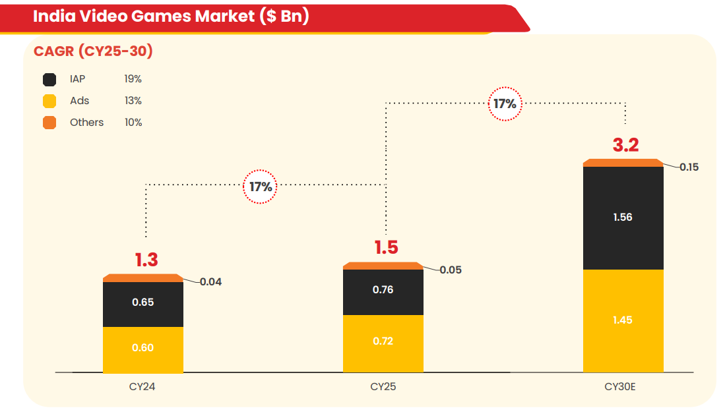
Source: Lumikai – State of Interactive Media Report 2025
Consumer expenditure on mobile gaming in India crossed USD 400 million in 2024, and in-game purchases account for 63.49% of the gaming revenue, but a significant share of this expenditure often flows out to foreign-owned games and overseas IP. Prime Minister Narendra Modi, in his 2024 Independence Day address, encouraged Indian youth and IT professionals to dominate the global gaming market with Make in India gaming products. This becomes an important consideration for policymakers now: How to strengthen domestic value creation within the Indian gaming ecosystem?
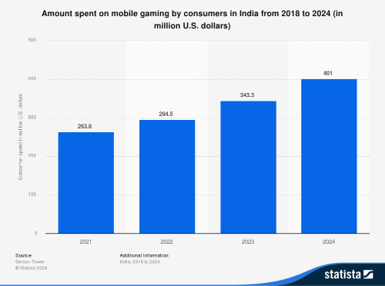
Source: Statista – Amount spent on mobile gaming by consumers in India (2018-2024).
Online gaming in India is expected to unlock around USD 63 billion in investor value by 2029 and create over two million jobs by 2034. About 2364 gaming startups in India, such as Zupee, WinZo, JetSynthesys, MPL and Nazara, have already raised a collective funding of more than USD 2.8 billion over the last five years, and the government has allowed 100% foreign direct investment in the sector. Moreover, the sector reportedly generated over 80,000 jobs till 2024 and is projected to create another 250,000 in the next decade.
The gaming sector in India did not grow overnight. Bigger than India’s entire domestic box office revenue of USD 1.48 billion in 2025, its success stemmed from gradual, organic growth. Young people started gaming as hobbies, and the COVID-19 lockdown added momentum to their digital careers. Content creators built massive online audiences, private organisers started running competitive tournaments, and with many games attracting huge fan bases, brands followed where the eyeballs went.
India’s gaming sector, when viewed through the lens of the Orange Economy, which recognises creative and cultural industries as drivers of economic growth, has immense potential to converge its domestic growth story with regional economic engagement, across Asia’s expanding digital economies.
Southeast Asia as the Natural Partner
Online gaming represents a new frontier of economic diplomacy, which amalgamates cultural influence and P2P ties with trade and technological innovation. Indian studios, once back-end vendors working on outsourced projects for international publishers, are now recognised as creative forces with their own IP. This transition from consumption to creative exports opens new diplomatic doors with Southeast Asia, one of the largest gaming markets in the world.
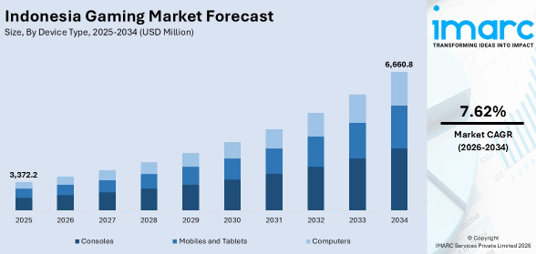
Source: IMARC – Indonesia’s Gaming Market Forecast (2025-2034).
The gaming market of Southeast Asia was valued at USD 9.06 billion in 2025. With 10% growth between January and August 2024, Indonesia is the region’s largest market for game downloads, accounting for 41% of the downloads. Valued at USD 3.37 billion in 2025, Indonesia’s gaming market is projected to reach USD 6.66 billion by 2034. Coupled with the Indonesian government’s enactment of Presidential Regulation No. 19 of 2024 to accelerate this industry, these trends make Indonesia a target market for India.
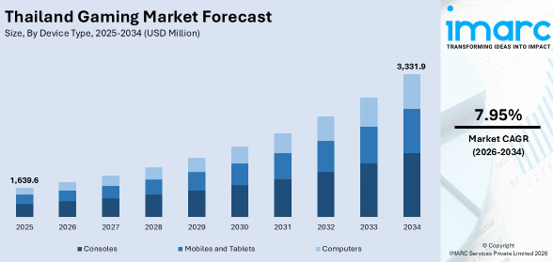
Source: IMARC – Thailand Gaming Market Size (2025-2034).
Thailand, the region’s largest market by revenue, saw mobile gaming revenue grow 10% in 2024 to USD 400 million. Supported by government tax incentives and a well-established professional esports ecosystem, Thailand’s market is expected to cross the USD 2 billion player spending milestone next year and reach USD 3.33 billion by 2034. Vietnam, one of the emerging gaming markets, is projected to reach USD 2.6 billion by 2034, while Malaysia’s gaming market, valued at USD 1.1 billion in 2025, is expected to more than double by 2034.
A New Diplomatic Opportunity in the World of Pixels
The year 2023 marked a historic win for the growing e-sports community in India when the government recognised it as a sport, putting it under the oversight of the Ministry of Youth Affairs and Sports. That same year, the Uttar Pradesh government signed an MoU with Garena, a Singapore-based global games company, making it the first Indian state to be at the forefront of esports by leveraging local data infrastructure.
Indonesian officials saw India’s restrictions on Chinese gaming products as an opportunity for Indonesian developers to expand into the Indian market through both business-to-business and business-to-consumer models.
The following year, Skyesports, India’s leading esports tournament organiser, collaborated with the Indonesian Embassy in New Delhi for an esports showmatch at the India Gaming Show to commemorate 75 years of India–Indonesia diplomatic relations. Indonesia, the region’s dominant market by player numbers, sees an overwhelming majority of its gaming revenues accrue to foreign publishers, especially Chinese firms, while its local studios still subsist on meagre budgets. This outflow of revenues, particularly to China, sparks legitimate concerns over economic independence, creative sovereignty, and domestic value-creation—concerns that resonate with India’s own push to become a creative exporter of gaming IP. Indonesian officials saw India’s restrictions on Chinese gaming products as an opportunity for Indonesian developers to expand into the Indian market through both business-to-business and business-to-consumer models.
Online gaming diplomacy can serve as a conduit for regional economic integration if proper regional financing channels are formed. Formal bodies, joint subsidies, co-production funds, and bilateral/multilateral gaming summits could expand collaborations beyond individual commercial deals into structured regional arrangements. Governments could also explore the creation of regional elite-level gaming training academies. China already has robust state-supported vocational schools and professional youth training camps for official exchanges such as Dream Compete Future E-sports. India and Southeast Asian nations could pursue greater cooperation through knowledge-sharing mechanisms and regulatory dialogues to learn more about national cultural sensitivities and policy priorities. The Indonesian Game Rating System (IGRS) framework of 2026 can serve as a template for regulatory harmonisation, easing cross-border publishing and institutionalising the foundations of regional gaming diplomacy.
There is enough dynamism in the gaming sector for India and Southeast Asia to treat online gaming as a new vehicle for economic diplomacy.
Way Forward
A Finnish case study found that the digital games industry’s economic contribution extends well beyond direct digital game sales, triggering demand for complementary products such as hardware, processors, content, and broadband, while stimulating R&D and innovation in manufacturing across sectors.
The private sector is already blazing a trail in establishing online gaming as a major contributor to the orange economy.
There is enough dynamism in the gaming sector for India and Southeast Asia to treat online gaming as a new vehicle for economic diplomacy. The sector is embryonic but holds enormous potential to connect the two regions and build a new India–Southeast Asia digital corridor by engaging younger generations through genuine human connection and deepening regional integration through commercial interdependence.
The private sector is already blazing a trail in establishing online gaming as a major contributor to the orange economy. JioBLAST, the joint venture between India’s Reliance Jio, RISE Worldwide, and Denmark’s BLAST ApS, recently partnered with Finnish mobile game development company ‘Supercell’ to operate the Brawl Stars Challengers 2026 circuit across South and Southeast Asia. This partnership will integrate the region’s gaming markets and players under a single competitive ecosystem and further reap localised economic benefits through tournaments, event production and heavier usage of local internet infrastructure.
The gaming sector needs government backing through appropriate policy frameworks that enable long-term IP, technology co-development, and strengthen domestic value chains. The Ministry of External Affairs, Ministry of Information and Broadcasting, and the Confederation of Indian Industry/Federation of Indian Chambers of Commerce and Industry could coordinate with their Southeast Asian counterparts to propel these efforts and bring this idea to fruition.




Find on this page

The Centre for Social and Economic Progress (CSEP) is an independent, public policy think tank with a mandate to conduct research and analysis on critical issues facing India and the world and help shape policies that advance sustainable growth and development.