
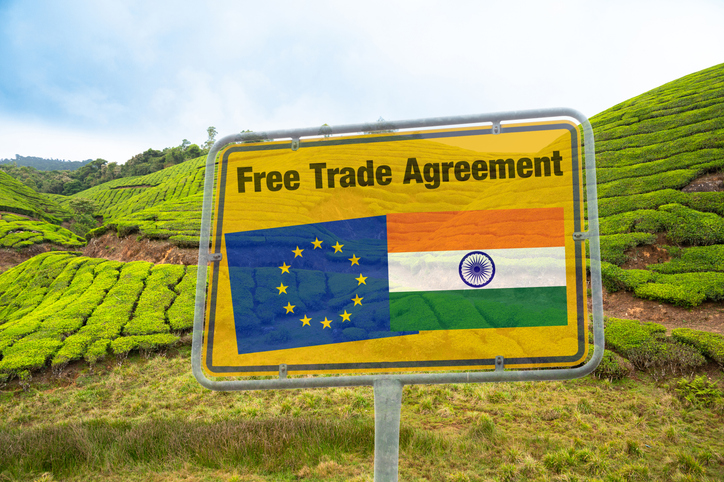
India–EU Free Trade Agreement: Promising in Scope, Limited in Regulatory Space
Reading Time: 7 minutesBackdrop
The India–EU Free Trade Agreement (FTA) is being described as one of the most comprehensive and ambitious trade agreements India has negotiated so far. The negotiations concluded on 27 January this year during a high-level visit of EU officials, and the release of the full text of the agreement now allows a closer look at what has been agreed. The agreement goes far beyond traditional tariff reduction. It introduces several new areas, including digital trade, sustainable food systems, carbon border cooperation, Small and Medium Enterprise (SME) facilitation, and competition policy, some of which had not featured prominently in India’s earlier trade agreements. The breadth of the text reflects the intensity of negotiations between the two sides. A closer examination of the agreement’s chapters reveals both their strengths and limitations.
Rules of Origin
On Rules of Origin, the India–EU FTA attempts to reduce uncertainty while introducing procedural innovation. Like several earlier trade agreements, such as those with Mauritius, Chile, and Thailand, it incorporates a ‘set rule’ for certain product categories, especially broad or mixed classifications, to reduce ambiguity in determining the origin of complex goods.
A more significant change is the shift from the traditional Certificate of Origin (CoO)—the key documentary proof for claiming preferential tariffs—to a Statement on Origin (SoO), produced by exporters themselves and valid for up to one year. This move toward self-certification reduces the need for direct interaction between traders and government authorities, reflecting growing trust in business compliance.
In addition, the agreement enables ‘Importer’s Knowledge’ (IK), allowing importers to claim preferential treatment by substantiating the origin by using information from exporters. Together, the SoO and IK mechanisms represent a business-friendly attempt to simplify origin procedures and make the system more flexible.
Customs and Trade Facilitation
This chapter is one of the more progressive parts of the agreement. It allows the two sides to exchange customs information automatically, even before goods arrive at the border, thereby improving risk assessment and speeding up clearance for legitimate trade.
The agreement also strengthens the Authorised Economic Operator system. It ensures that all eligible operators are allowed to qualify, and SMEs are not discriminated against. Benefits such as fewer inspections and faster clearance are clearly outlined, providing greater predictability for businesses.
Another important feature is the removal of the mandatory use of customs brokers. India has traditionally relied on Custom House Agents, but this provision encourages direct interaction between traders and customs authorities, aligns with India’s digitalisation and customs reform efforts, and may lower transaction costs.
The most controversial issue related to cross-border data flows has been deferred through a five-year review clause.
Digital Trade
This chapter is notable not so much for what it opens up, but for what it carefully avoids. Both sides recognise privacy as a fundamental right and retain the freedom to decide their own level of protection for personal data. This preserves regulatory sovereignty for both India and the EU.
The agreement also prohibits requiring the transfer of source code as a condition for market access, thereby protecting Indian technology firms from forced disclosure abroad and shielding EU companies from localisation-related demands. However, the most controversial issue related to cross-border data flows has been deferred through a five-year review clause.
The agreement proposes establishing a working group to examine regulatory regimes that may affect trade between the parties, including India’s Quality Control Orders and relevant EU regulations.
This chapter also recognises e-invoicing, electronic contracts, and paperless trade documentation, as well as includes consumer protection measures, anti-fraud rules, and controls on unsolicited commercial messages, thereby aligning with India’s GST framework and broader digitisation efforts.
Technical Barriers to Trade
One notable provision in the Technical Barriers to Trade (TBT) chapter concerns conformity assessment. The agreement proposes establishing a working group to examine regulatory regimes that may affect trade between the parties, including India’s Quality Control Orders and relevant EU regulations. Such a mechanism could promote transparency, improve mutual understanding, and potentially reduce unnecessary compliance burdens on businesses operating in both markets.
Subsidies and Competition Law
The agreement allows both sides to maintain their own competition laws and requires them to designate an independent authority to enforce them. These laws are expected to address horizontal and vertical agreements, abuse of dominance, and anti-competitive mergers.
Subsidies, a sensitive public policy issue in India, are also addressed through a dedicated chapter. However, the provisions mainly apply to goods-related subsidies and focus on transparency and information sharing. They fall short of imposing strict limits on industrial policy choices, which help preserve national policy space.
Small and Medium Enterprises
The dedicated chapter on SMEs stipulates that to improve business facilitation, both sides will create an SME-focused website providing clear information on tariffs, non-tariff measures, rules of origin, customs procedures, and other requirements. Administrative contact points will also be established to help SMEs understand and use the agreement.
These measures are significant given the low awareness and utilisation of FTAs among many exporters. By improving access to information and coordination, the chapter aims to make the agreement more accessible for smaller firms.
The EU has committed to supporting India’s efforts to reduce greenhouse gas emissions by mobilising financial resources, tools, and related investments.
Carbon Border Adjustment Mechanism
One of the most debated issues globally, particularly in India, is the EU’s Carbon Border Adjustment Mechanism (CBAM), which effectively imposes a carbon levy on certain imports into the EU. Recognising its significance, both sides negotiated a dedicated annex on CBAM.
Under this framework, the EU has committed to supporting India’s efforts to reduce greenhouse gas emissions by mobilising financial resources, tools, and related investments. It will also provide technical assistance and capacity-building support to help Indian industries comply with CBAM requirements, with specific reference to supporting MSMEs.
Importantly, the annex provides Most Favoured Nation treatment in CBAM implementation, ensuring India receives treatment no less favourable than other third countries. For instance, the EU has provided transitional arrangements and recognised domestic carbon pricing systems for partners such as the UK, and has engaged in technical cooperation with the US. The agreement ensures that India will not be placed at a disadvantage in comparison.
Sustainable Food Systems
This chapter focuses on improving the sustainability of food production, reducing food loss and waste, promoting responsible use of fertilisers and pesticides, and enhancing animal health and welfare.
There is no dedicated chapter on investment. In contrast, the 2024 India–European Free Trade Association (EFTA) agreement included a clear commitment to invest US$100 billion over time.
In addition, it addresses the rising threat of antimicrobial resistance and highlights the need for cooperation to promote responsible antibiotic use in food production. To take these discussions forward, the agreement proposes a Joint Committee on Sustainable Food Systems, which will serve as a platform for continued dialogue and policy exchange.
The Missing Avenues
While the India–EU FTA appears modern and forward-looking, several important gaps remain.
First, there is no dedicated chapter on investment. In contrast, the 2024 India–European Free Trade Association (EFTA) agreement included a clear commitment to invest US$100 billion over time. Although trade liberalisation can indirectly attract investment, an explicit investment framework could have provided stronger signals to investors. Public procurement is also largely absent. Given India’s sensitivities in areas such as food security and the Public Distribution System, structured engagement with the EU might have helped secure greater policy space while addressing external concerns predictably.
Another drawback is the limited enforceability of several chapters. Competition, subsidies, SMEs and sustainable food systems are excluded from dispute settlement. This creates a two-tier structure: Tariff commitments are binding, but many regulatory provisions remain soft. The agreement relies heavily on dialogue and consultation, but lacks strong mechanisms to resolve disputes if tensions arise.
The chapter on Subsidies reflects this cautious approach. Although it introduces transparency requirements, it does not meaningfully constrain industrial policy. Agricultural and fishery subsidies are excluded, smaller subsidies fall outside the scope, and dispute settlement is unavailable. In an era of active industrial policies, the agreement opts for notification rather than discipline.
There is no clear guideline on the mobilisation of financial resources for capacity building and regulatory requirements for CBAM compliance.
The CBAM annex is another area where India secured engagement but not relief. There is no automatic recognition of any future Indian carbon pricing system, no clear transition flexibility, and no binding commitment on mutual recognition of verification bodies. Instead, the text focuses on technical dialogue and possible cooperation. For sectors such as steel, aluminium, and cement, compliance costs are likely to remain largely unchanged. The agreement institutionalises cooperation but does not substantially reduce exposure to the EU’s carbon border mechanism. There is no clear guideline on the mobilisation of financial resources for capacity building and regulatory requirements for CBAM compliance, whether SMEs would receive differential support, and whether mutual recognition mechanisms for each other’s regulatory systems will be developed.
Similarly, the Sanitary and Phytosanitary hapter improves timelines and transparency but does not fundamentally rebalance regulatory authority. Science-based review mechanisms already exist under World Trade Organization rules, and past disputes show that scientific interpretations can differ significantly. The agreement does not clearly explain how persistent SPS disagreements would be resolved beyond consultation.
The TBT chapter also raises concerns. While it emphasises regulatory dialogue, EU regulations such as the EU Deforestation Regulation and Corporate Sustainability Due Diligence requirements could increase compliance burdens for Indian exporters. These measures may act as non-tariff barriers, and resolving such issues through committees or dispute settlement could add time and cost. A more comprehensive negotiation on bilateral conformity assessment and the inclusion of the EU’s regulations might have been more promising.
The Sustainable Food Systems chapter offers a mixed picture. Although non-binding, its committees and action plans may gradually encourage alignment with evolving EU standards. Such convergence could help Indian firms integrate into global value chains, but may also increase compliance requirements.
Similarly, modernising customs procedures and enhancing risk management may benefit established exporters, but smaller firms may face higher compliance expectations, stricter audits, and more demanding supply chain standards. Without parallel capacity-building measures, procedural sophistication risks widening the gap between large and small exporters.
Finally, although origin verification procedures have improved, inconsistencies in record-keeping requirements could create compliance burdens. The time period for maintaining documents related to the SoO differs from that for IK. Such differences may create confusion for exporters and importers, particularly SMEs that lack sophisticated compliance systems.
Concluding Remarks
Overall, the agreement reflects a broader pattern—prioritising dialogue, cooperation, and regulatory engagement over strict enforcement of obligations. It modernises processes but avoids hard constraints on policy space. For India, this means participation in evolving regulatory frameworks but with limited protection from external standard-setting pressures. For the EU, it secures structured engagement and opportunities for supply chain diversification without compromising its regulatory autonomy.
That said, if implemented effectively through domestic reforms, capacity building, and institutional coordination, the agreement could prove to be a game-changer. Its depth and breadth make it one of the most promising trade texts negotiated by India in recent years, though much will ultimately depend on how seriously both sides implement its commitments.

Himanshu Jaiswal


Find on this page

The Centre for Social and Economic Progress (CSEP) is an independent, public policy think tank with a mandate to conduct research and analysis on critical issues facing India and the world and help shape policies that advance sustainable growth and development.