
Motihari–Amlekhganj Pipeline: How India–Nepal Energy Connectivity Is Strengthening Energy Security
Reading Time: 5 minutesBuilt in just fifteen months, South Asia’s first cross-border petroleum pipeline illustrates how cross-border infrastructure can make fuel supplies more resilient, efficient, and reliable while strengthening regional cooperation.
In April 2026, Nepal briefly became the most expensive place to buy petrol in South Asia because of the closure of the Strait of Hormuz. The Nepal Oil Corporation (NOC) revised prices four times in a month, with petrol rising from NPR 137 to NPR 219 per litre. The episode revived memories of Nepal’s 2015 fuel crisis, when protests along the southern border disrupted truck-based petroleum imports and triggered months of severe shortages, leaving hospitals struggling to maintain oxygen and medicine supplies. Private vehicles were restricted from fuel supply, with emergency services being prioritised. Subsequently, Nepal received its first-ever emergency fuel shipments from Beijing.
Nepal’s Fuel Import Dependence and Energy Vulnerability
The two episodes share a structural problem: Nepal, a landlocked country, imports all of its petroleum, refines none of it, and maintains insufficient reserves. This makes it highly sensitive to price movements in India or the Gulf, with vulnerabilities arising across three layers:
- Domestic Capacity: Nepal has no domestic petroleum refining capacity and maintains limited reserves, providing only a short buffer against supply disruptions.
- Energy Dependence: Petroleum comprises 20% of Nepal’s energy supply, spanning transport, industry, agriculture and urban LPG – all of it imported from India. Nepal intends to transition towards domestic hydropower; however, it remains dependent on imported LPG, making secure petroleum delivery infrastructure critical to immediate energy security.
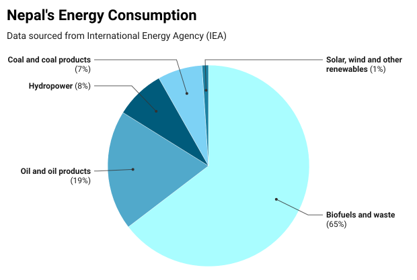
Source: International Energy Agency (IEA).
Nepal’s measures to reduce petroleum dependence include a net-zero target by 2045, a goal for electric vehicles to make up 90% of private passenger vehicle sales by 2030, and a 10% bioethanol blending policy for petrol in FY2025–26.
- Petroleum Delivery Infrastructure: Until 2019, petroleum arrived primarily by road tankers, through difficult terrain and a limited number of border checkpoints, most notably the Raxaul–Birganj corridor. Trucks remain vulnerable to blockades, accidents, delays, and fuel theft.
The Motihari–Amlekhganj pipeline—69 km in length, with capacity for two million metric tonnes per annum and a project cost of INR 324 crore—was built to address this third layer.
The Motihari–Amlekhganj pipeline, South Asia’s first cross-border petroleum pipeline, demonstrates several concrete benefits of cross-border energy.”
Why the Motihari–Amlekhganj Pipeline Outperforms Truck-Based Delivery
The Motihari–Amlekhganj pipeline, South Asia’s first cross-border petroleum pipeline, demonstrates several concrete benefits of cross-border energy. However, while pipelines improve delivery reliability, they do not eliminate import dependence, price exposure, security risks, or environmental trade-offs.
Upon inauguration, the drop in logistics expenses allowed Nepal to immediately reduce the retail price of diesel, petrol, and kerosene by NPR 2 per litre across the country, with NOC saving about NPR 2 billion annually.
Reliability of Supply
A buried, sealed pipeline is insulated from surface-level disruption. Protests, weather, accidents, and congestion cannot disrupt an underground pipe the way they disrupt trucks. This resilience is particularly important for Nepal, given how the 2015 crisis reflected the fragility of truck-based delivery.
Cost Efficiency
Improved reliability also brings cost benefits with reduced transportation costs. Upon inauguration, the drop in logistics expenses allowed Nepal to immediately reduce the retail price of diesel, petrol, and kerosene by NPR 2 per litre across the country, with NOC saving about NPR 2 billion annually.
Eliminating Transit Losses and Pilferage
Road tanker systems are vulnerable to pilferage, since drivers can siphon fuel or dilute petrol with cheaper substitutes. These losses occurring in transit were difficult to detect, required manual inspections, and left the system vulnerable to delays. The Motihari–Amlekhganj pipeline is a sealed, SCADA-monitored system that tracks petroleum electronically from Motihari to Amlekhganj, adding a layer of automated security that alone saves the NOC billions of rupees annually, thereby also improving accountability.
Reduced Border Congestion and Delays
Routing petroleum through the pipeline reduced border congestion at Raxaul–Birgunj. Until 2019, this primary land trade corridor handled fuel tankers alongside cargo trucks carrying iron, cement, and other goods through narrow, two-lane corridors. Decongesting the border also reduced trade costs and transit times for other goods. While often overlooked, these indirect benefits demonstrate how energy infrastructure can improve the efficiency of wider trade corridors.
The Pipeline as an Infrastructure Success Story
Beyond its operational benefits, the pipeline is an infrastructure success story, becoming operational fifteen months ahead of schedule for three reasons.
- Political Support: The 2015 blockade was a strong motivation for Nepal, evident in the intervention of the Nepali Federal Cabinet. In 2018, Parsa National Park authorities demanded INR 1 billion annually from the NOC for long-term landscape restoration, which the NOC resisted. The dispute was resolved through expedited higher-level inter-ministerial clearance after the Cabinet intervened, allowing work on the corridor to proceed.
- Favourable Implementation Conditions: The pipeline’s 69 km route ran through flat Terai terrain between Amlekhganj and Motihari, largely avoiding new greenfield construction or large-scale land acquisition. Horizontal directional drilling (HDD) was used to lay pipes under rivers and highways, bypassing the delays associated with open-trench digging and minimising disruption in populated areas. The pipeline was laid alongside the existing Birgunj–Pathlaiya highway and railway corridor on government-owned land, helping reduce the time required for the land acquisition phase.
- Institutional Capacity: The project was funded by India under its Neighbourhood First policy. This eliminated the financing negotiation phase and the wait for Nepal’s budget allocation. Indian Oil Corporation, which already operates 13,000 km of pipeline domestically, brought in its capabilities, which may have further contributed to the project’s implementation.
62 km extension from Amlekhganj to Chitwan and a new 50 km Siliguri to Jhapa transnational pipeline. The Chitwan extension, though internal to Nepal, is being built in collaboration with India.
Expanding South Asia’s Cross-Border Pipeline Network
Nepal is not the only South Asian case illustrating the value of cross-border energy infrastructure.
The Motihari–Amlekhganj pipeline is one of two operational cross-border petroleum pipelines linked to India; the other is the 131 km India–Bangladesh Friendship Pipeline connecting Siliguri to Parbatipur. Bangladesh’s experience illustrates how pipelines can serve as a structural tool for strengthening energy security. When fuel shortages hit in early 2026, Dhaka turned to the existing pipeline, requesting India’s assistance, and Numaligarh Refinery Limited pumped 5,000 metric tonnes of diesel to the Parbatipur depot to stabilise local supplies. The pipeline thus provided several tangible benefits over a truck-dominant setup.
Two more pipeline projects are under construction and consideration: a 62 km extension from Amlekhganj to Chitwan and a new 50 km Siliguri to Jhapa transnational pipeline. The Chitwan extension, though internal to Nepal, is being built in collaboration with India. Together, these projects point towards the gradual emergence of a more connected sub-regional energy network in the eastern part of the Indian subcontinent. Furthermore, India is completing its Northeast Gas Grid (NEGG), binding all northeastern states, with plans to connect it to the national gas grids of Bangladesh, Nepal, and Bhutan.
Cross-border pipelines cannot eliminate import dependence or insulate countries from global energy shocks. They can, however, make fuel delivery systems more reliable, efficient, and resilient. The Motihari–Amlekhganj pipeline demonstrates how relatively modest infrastructure investments can generate significant operational and economic benefits while strengthening regional connectivity. As South Asia explores deeper forms of energy cooperation, the project offers both a useful model and practical lessons for future initiatives.
Timeline:
| Year | Milestone | Details |
| 1996 | Project conceptualised | Pipeline from Motihari (India) to Amlekhganj (Nepal) first proposed by technical bodies |
| 2004 | Early bilateral understanding | Preliminary NOC-IOC discussions; no formal agreement reached |
| 2015 | MoU signed | Formal inter-governmental agreement signed between IOC and NOC |
| 2017 | Pre-construction phase | Feasibility studies, Detailed Project Report (DPR) preparation, and statutory approvals completed |
| 2018 | Construction begins | Civil laying commences across the Indo-Nepal border at Raxaul; HDD technology deployed under rivers and highways |
| September 2019 | Inauguration | PM Modi and PM Oli jointly inaugurated South Asia’s first cross-border petroleum products pipeline on 10 September 2019. |
| 2019–2022 | Testing and validation | IOC and NOC test pipeline for pressure stability, pilferage prevention, and cost savings verification; multi-product upgradation planned. |
| 2022 | Terminal upgrade initiated | Upgradation of Amlekhganj terminal commenced to enable multi-product handling (petrol, diesel, ATF) and expanded storage capacity. |
| 2025 | Terminal upgrade completed | Construction handover completed; terminal now capable of multi-product transmission and sequencing. |


Abhishek Agarwal



Find on this page

The Centre for Social and Economic Progress (CSEP) is an independent, public policy think tank with a mandate to conduct research and analysis on critical issues facing India and the world and help shape policies that advance sustainable growth and development.