

India-Europe Connectivity: The Role of IMEC and West Asia
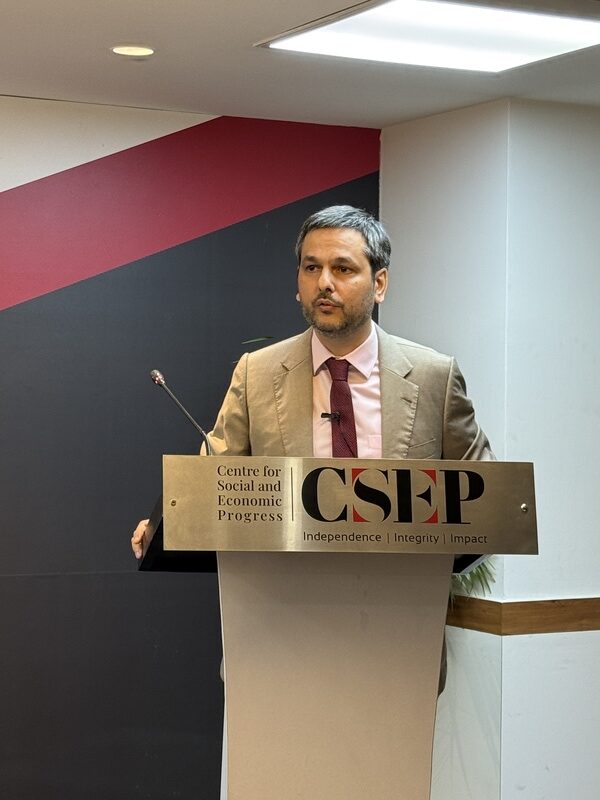
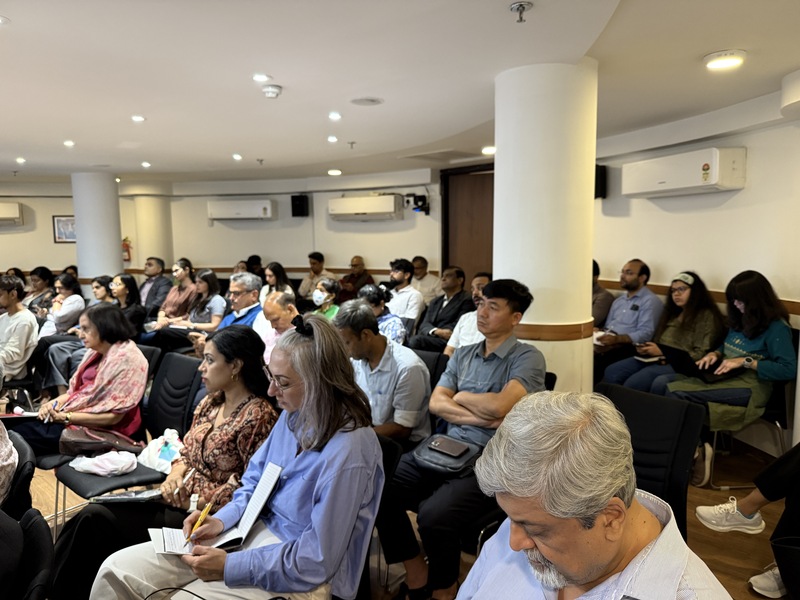
The Centre for Social and Economic Progress (CSEP) hosted a seminar titled “India-Europe Connectivity: The Role of IMEC and West Asia” on Wednesday, July 8, 2026.
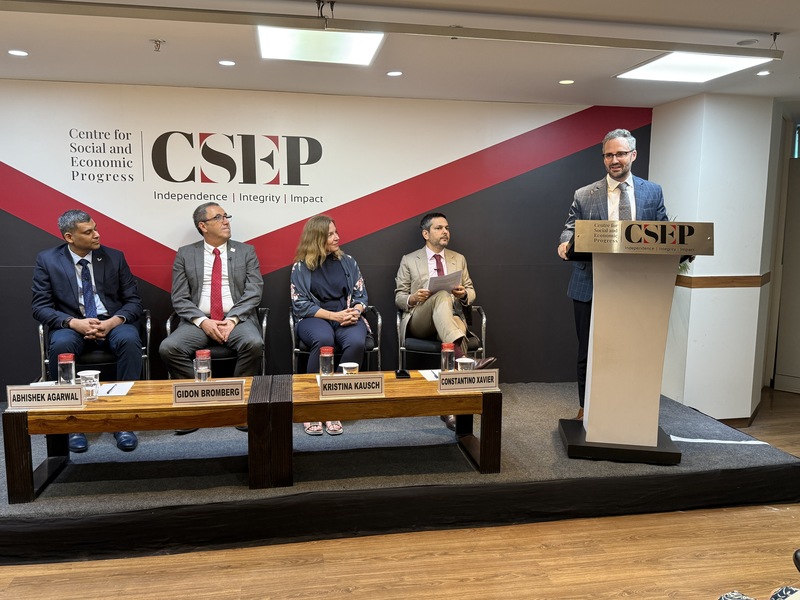
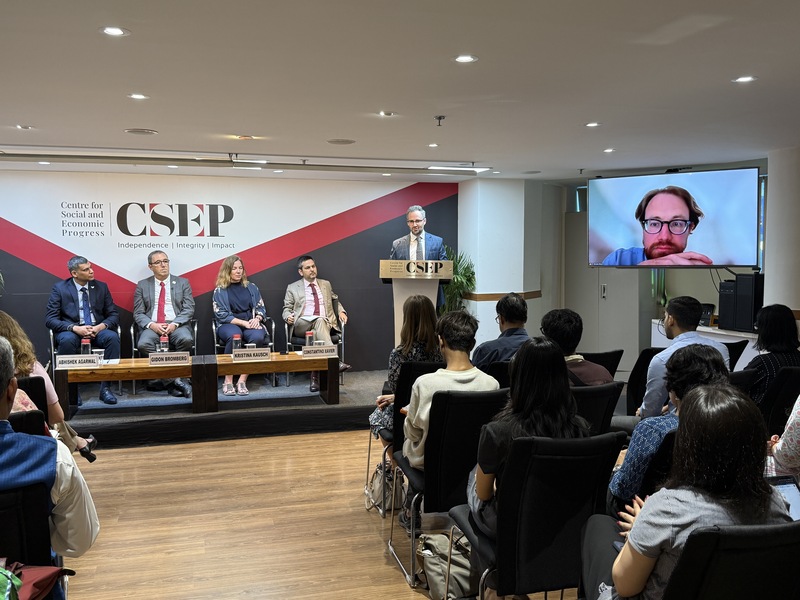
The event featured a panel discussion between Gidon Bromberg, Co-Founder and Israeli Director, EcoPeace Middle East; Kristina Kausch, Deputy Director, South and Wider Europe Program, GMF; Nicolas Blarel, Associate Professor, International Relations, Institute of Political Science, Leiden University; and Abhishek Agarwal, Visiting Fellow, CSEP. The discussion was moderated by Constantino Xavier, Senior Fellow, CSEP.
About the event
Against a backdrop of geopolitical uncertainty, supply chain disruptions, energy transitions, and shifting patterns of global trade, India and Europe have been trying to deepen cooperation across connectivity, infrastructure, technology and energy sectors, including through the India-Middle East-Europe Corridor (IMEC) in their common neighbourhood of West Asia. However, recent developments, including the Gaza crisis and the Iran war, have underscored the importance of political stability, regional security, and resilient supply chains and connectivity partnerships. What should the next phase of India–Europe connectivity looks like and what role for IMEC in partnership with other countries? How can both sides strengthen economic resilience while managing geopolitical and conflict risks in West Asia? And what role can connectivity initiatives, infrastructure partnerships, digital cooperation, and energy collaboration play in shaping a more stable, secure and prosperous West Asia?
Based on the CSEP research project “India and Europe: Bridging Continents Through IMEC” in partnership with FES-India, this seminar featured experts from Europe, West Asia and India to address some of these key questions.
Panellists
Gidon Bromberg
Gidon Bromberg co-founded EcoPeace Middle East in 1994 and has served as its Israeli Director for three decades. EcoPeace Middle East, a joint Palestinian, Jordanian, and Israeli organisation utilises the concept of connectivity to advance the two-state solution & regional integration. The IMEC Peace Triangle concept utilises the economic engine of connectivity to advance these geopolitical goals in a transformative manner that aligns with national security and climate resilience – policy objectives that are more relevant than ever given present marine blockages. Mr Bromberg has written extensively on the relationship between natural resource diplomacy and Middle East peace. He has presented these issues before the UN Security Council, US Congress, European Parliament, UN Climate Summit, and in other local and international forums. EcoPeace was nominated for the Nobel Peace Prize in 2024 and 2025.
Kristina Kausch
Kristina Kausch is Deputy Director of GMF’s South and Wider Europe program, dividing her time between Madrid and Brussels. An established voice on European foreign affairs and Europe’s relations with its neighbourhood, she conducts research on a broad interdisciplinary portfolio that includes international security, connectivity, the geopolitics of technology, and global power shifts. Prior to joining GMF, Kausch held positions with the Carnegie Endowment for International Peace; FRIDE, a Spanish think tank; the Bertelsmann Stiftung; and GIZ, the German development cooperation agency. She has contributed to a wide range of media outlets including The New York Times, the Financial Times, The Guardian, Politico, El País, RTVE, ARD, or Der Spiegel.
Nicolas Blarel
Nicolas Blarel is Associate Professor of International Relations at the Institute of Political Science, Leiden University in The Netherlands. He studies foreign and security policy-making, the politics of power transition in global politics, the politics of migration governance, and the international politics of South Asia. His current research project centers more specifically on the decentralisation and regionalisation of the foreign policy decision-making process in India. Nicolas has also worked on mapping and theorising migration governance in the South Asia to Gulf migration corridor. Nicolas equally studies India’s relations with the Middle East and has published The Evolution of India’s Israel Policy: Continuity, Change, and Compromise since 1922 (Oxford University Press, 2015). Nicolas also recently co-edited the Oxford Handbook of India’s National Security (Oxford University Press, 2018). Nicolas received his PhD from Indiana University, Bloomington and has previously studied at Sciences-Po Paris and at the Institut d’Etudes Politiques, Strasbourg.
Abhishek Agarwal
Abhishek Agarwal is a Visiting Fellow at CSEP. A co-creator, nurturer and eager learner, Abhishek actively sows and nurtures ideas that develop into significant programs and reforms in infrastructure governance and cooperation management. Key past initiatives include PM GatiShakti, Integrated Infrastructure Planning, Infrastructure Digitalization, De-risking & Resilience, Alternate Financing Mechanisms, Smart Cities, RURBAN, City-Regions (Growth Hubs), District Area Development Approach, Leveraging Tourism, Vibrant Village Program, and Hierarchical Spatial Governance. Past associations include NITI Aayog, GIZ, UNDP, Odisha, Tamil Nadu, Rajasthan, IL&FS, GIFT City, Gujarat Tourism Opportunities (GUJTOP), Gujarat Industrial Infrastructure Projects Limited (GIIPL), and partnerships with various Industrial Development Authorities and Municipal Corporations. Abhishek is an alumnus of the prestigious International Visitors Leadership Program (IVLP) of the Department of State (Govt. of US) for ‘Cooperation on Infrastructure for the Indo-Pacific’.
Moderator
Constantino Xavier
Constantino Xavier is a Senior Fellow at the Centre for Social and Economic Progress (CSEP), New Delhi, where he directs the program in Foreign Policy and Security Studies. He is also a non-resident fellow in the Foreign Policy program at the Brookings Institution, in Washington DC, and visiting professor at Ashoka University’s Department of International Relations.
His research expertise is on India’s role as a regional power in South Asia, the Bay of Bengal and Indian Ocean regions, especially relations with Nepal, Bangladesh, Sri Lanka and Myanmar. His studies under the CSEP Sambandh Initiative on Regional Connectivity have had wide impact with governments, industry and other stakeholders invested in enhancing India’s geoeconomic integration with neighbouring countries and regions, from the Gulf to Southeast Asia.
Dr Xavier’s broader work explores how India navigates the geopolitics of a changing regional and global order by balancing national security interests and growing economic interdependence. He also focuses on India’s relations with the European Union and other Indo-Pacific powers across the Global South. At CSEP he is currently leading research projects on India’s regional connectivity partnerships, climate cooperation, critical minerals security and China’s role in South Asia.
All content reflects the individual views of the speakers. The Centre for Social and Economic Progress (CSEP) does not hold an institutional view on any subject.
Please contact Gurmeet Kaur at GKaur@csep.org for general queries and Ayesha Manocha at AManocha@csep.org for media queries.


The Centre for Social and Economic Progress (CSEP) is an independent, public policy think tank with a mandate to conduct research and analysis on critical issues facing India and the world and help shape policies that advance sustainable growth and development.