
What Actually Drives India–Africa Trade? The Role of Institutions
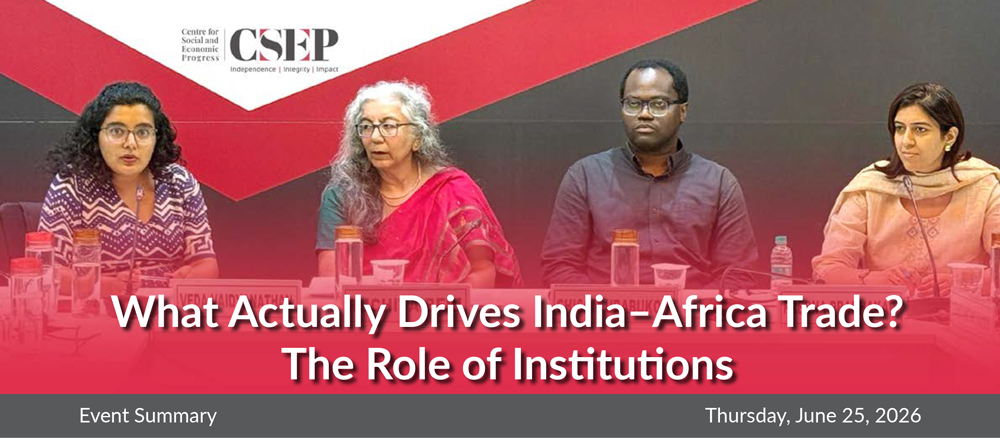
- CSEP hosted its 41st Foreign Policy and Security Studies Tiffin Talk, featuring Chisom Ubabukoh, Associate Professor from O.P. Jindal Global University.
- The presentation was titled, “What Actually Drives India–Africa Trade? The Role of Institutions,” and examined the factors shaping one of the fastest-growing economic partnerships in the Global South. Using a gravity model of trade for analysis, the research found that while traditional determinants such as GDP, population, and distance remain significant, institutional quality also plays a crucial role in terms of regulation and corruption. The session highlighted how improving trade infrastructure, simplifying regulations, and strengthening institutions will be central to unlocking the full potential of India–Africa economic relations.
- The session featured comments from discussants Ruchita Beri, Senior Fellow, Vivekananda International Foundation, and Prerna Prabhakar, Fellow, CSEP, and was moderated by Veda Vaidyanathan, Fellow, CSEP.
- This series of closed-door research seminars is curated by Constantino Xavier, Senior Fellow, CSEP, and Shivshankar Menon, Distinguished Fellow, CSEP. It focuses on contemporary, evidence-based research with policy relevance to bridge Delhi’s scholar-practitioner divide.
India-Africa Trade in a Historical and Contemporary Context
The talk began by situating India–Africa economic relations within a broader historical context. Commercial ties between the two regions date back to the first century CE through Indian Ocean maritime trade, while later waves of migration fostered enduring commercial links across East and Southern Africa. In modern times, their relationship has expanded significantly, with bilateral trade increasing from approximately USD 8.2 billion in 2000 to over USD 100 billion in 2023, making Africa India’s third-largest trading partner after the United States and the European Union.
Today, both India and Africa are regions with growing economic presence and tremendous potential. Rapidly growing consumer markets, young working populations, expanding digital sectors, and shared interests in food and energy security place this partnership as an increasingly important pillar of South–South cooperation. Despite this growing significance, the speaker noted that relatively little empirical work has examined the underlying drivers of India–Africa trade.
Institutions as Determinants of Trade
Building on the Gravity Model, which predicts that trade between two countries increases with their economic size and decreases with the geographical distance between them, the session began by examining the traditional determinants of trade. It then explored whether institutional quality further influences trade outcomes. In particular, the analysis focused on two variables: control of corruption and regulatory quality. The discussion particularly engaged with two theoretical perspectives regarding corruption. First, the “sanding the wheels” hypothesis, which argues that corruption undermines efficiency by increasing transaction costs and weakening institutions. In contrast, the second theory, titled “greasing the wheels”, suggests that in highly bureaucratic environments, corruption may temporarily facilitate commerce by helping firms circumvent administrative bottlenecks. The speaker positioned his research within this debate to determine which hypothesis is better reflected in contemporary India–Africa trade dynamics. The speaker also explained the methodological choice of using the “Poisson Pseudo-Maximum Likelihood (PPML) regression”, an econometric technique often used to examine international trade. He explained that it offers advantages over conventional estimation techniques by accommodating zero trade observations and producing more robust estimates of trade flows.
Trade Patterns and Empirical Findings
Additionally, the presentation addressed bilateral merchandise trade patterns between India and Africa. India’s imports remain concentrated in primary commodities, including crude oil, minerals, coal, gold, cocoa, and agricultural products; while its exports primarily consist of manufactured goods such as pharmaceuticals, refined petroleum products, machinery, chemicals, vehicles, and textiles. The speaker observed that this composition continues to resemble a traditional north-south trading relationship.
The findings largely confirmed the assumptions of the Gravity Model: larger African economies and populations were associated with larger volumes of trade, while facing an overall dampener due to the greater distance between the land masses. However, within this section, the speaker pointed out that “distance” should not only be understood geographically but also in terms of logistics, port availability, shipping infrastructure, customs efficiency, and overall trade facilitation. However, the study’s most notable finding concerned corruption: higher levels of corruption were associated with greater trade flows, lending support to the “greasing the wheels” hypothesis. The speaker cautioned, however, that this relationship likely reflects short-term adjustments to administrative inefficiencies rather than a desirable long-term development and trade strategies. It was found that as economies become larger and more advanced, the negative consequences of corruption become increasingly pronounced, highlighting the growing importance of anti-corruption reforms and stronger regulatory frameworks as markets mature.
Discussion
The discussants sharpened the findings in several productive directions. On the corruption result, a key observation was that the “greasing the wheels” finding aligns well with the nature of India-Africa trade itself. Much of the commerce, particularly in West Africa, happens in commodity-heavy, high-bureaucracy environments where informal workarounds are common. This contextual fit strengthens the plausibility of the finding, but it also raises the question of which specific countries are driving the result, and whether the relationship holds its presence uniformly across the continent, or is concentrated in a handful of markets.
On the stagnation puzzle, one discussant noted that India’s private sector has been deeply embedded in Africa for decades. Major Indian conglomerates have been operating across the continent since the 1970s, and Indian companies are present in significant numbers across several African economies. Yet bilateral trade has hovered around USD 70 – 100 billion for nearly a decade. This raised a pointed question: if institutional and commercial ties are so entrenched, what is actually constraining faster trade growth between India and Africa?
Methodologically, the discussants raised several suggestions as well. First, presenting trade flows relative to India’s total global exports would provide more analytical traction than absolute values. Second, separating the dependent variable into exports and imports would allow the model to capture how corruption and regulatory quality affect trade barriers differently for the two directions of trade flow. Third, the institutional variables may be collinear, and dropping or instrumenting for one would strengthen robustness. Fourth, geopolitical controls, including variables like participation in summits, bilateral diplomatic engagement, and regional conflicts, could help isolate institutional effects from political ones.
While discussing his ongoing research, the presenter noted that a similar analysis was done on China-Africa trade. He observed that corruption showed a stronger positive effect and regulatory quality mattered less in this scenario, which is likely due to the role of Chinese state-backed infrastructure investment, where trade flows are partly embedded in large state-to-state deals rather than private sector activity alone. India’s more independent market-led engagement means that regulatory clarity, which private firms rely on separately, becomes a stronger determinant for their operational success.
Policy Implications
The session concluded with two key takeaways: Trade follows larger markets and better logistics. For Indian policymakers, regulatory engagement ought to take a bigger stage during diplomatic undertakings. Targeting bigger African economies, investing in port and shipping connectivity, and pushing for streamlined customs corridors will deliver more durable results.
Further, regulatory quality is a strong institutional lever for sustaining the flow of goods. For African policymakers, simplifying business entry, reducing administrative friction, and building credible regulatory frameworks are essential. The speaker stressed that the factor holding back India-Africa trade’s true potential is not the distance between the regions or economic size. It is the institutional gap which reduces ease of business, and that is the area that both sides need to invest in.






The Centre for Social and Economic Progress (CSEP) is an independent, public policy think tank with a mandate to conduct research and analysis on critical issues facing India and the world and help shape policies that advance sustainable growth and development.