
Key Insights | Mapping India’s Export Geography : A District-Level Cluster Strategy for the National Manufacturing Mission
Reading Time: < 1 minuteDOWNLOADS
Abstract
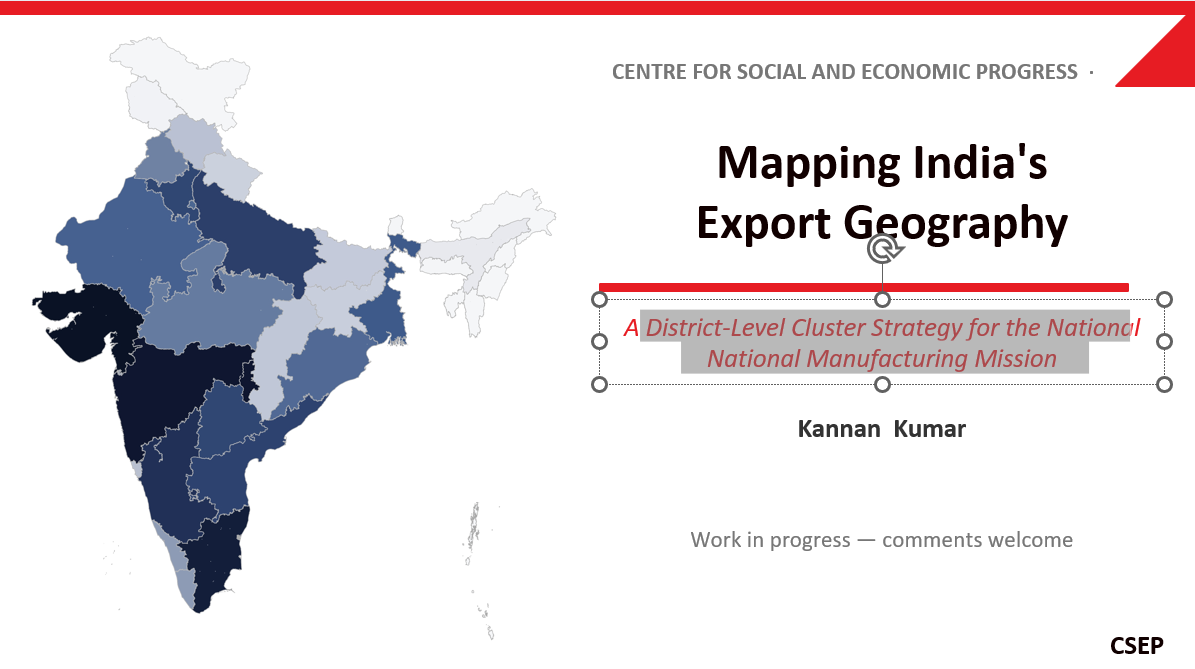
India’s Foreign Trade Policy 2023 and the National Manufacturing Mission (NMM) propose a district- and cluster-based export promotion strategy. However, neither policy specifies which districts to target. This paper therefore attempts to provide the spatial map that NMM’s cluster philosophy currently envisions. Using the DGCI&S district-level merchandise export data for FY2021-22 to FY2024-25 and the ASI state-level manufacturing GVA, we find three empirical facts. First, India’s export geography is extremely concentrated and shows no sign of deconcentrating – the top decile of districts accounts for 82.1 per cent of merchandise exports, and the bottom half contributes less than 0.5 per cent. More importantly, the district-level Gini remains above 0.87 every year, falling only from 0.880 to 0.872. Second, eight states exhibit a manufacturing–export disconnect. These states have a manufacturing GVA of USD 60 billion but export just USD 8.8 billion. We believe improving the export ecosystem could help these states increase exports. Third, the Indian export basket is shifting toward electronics and high-value manufacturing, which is geographically narrow and is leading to greater geographical concentration. Drawing on insights from new trade theory and agglomeration economics, we constructed a district-level index with four criteria: export readiness, manufacturing depth, export consistency, and meaningful product diversification. This index identifies 45 districts into three tiers: 17 scale-up clusters, 20 acceleration clusters across 14 states as the primary NMM target, and 8 foundational districts in disconnected states requiring binding-constraint diagnostics.


Find on this page

The Centre for Social and Economic Progress (CSEP) is an independent, public policy think tank with a mandate to conduct research and analysis on critical issues facing India and the world and help shape policies that advance sustainable growth and development.