
MacroInsights: Borrowed Time—Household Debt Can No Longer Mask India’s Consumption Slowdown
Reading Time: 3 minutesMacroInsights, a Centre for Social and Economic Progress (CSEP) series, dissects key economic developments and policy issues of macroeconomic significance. It offers timely, evidence-based analysis to inform public debate and policymaking.
Three debt-fuelled revivals since 2016–17 have propped up spending, which continues to weaken, hinting at structural forces at play.
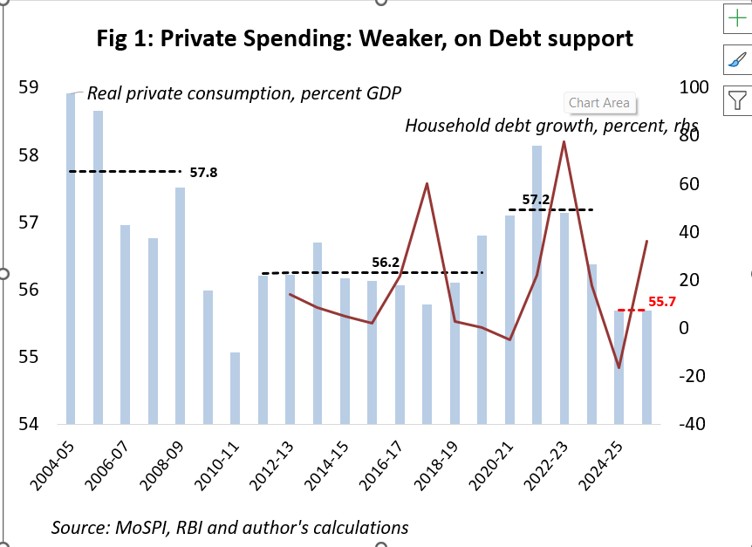
Private consumer spending continues its progressive weakening. Rebased GDP data (2022–23 base) show private consumption’s share of aggregate demand down 1.5 percentage points since the post-pandemic recovery wore off. Longer trend since 2004–05 shows a steeper 2.1-point fall from the 57–58% share held through 2010–11 (Figure 1). This is a two-decade trend, not a post-Covid blip. Wider developments hint that the further slippage may not be temporary, notwithstanding fresh debt support.
Debt has been the fallback every time. Households leaned on borrowings to smooth consumption through each shock since 2016–17: financial liabilities rose a cumulative 82 per cent in FY17–18 through demonetisation and the NBFC crisis, then 99.5 per cent in FY22–23 as pent-up demand combined with low interest rates post-pandemic. Both episodes propped up consumption’s share of income, underlining how load-bearing debt has become for demand, even at its 1.5 percentage point lower trend in the post-2011 period.
Spending slipped again since 2023–24 as disposable incomes slowed and households scaled back borrowings (Figure 2). Income growth genuinely slowed: nominal disposable income growth fell from a pre-pandemic norm of 11 per cent a year to an average of 9.5 per cent in 2020–21 to 2025–26, and to just 9 per cent last year. The clearest pointer is the consumption-to-income growth ratio, which fell from 1.13 before the pandemic to 0.92 after 2020. The RBI tightened credit supply at almost the same time, raising risk weights on unsecured personal loans and credit cards from November 2023 to cool the FY22–23 debt boom. Income deceleration and a regulatory brake, therefore, joined forces.
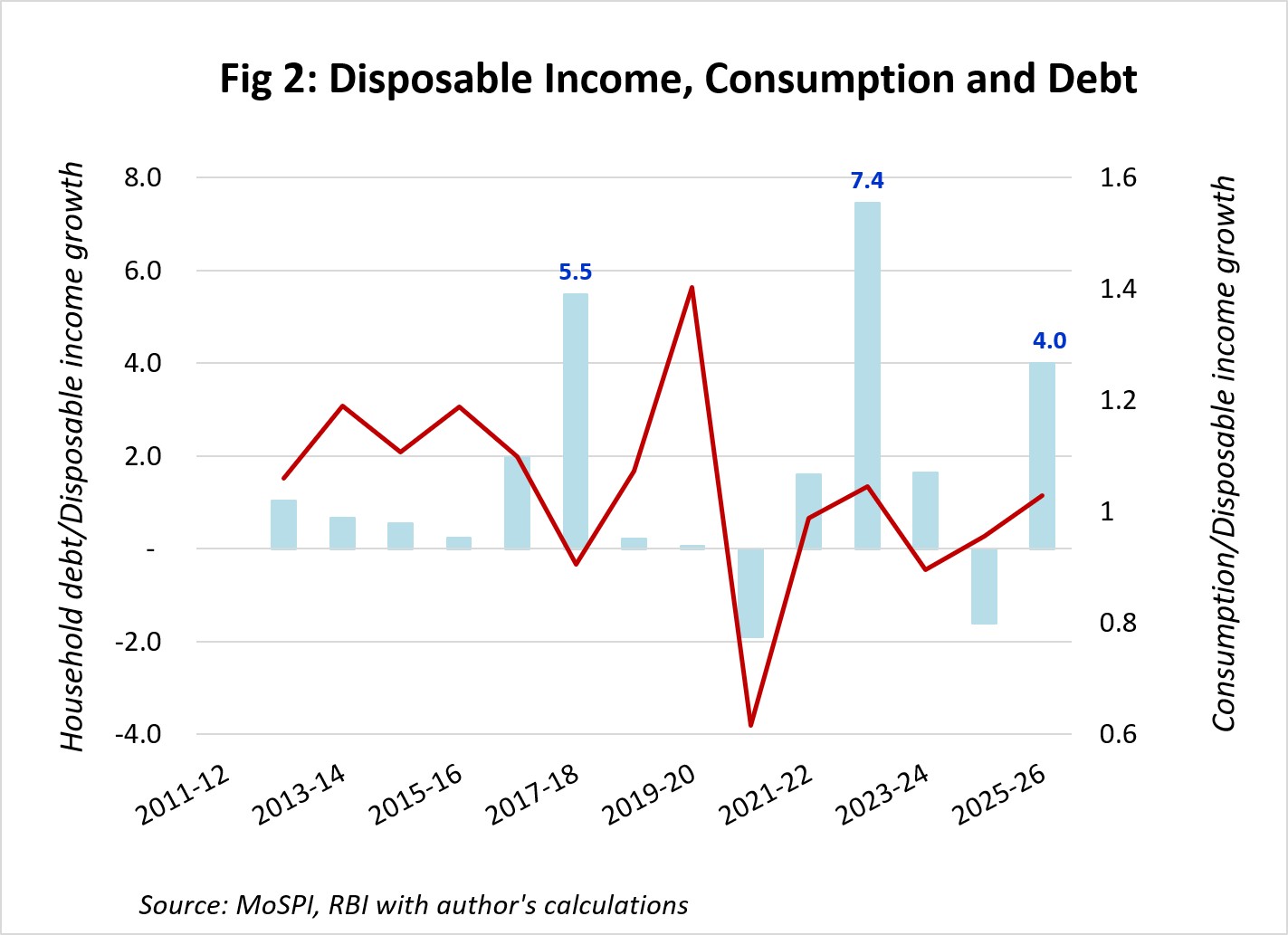
Prompting monetary–fiscal stimulation in 2025–26, household borrowing responded! Cumulative monetary easing of 125 bps in Feb–Dec 2025, a higher income-tax threshold, GST cuts on mass-consumption and durable goods, and the RBI’s own reversal of its 2023 tightening (risk weights eased back from February 2025) combined to drive a 36 per cent growth in household borrowing last year (Figure 2).
The shape of that revival should worry, not reassure. Household debt grew roughly four times faster than disposable income in 2025–26—a smaller gap than FY22–23’s sevenfold, but matching the FY17–18 ratio, after which the consumption lift faded within a year or two.
The stock of debt is still manageable; its composition is not. Household debt stood at 45.8 per cent of GDP in March 2026—up from 43.9 per cent a year ago, above the five-year average of 42.9 per cent, yet still below China (59 per cent), Malaysia (≈70 per cent), and Thailand (≈87 per cent). But non-housing retail loans—personal, credit card, durable, and auto—now make up 58.4 per cent of household borrowing, a rising share that keeps outpacing housing, agriculture, and business credit.
Debt can only buy time—such spending has proven short-lived. Over FY13–FY26, household liabilities grew at an average of 22 per cent a year against 10 per cent disposable income growth—roughly double the pace. Each debt burst (FY17–18, FY22–23, now FY25–26) has bought a temporary lift, not a lasting one, and this revival needed monetary easing, fiscal stimulus, and a regulatory reopening of credit taps together to arrive. That combination is itself the signal: the weakness is rooted in income growth, not credit access, and debt can buy time but not substitute for it.
Read Previous Articles:
MacroInsights: Rupee Pressures—Then and Now: Why This Isn’t 2013 but a Structural BoP Problem
MacroInsights: Gulf War Shock—How Resilient is the Economy
MacroInsights: Crowding-Out? Shrinking Savings, High Public Borrowing Impact Interest Rates

Renu Kohli


Find on this page

The Centre for Social and Economic Progress (CSEP) is an independent, public policy think tank with a mandate to conduct research and analysis on critical issues facing India and the world and help shape policies that advance sustainable growth and development.