Is it Time to Recalibrate Protectionism? The Case of the Indian Steel Industry
Reading Time: 4 minutesDOWNLOADS
Executive Summary
The Indian Steel Growth Story
The Indian steel growth story has been one of success. In the past two decades, the domestic steel industry has risen in the ranks and gone from the ninth-largest steel industry in the world to the second-largest globally, next only to China. This industry, fuelled by India’s ever-expanding hunger for steel to feed its growing manufacturing and infrastructure industries, has grown at 7% on average over the last two decades.
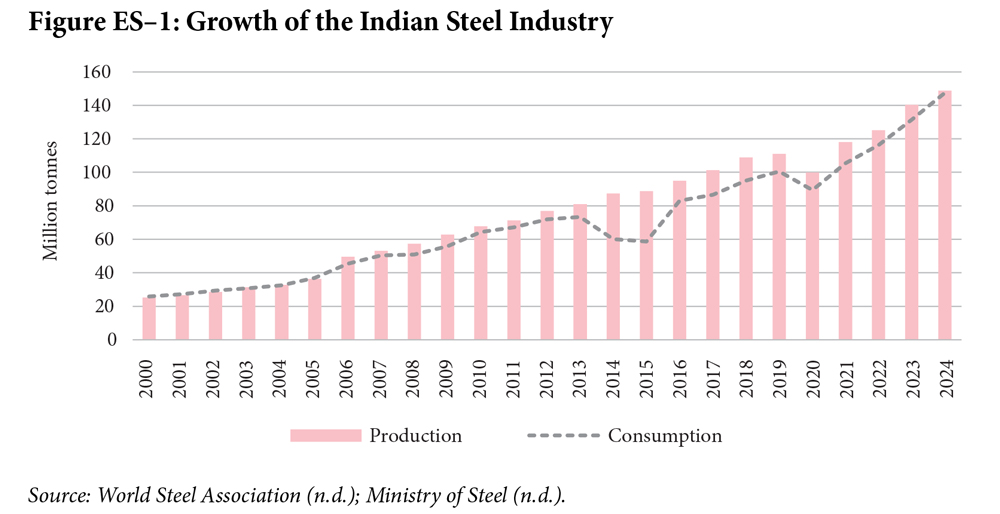
However, this story is still not as rosy as it seems. The per-capita consumption of steel in India, at 97.7 kg, was much lower than the world average of 221 kg and China’s 635 kg in FY24 (Ministry of Steel, 2025). The growth outlook for steel demand in India remains robust, projected to reach 192 million tonnes by 2030, despite the lower per-capita consumption.
A Protected Industry
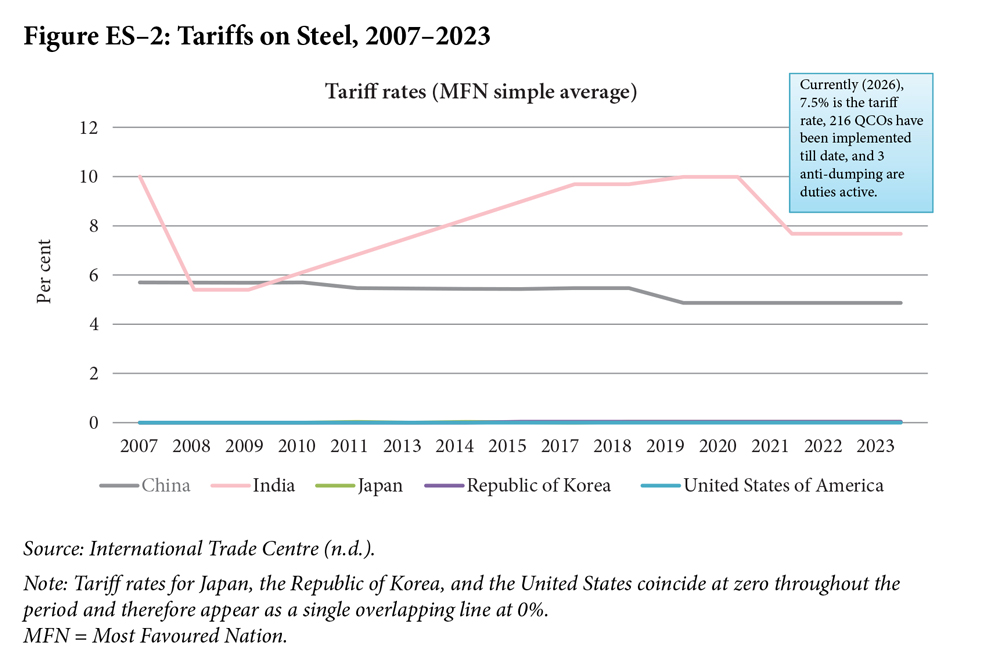
The steel industry has been protected for quite some time. Tariffs were slashed during the 2000s but were reinstated after 2015. The industry is also further shielded from foreign steel through Quality Control Orders (QCOs) and anti-dumping duties. Furthermore, the industry sees competitive advantages over its counterparts in other countries through abundant, cheap iron ore inputs and lower labour costs. Despite these advantages, Gupta and Sachdeva (2026) have shown that the Indian steel industry is still behind global peers like China and Japan in pricing and export competitiveness. At the same time, the profits that the large Indian steel firms make are higher than the global average. Steel protection in India is thus a combination of tariffs and non-tariff measures (NTMs), and any assessment of liberalisation must keep both in view.
Study Objective and Approach
The question of what would happen if the protection provided to the steel industry were reduced is a difficult one to answer. Steel is a key input to several downstream industries, many of which could benefit from cheaper steel in order to expand their output. Hence, the net impact on India’s Gross Domestic Product (GDP) stemming from reduced protection to steel is ambiguous and requires much closer inspection.
This study aims to investigate the impact of a reduction in steel tariffs on the Indian economy, particularly unpacking its effect on the GDP, domestic steel sector, and other downstream sectors that consume steel. For the analysis, Computable General Equilibrium (CGE) modelling is used, which considers all sectors in the economy and the interlinkages between them, providing a more holistic picture of the impacts of reducing the protection currently provided to the steel industry.
Key Findings
The results from the simulations (which have reduced tariffs by 10–90%) show that India’s GDP increases by 0.007% (or US$237 million). Although steel output falls, the impact is minimal (1% overall output reduction, with a 90% cut in tariffs on steel). The trade balance improves, and aggregate exports rise by 0.1% (US$612 million) when 90% of steel tariffs are reduced. Employment also gets a boost, fuelled by expansion in downstream sectors like machinery, automotive, electronics, and others, which can use the now cheaper steel to increase output, reduce prices, and export more. Welfare improves overall. The results look promising when we account for the business-as-usual growth that happens in the steel industry. They show that even when tariffs on steel are halved, the steel industry’s growth remains largely unaffected, and it can sustain its growth.
The findings from this study suggest that reduced protection to the steel industry can generate gains for the Indian economy without undermining the standing of the domestic steel industry. It must be stressed that these gains are modest in absolute terms. In this study, we liberalise only tariffs while the substantial protection embedded in NTMs (216 QCOs and active anti-dumping duties) remains in place across simulations. The implication of this is that the gains from reducing tariffs alone while retaining NTMs are limited. Unlocking the full benefit from liberalisation requires recalibrating both tariff and non-tariff protection.
Key Takeaways and Way Forward
This study points to four conclusions for policymakers:
- Tariff liberalisation is net positive for India. Reducing steel tariffs raises GDP (+0.007%, or US$237 million), aggregate exports (+0.1%, or US$612 million at a 90% cut), and overall welfare, with employment gains led by downstream steel-consuming sectors such as machinery, automotive, and electronics.
- The domestic steel industry remains resilient. Even when tariffs are halved, the industry sustains its growth trajectory; output falls only marginally (about 1% under a 90% tariff cut).
- The gains are modest by design. Only tariffs are liberalised in this analysis—the substantial protection embedded in NTMs (216 QCOs and active anti-dumping duties) remains in place across every simulation, capping the upside.
- The way forward is to recalibrate both tariff and non-tariff protection. Reducing tariffs alone results in limited gains. A phased, calibrated easing of both tariff and non-tariff barriers rather than just tariff cuts could unlock greater liberalisation benefits for the whole economy.

Aparna Preethan

Badri Narayanan Gopalakrishnan

Find on this page

The Centre for Social and Economic Progress (CSEP) is an independent, public policy think tank with a mandate to conduct research and analysis on critical issues facing India and the world and help shape policies that advance sustainable growth and development.