

Developing Competencies for a Climate-Resilient Health Workforce in South and Southeast Asia
Reading Time: 3 minutesEditor's Note
This Executive Policy Brief is published as part of the work undertaken under The Asian Collective for Health Systems (TACHS), which has its secretariat at CSEP.
DOWNLOADS
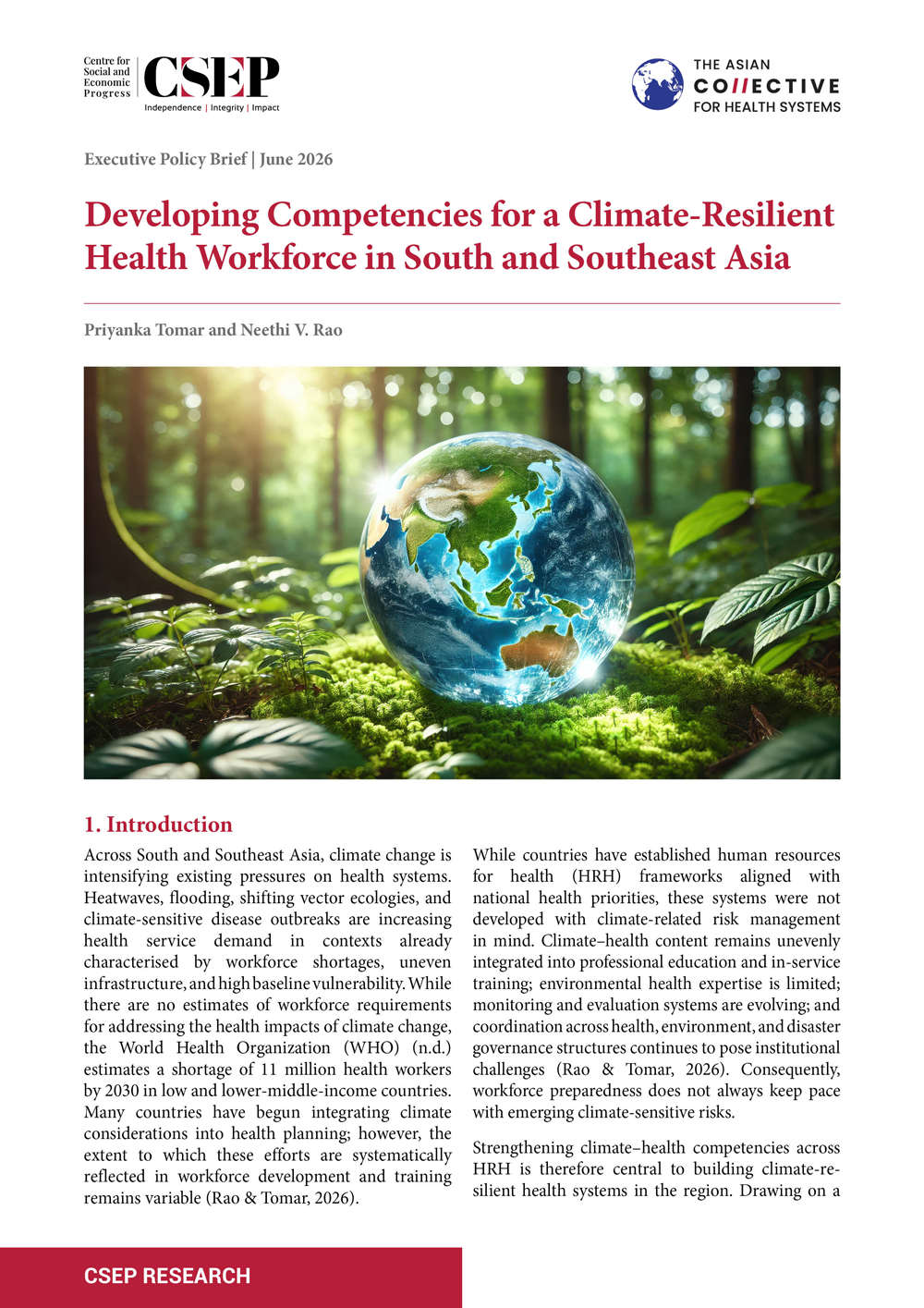
Across South and Southeast Asia, climate change is intensifying existing pressures on health systems. Heatwaves, flooding, shifting vector ecologies, and climate-sensitive disease outbreaks are increasing health service demand in contexts already characterised by workforce shortages, uneven infrastructure, and high baseline vulnerability. While there are no estimates of workforce requirements for addressing the health impacts of climate change, the World Health Organization (WHO) (n.d.) estimates a shortage of 11 million health workers by 2030 in low and lower-middle income countries. Many countries have begun integrating climate considerations into health planning; however, the extent to which these efforts are systematically reflected in workforce development and training remains variable (Rao & Tomar, 2026).
While countries have established human resources for health (HRH) frameworks aligned with national health priorities, these systems were not developed with climate-related risk management in mind. Climate–health content remains unevenly integrated into professional education and in-service training; environmental health expertise is limited; monitoring and evaluation systems are evolving; and coordination across health, environment, and disaster governance structures continues to pose institutional challenges (Rao & Tomar, 2026). Consequently, workforce preparedness does not always keep pace with emerging climate-sensitive risks.
Strengthening climate–health competencies across HRH is therefore central to building climate-resilient health systems in the region. Drawing on a peer-reviewed global scoping review and regional stakeholder interactions (Tomar & Rao, 2026), this policy brief examines ten climate-vulnerable countries in Asia [1] and advances three contributions: (a) a structured climate–health competency framework; (b) identification of cadre-specific requirements across community, clinical, and public health management roles; and (c) phased recommendations that operate at two levels—short-term operational actions to strengthen training and service delivery, and longer-term institutional reforms to embed these capacities within HRH systems.
Q&A with authors
What is the core message of the paper?
The core message of the paper is that building climate-resilient health systems across South and Southeast Asia requires transforming national Human Resources for Health (HRH) frameworks from a “one-size-fits-all” approach to a structured, cadre-specific competency model.
While climate change is escalating healthcare demands in an already vulnerable region, existing health systems were not designed for climate risk management. To bridge this gap, the paper introduces the KSTCP framework, which organises competencies into Knowledge, Systems Thinking, Technical Skills, Communication & Leadership, and Practice, and argues that these must be distinctly mapped and tailored to the unique functions of community health workers, clinicians, and public health professionals. Ultimately, training alone is insufficient; these competencies must be systematically institutionalised through policy, long-term financing, and civil service reforms.
What presents the biggest opportunity?
The biggest opportunity lies in operationalising targeted, cadre-specific training through existing, ready-made public health infrastructure and digital platforms rather than creating redundant, parallel architectures.
The paper highlights several critical pathways:
- Supervisory Cascade Models: Large, decentralised health systems in the region already possess public health training institutes (like India’s State Institutes of Health and Family Welfare or Nepal’s National Health Training Centre) that can act as “train-the-trainer” hubs. This allows certified master trainers to rapidly embed applied climate skills down to frontline workers at scale.
- Blending Digital & Applied Delivery: Foundational literacy can be rolled out via national digital platforms at a low marginal cost for formal cadres, while interactive, face-to-face methods can be reserved to maximize the community impact of local cadres.
- Empowering Community Health Workers (CHWs): Transitioning CHWs from hazard-specific pilots into integrated actors allows national systems to leverage the massive amounts of routine household data they collect for predictive climate-health forecasting.
What presents the biggest challenge?
The biggest challenge is overcoming the fragmented, ad-hoc nature of current training initiatives and resolving institutional mismatch across governance sectors.
Specific hurdles include:
- Lack of Systematic Institutionalisation: Current climate-health training is heavily reliant on short-term, donor- or NGO-led workshops and pilot initiatives. It lacks integration into formal medical curricula, accredited continuing professional development (CPD), surveillance systems, or structured civil service career pathways.
- The Global Framework Mismatch: Existing global competency models largely presuppose advanced digital infrastructure, high institutional capacity, and robust governance typically found in High-Income Countries (HICs), leaving resource-constrained low- and lower-middle-income countries (LMICs) without appropriate solutions.
- Institutional and Financing Inertia: Coordination across disjointed health, environment, and disaster governance structures poses severe administrative roadblocks. Furthermore, the lack of dedicated national budget lines forces a dangerous dependency on unpredictable, short-term external funding.
FOOTNOTES
[1] These countries are Bangladesh, India, Indonesia, Malaysia, Nepal, Philippines, Singapore, Sri Lanka, Thailand, and Vietnam.

Priyanka Tomar

Neethi Rao


Find on this page

The Centre for Social and Economic Progress (CSEP) is an independent, public policy think tank with a mandate to conduct research and analysis on critical issues facing India and the world and help shape policies that advance sustainable growth and development.