

CSEP-ISAS Workshop: Configuring India-China Climate Cooperation
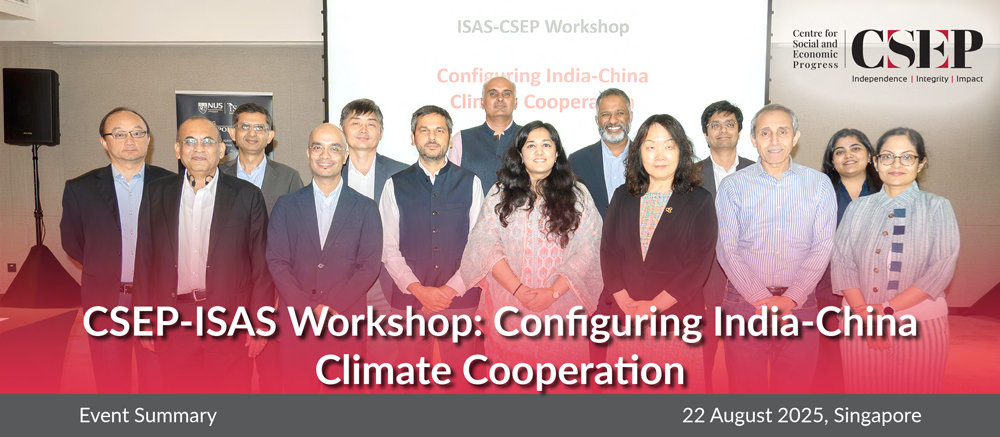
- Centre for Social and Economic Progress (CSEP) and the Institute for South Asian Studies, National University of Singapore (ISAS-NUS) hosted a workshop as part of their on-going research collaboration on “Configuring India-China Climate Cooperation” on 22 August 2025 in Singapore.
- The discussion focused on whether and how India and China can strategically engage on climate and energy diplomacy. It highlighted that by focusing on narrow, functional areas and leveraging multilateral and private sector channels, India and China may find limited but meaningful pathways of collaboration that serve both national interests and global climate goals.
- The participants included think tankers and scholars from research institutes and universities in India and China, as well as representatives from business and multilateral institutions.
Framing India–China Climate Diplomacy
The workshop opened by situating India–China climate relations in a wider geopolitical and historical frame. Presenters introduced the idea of “green diplomacy” as a potential bridge in a relationship otherwise strained by border disputes, strategic rivalry, and global power competition. The key proposition was that, with a strategic approach India and China may still carve out selective spaces of cooperation in climate and energy, which can contribute to trust-building between the two countries.
Participants recalled earlier attempts of cooperation since the 1990s, noting that such efforts peaked in 2015, and tapered off to completely stop in 2020. The current climate–energy agenda is thus seen as part of a cautious “renormalisation,” though understanding its feasibility was repeatedly emphasised as vital. Both countries’ climate ambitions are clear: China has pledged carbon neutrality by 2060, while India has set a net-zero target for 2070.
Several interventions urged greater clarity in the research framing: What precisely is meant by “climate diplomacy”? What are the boundaries between climate, energy, and environmental cooperation? And is the goal to document what India can learn from China, or to identify where practical engagement is possible despite rivalries? These questions set the stage for a deeper thematic exploration.
Trade, Investment, and Supply Chains
A central theme was the economic dimension of climate engagement. China has developed formidable capacities in renewable energy, batteries, and electric mobility. India’s clean energy goals, despite an attempt towards self-resilience remain heavily dependent on imports of Chinese components and critical minerals. This asymmetry creates vulnerabilities for India: trade deficits, exposure to supply disruptions, and the fear of “weaponisation” of minerals. Speakers highlighted Chinese dominance of supply chains and restrictions on critical components, and movement of technical staff.
The debate turned to whether India’s protectionist stance, through measures which screen foreign direct investments (FDI) from neighbouring countries, serves or undermines its long-term climate and energy transition. Some argued that securitising trade deficits is counterproductive. The real question is how to differentiate between strategic and nonstrategic sectors. Others emphasised that self-reliance is not achievable in totality; India must prioritise what requires national security safeguards (semiconductors, rare earths) while allowing freer flows in other areas.
Evidence from Southeast Asia was instructive. Despite geopolitical tensions, countries like Indonesia and the Philippines continue to attract substantial Chinese investment in grids, storage, and electric vehicles (EVs). These cases suggest that political frictions need not preclude sectoral cooperation, provided local frameworks manage risks. For India, one pathway is to expand regional or plurilateral trade engagement, whether through Regional Comprehensive Economic Partnership (RCEP), Comprehensive and Progressive Agreement for Trans- Pacific Partnership (CPTPP).
At the same time, the business-to-business dynamic remains robust even as state-to-state ties falter. Companies continue to collaborate on manufacturing and supply, underscoring the gap between commercial pragmatism and political caution. This divergence was seen by many as both a challenge and an opportunity.
Technology, Knowledge, and Innovation
The technological dimension revealed a stark asymmetry. China today leads the world in patents, research output, and deployment of renewables and storage, while India lacks a cohesive innovation strategy in climate-related fields. One presenter provocatively argued that India has “missed the bus” on many fronts where China invested early and strategically, starting from the 1980s. Direct collaboration in frontier technologies, therefore, is unlikely, given Chinese restrictions on exporting sensitive technologies and India’s weaker research & development (R&D) base.
Still, several areas of pre-competitive or non-sensitive cooperation were identified. These include grid stability, demand-side management, and carbon market design—spaces where both countries face comparable implementation challenges. Climate adaptation, sustainable agriculture, and workforce transitions in coal-dependent regions were also flagged as domains for mutual learning.
Some participants stressed that India must first clarify its own developmental objectives in the energy transition. Is climate policy primarily about mitigation, industrial development, or energy security? Without such clarity, engagement with China risks being ad hoc. Others countered that India need not wait for perfect coherence and that studying China’s successes and failures remains valuable, even if direct transfer is limited. Singapore and the EU were cited as important intermediaries, offering comparative perspectives on how other countries have worked with China.
Overall, the technology debate balanced realism with pragmatism. While high-tech transfer is improbable, targeted exchanges on regulatory mechanisms, adaptation strategies, and best practices remain feasible and worthwhile.
Institutions, Finance, and Future Pathways
The final theme revolved around institutions and finance. Both countries face massive financing needs for their transitions, yet differ in approach. China has built extensive green FDI networks and shaped global taxonomies through platforms like the Network of Greening the Financial System (NGFS), while India has only recently drafted its taxonomy.
Discussions explored three potential pathways for climate finance cooperation; (i) State-led coordination through central banks and multilateral fora; (ii) Bilateral dialogues on taxonomies and finance rules; and (iii) Industry and market-led engagement via investors, asset owners, and cross-border corporate networks.
Examples included proposals for an Indo–China Green Corridor Fund under Asian Infrastructure Investment Bank (AIIB) or the New Development Bank (NDB), linkages between national carbon markets, and cooperation on green bonds and currency swaps. Participants also debated the risks of greenwashing, debt sustainability, and environmental standards in Chinese overseas projects, noting that India must learn from both the strengths and shortcomings of China’s regulatory experience while China could benefit from India’s entrepreneurial and business experiments especially at the grassroots.
On the institutional side, recommendations included reviving dormant bilateral frameworks, expanding Track 2 and subnational cooperation, and insulating climate cooperation from border disputes. Universities, think tanks, and private firms were identified as key actors in this process. The emphasis was on building incremental trust through narrow, issue-specific initiatives rather than sweeping agreements vulnerable to political shocks.
India is dependent in the short and medium term on China to meet its energy goals, yet the relationship is strained by mistrust, asymmetry, and geopolitical rivalry. Climate and energy could be an arena of complementarity. While direct high-tech collaboration is improbable on technologies that China dominates and political barriers are high, there is scope for pragmatic, sectoral engagement in climate adaptation, climate finance, carbon markets, and regulatory learning, jointly working on norms and technologies to shape Global South discourse.




The Centre for Social and Economic Progress (CSEP) is an independent, public policy think tank with a mandate to conduct research and analysis on critical issues facing India and the world and help shape policies that advance sustainable growth and development.