
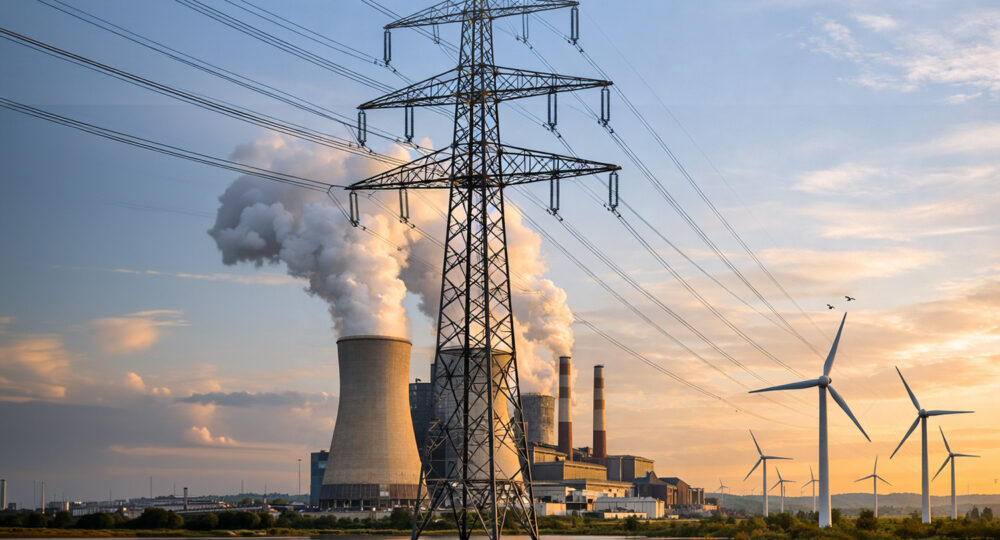
Decarbonising India Isn’t Sequential or Binary With “Power Sector First”
Reading Time: 3 minutesDOWNLOADS
Executive Summary
India has a commitment to net-zero greenhouse gas emissions by 2070, which will require emission reductions across sectors such as power, industry, transportation, and even agriculture/forestry. The question then becomes what is the optimal pathway to do so, while keeping in mind additional objectives of cost, energy security, resilience, jobs, etc.
Conventional wisdom states that countries can or should decarbonise their power sector first, given the low costs of clean energy solutions. Wind and solar are already very inexpensive, and even storage costs are declining rapidly. This generalisation turns out to be only partially true. Beyond just seeking the cheapest solution, there can be other trade-offs depending on whether we seek the fastest decarbonisation versus greatest cumulative emissions reduction.
The Tail of 100% Decarbonisation is Expensive
This paper shows how there are strong non-linearities in decarbonising all sectors, including the power sector. Decarbonising some or even much of the emissions in the power sector may be inexpensive, especially compared to the historical default source, coal, but the tail of emissions is expensive to abate. While the power sector may decarbonise more and faster than other sectors of the economy, India should not lock into an unnecessarily early timeframe for zeroing emissions from the power sector.
India should have a graded plan that accelerates all low-cost emissions across sectors, a calculus that would have higher emissions reductions from the power sector in the short run, but should not treat non-power abatement as a subsequent goal. Because of the inherent variable nature of renewable energy (RE) and demand, even with “cheap storage” secure 100% decarbonisation is expensive. The real need is not cheap RE (or storage) considered as a standalone silo, but using system-wide analysis to determine the lowest cost portfolio of generation, including any judicious use of fossil fuels.
Policy Implications and Recommendations
The current plans for the upcoming carbon credit trading scheme (CCTS) exclude the power sector. Were it to be included, it would put greater pressure on the power sector based on $/tCO₂ (US dollar per ton carbon dioxide) in the near term, but after a point, the costs of decarbonising the power sector would grow non-linearly. There are also a range of complexities around path dependency that complicate a narrow focus on the power sector “going first” in the journey of decarbonisation, ostensibly to give some breathing space for industry and hard-to-abate sectors.
There are several recommendations for more cost-effective decarbonisation for India. Firstly, there should be accelerated electrification of other sectors, especially industry and transportation. Secondly, India should emphasise non-supply options such as energy efficiency. In particular, these should focus on electricity grid dynamics such as time-of-day (ToD). The new need will not be saving energy per se but saving energy at the right time and place, especially during the evening peak. Thirdly, planning should focus on the Pareto 80:20, the lower hanging fruit, which can reduce much of the emissions without worrying about a full zero in any given sector. This aligns with the COVID-inspired “flatten-the-curve” approach, which reduces but delays the peak, lowering total emissions or costs while extending the timeline for zero. In India’s case, the ultimate timeline for zero would be 2070, but sectoral zeros need not be much sooner. Fourthly, the energy transition will require detailed, transparent, and granular modelling—assumptions matter, as does the political economy (including how stakeholders respond). It is possible that modelling would show that the power sector does more early heavy lifting for decarbonisation, but that should be an outcome of the analysis, and not a policy constraint. Lastly, we will need to innovate and evolve new instruments for incentivising the right types of instruments and investments. In the power sector, a simple example is ToD pricing, which is missing for most users today.

Rahul Tongia

Find on this page

The Centre for Social and Economic Progress (CSEP) is an independent, public policy think tank with a mandate to conduct research and analysis on critical issues facing India and the world and help shape policies that advance sustainable growth and development.