
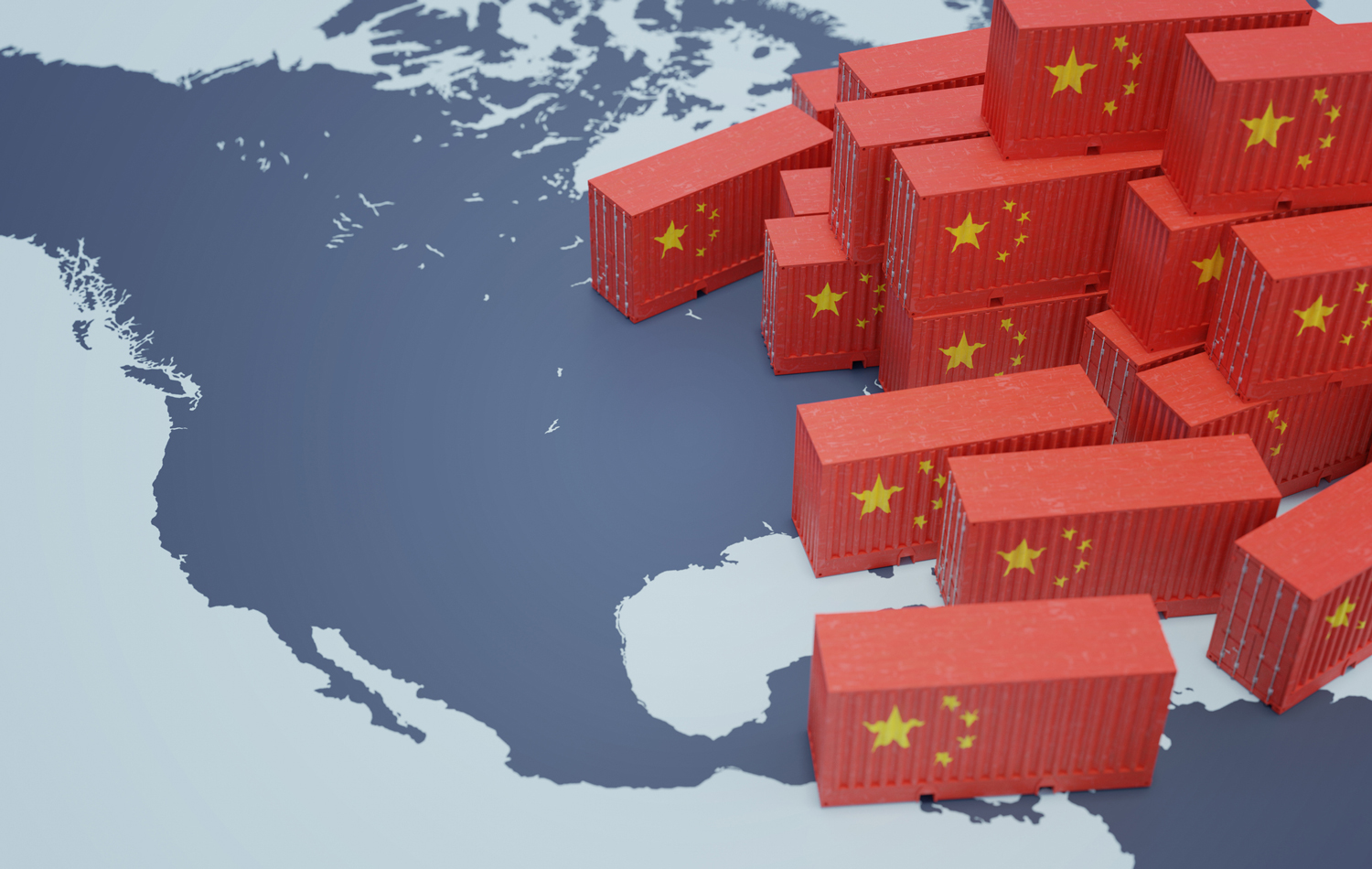
In Conversation With Ram Charan
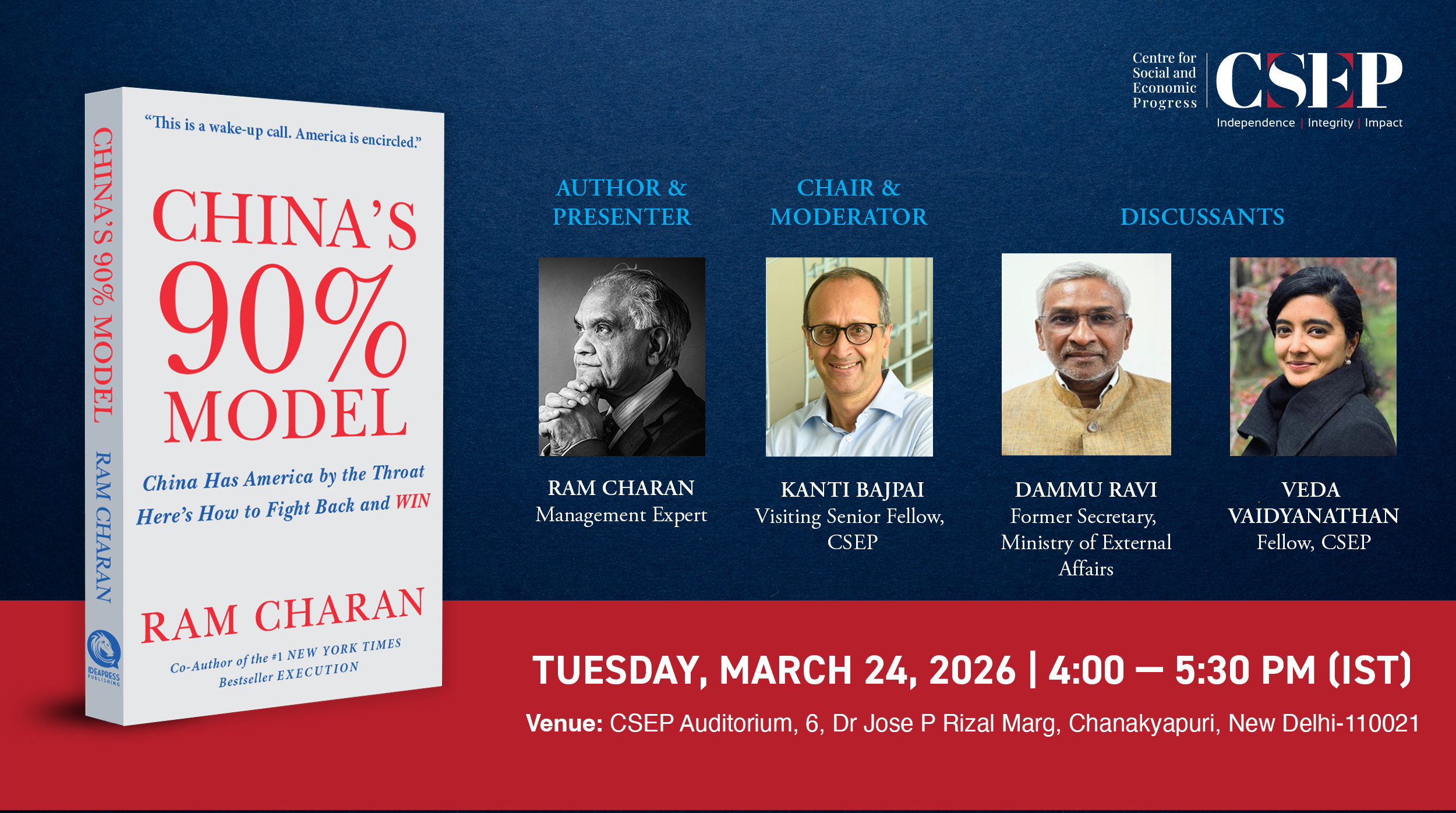
The Centre for Social and Economic Progress (CSEP) invites you to a special discussion with Ram Charan, one of the world’s most influential business advisers and bestselling authors.
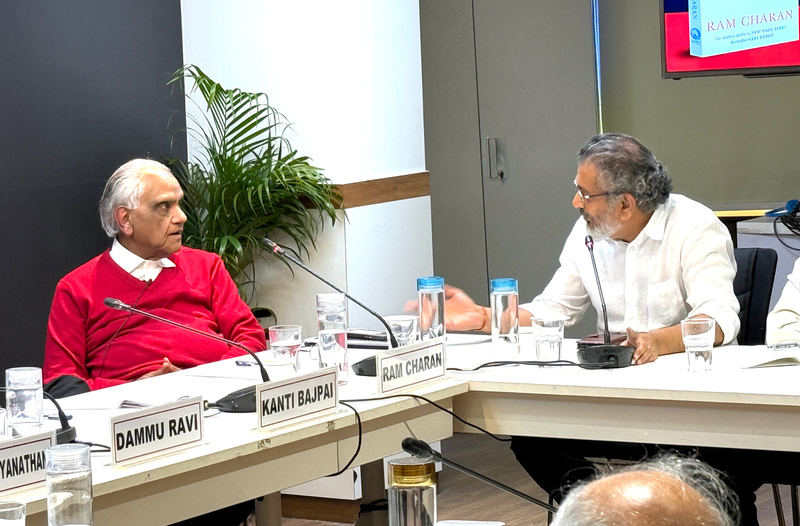
Drawing on decades of experience working with leading global companies, in both India and China, Ram Charan will present key ideas from his latest book, China’s 90% Model.
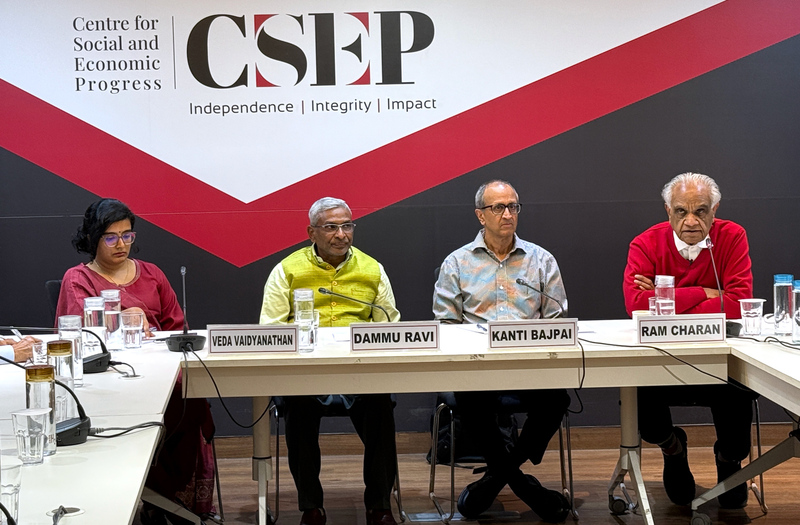
The presentation will be followed by a discussion with Dammu Ravi, Former Secretary, Ministry of External Affairs, and Veda Vaidyanathan, Fellow, CSEP. The session will be chaired and moderated by Kanti Bajpai, Visiting Senior Fellow, CSEP.
Extending beyond the book’s focus on US companies, the conversation will also reflect on the relevance of these ideas for India.
Join us for an opportunity to engage directly with one of the foremost thinkers on leadership and execution, and to reflect on what changing global dynamics mean for businesses and policymakers alike.
Please note: This is an in-person event. A recording will be available on the CSEP website and YouTube channel after the event.
Author & Presenter
Ram Charan
Ram Charan is a world-renowned business adviser, author, and speaker recognised for his expertise in corporate governance, strategy, and execution. With four decades of experience consulting for Fortune 500 CEOs (GE, Bank of America, KLM), he specialises in cutting through complexity to provide practical, actionable advice to top business leaders.
Ram Charan is also a bestselling author of books like Execution, Leaders at all Levels, Leadership in the Era of Economic Uncertainty, Boards that Deliver and Every Business is a Growth Business.
Chair & Moderator
Kanti Bajpai
Kanti Bajpai is Visiting Senior Fellow, CSEP, Visiting Professor, Department of International Relations, Ashoka University and Emeritus Professor, Lee Kuan Yew School of Public Policy, National University of Singapore.
Before this, he held academic positions at the Lee Kuan Yew School of Public Policy, National University of Singapore (2011-25), Department of Politics and International Relations, Oxford University (2009-2010), the School of International Studies, Jawaharlal Nehru University (1994-2003), and the Maharajah Sayajirao University of Baroda (1989-1991). He was Headmaster, The Doon School, India (2003-2009).
Dr Bajpai has also held various visiting positions – at Wesleyan University, the University of Illinois at Urbana-Champaign, the Rajiv Gandhi Institute for Contemporary Studies in New Delhi, the Joan B. Kroc Institute for Peace at Notre Dame University, the Brookings Institution in Washington, D.C., and the Australian Defence Force Academy (ADFA) in Canberra. In 2010, he was Distinguished Fellow, Institute for Defence Studies and Analyses (IDSA) in New Delhi.
His main areas of research are Indian foreign policy and national security, South Asia, Asian international and strategic thought, and international security.
Most recently, Dr Bajpai published How Realist is India’s National Security Policy (Routledge, 2023), India Versus China: Why They Are Not Friends (Juggernaut, 2021), The Routledge Handbook of China-India Relations (2020, with Manjari Chatterjee Miller and Selina Ho), and India, the West, and International Order (2019, with Siddharth Mallavarapu). He is currently working on a book on India’s security.
Discussants
Dammu Ravi
Dammu Ravi retired as Secretary (Economic Relations) in the Ministry of External Affairs in August 2025.
He joined the Indian Foreign Service in 1989 and did postings in Indian missions in Mexico, Cuba and Brussels in the 1990s. At Headquarters, in his capacity as Director (2002-2005), he handled India’s relations with West European countries, EU and UN multilateral issues such as Development, Environment and Climate Change. As Joint Secretary for Latin America and Caribbean countries (2009-2013), he worked to deepen India’s engagement with the region.
During his deputation to the Department of Commerce (2014-2020), Mr Ravi handled India’s trade policy and World Trade Organization (WTO) issues and was a lead negotiator for the Regional Comprehensive Economic Partnership (RCEP).
As Chief Coordinator for COVID during lockdown, he coordinated disbursement of medicines and equipment and evacuation of Indians abroad through Vande Bharat flights.
As Secretary (Economic Relations) in the Ministry of External Affairs from Aug 2021 – Aug 2025, Mr Ravi handled mostly geo-economics issues related to India’s strategic objectives through Development Assistance to countries in the Global South; partnership with Africa; Multilateral Economic relations; and New and Emerging Strategic Technologies. He was India’s Sherpa for BRICS, IBSA, I2U2 and G7.
Mr Ravi has published several research papers on trade, investment, economic cooperation and integration. He regularly does book reviews for various dailies/magazines.
Mr Ravi holds a Master’s degree in Political Science from Jawaharlal Nehru University, Delhi.
Veda Vaidyanathan
Veda Vaidyanathan is a Fellow in Foreign Policy and Security Studies at CSEP. She examines Asian engagement in Africa from the grassroots, across multiple sectors and countries. These include financial services, mining, agriculture, infrastructure, and manufacturing in Zimbabwe, Zambia, Tanzania, Kenya, Ethiopia, and Ghana. Veda is also affiliated to the Institute of Chinese Studies and the Harvard University Asia Centre. She was a 2022-23 Fung Global Fellow at the Princeton Institute for International and Regional Studies at Princeton University.
All content reflects the individual views of the speakers. The Centre for Social and Economic Progress (CSEP) does not hold an institutional view on any subject.
Please contact Gurmeet Kaur at GKaur@csep.org for general queries and Ayesha Manocha at AManocha@csep.org for media queries.






The Centre for Social and Economic Progress (CSEP) is an independent, public policy think tank with a mandate to conduct research and analysis on critical issues facing India and the world and help shape policies that advance sustainable growth and development.