
India-Europe Geoeconomic Convergence: IMEC and Beyond
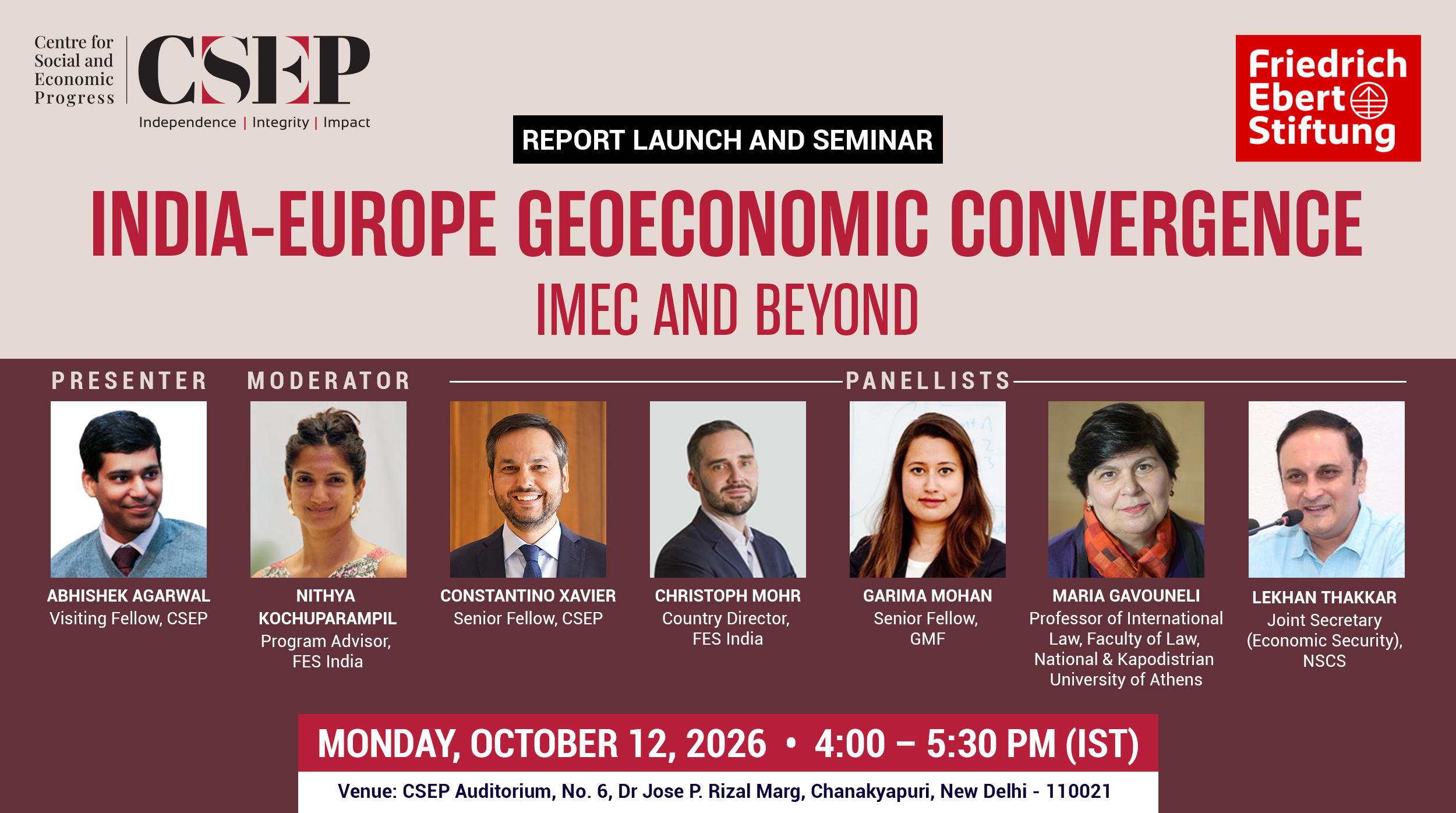
The Centre for Social and Economic Progress (CSEP) is pleased to invite you to the Report Launch and Seminar titled “India-Europe Geoeconomic Convergence: IMEC and Beyond”, organised in collaboration with Friedrich-Ebert-Stiftung (FES) on Monday, October 12, 2026, from 4:00 to 5:30 pm (IST).
The seminar will begin with Abhishek Agarwal, Visiting Fellow, CSEP, presenting the key findings from the new CSEP report “India and Europe: Bridging Continents Through IMEC”. This will be followed by a panel discussion featuring Constantino Xavier, Senior Fellow, CSEP; Christoph Mohr, Country Director, FES India; Garima Mohan, Senior Fellow, GMF; Maria Gavouneli, Professor of International Law, Faculty of Law, National & Kapodistrian University of Athens; and Lekhan Thakkar, Joint Secretary (Economic Security), National Security Council Secretariat (NSCS). The discussion will be moderated by Nithya Kochuparampil, Program Advisor, FES India.
The event will be held at the CSEP Auditorium, 6, Dr Jose P Rizal Marg, Chanakyapuri, New Delhi – 110021. Please note that this is an in-person event only. If you are in Delhi on the day, we invite you to join us for what promises to be a thought-provoking discussion. The event will be available on the CSEP website and YouTube channel upon completion.
About the event
About to sign a historic free trade deal, India and Europe are seeking deeper economic integration amid significant shifts in global trade, supply chains, energy systems, and geopolitics. Building on the new CSEP report, the discussion will examine both the practical challenges facing IMEC and its potential to become a building block for a wider India-Europe geoeconomic partnership, including through deeper trade, investment, technology, supply-chain and regional security cooperation. The panel discussion will focus on three key questions:
- Making IMEC work: How can India, Europe and their regional partners translate the political vision for IMEC into commercially viable connectivity? What role will infrastructure, logistics, financing, digital systems, regulatory coordination, and private-sector participation play?
- Geoeconomic convergence: How can trade, investment, supply-chain diversification, technology, energy cooperation, and the India-EU Free Trade Agreement reinforce a more resilient and mutually beneficial economic partnership?
- Global connectivity partnerships: How can India and Europe build a wider geoeconomic partnership that extends beyond a single corridor? What new forms of connectivity, economic and security cooperation could strengthen India-Europe ties amid a changing global order?
Presenter
Abhishek Agarwal
Abhishek Agarwal is a Non-Resident Fellow at NITI Aayog and a Visiting Fellow at the Centre for Social and Economic Progress (CSEP) in New Delhi. A co-creator, nurturer and eager learner, Abhishek actively sows and nurtures ideas that develop into significant programs and reforms in infrastructure governance and cooperation management. Key past initiatives include PM GatiShakti, Integrated Infrastructure Planning, Infrastructure Digitalization, De-risking & Resilience, Alternate Financing Mechanisms, Smart Cities, RURBAN, City-Regions (Growth Hubs), District Area Development Approach, Leveraging Tourism, Vibrant Village Program, and Hierarchical Spatial Governance. Multi-sectoral collaborations, member of various committees, appraising ~1700 mega-projects ($640bn) and convergence framework for 5000 micro projects and facilitating bilateral and multilateral engagements are key recent highlights. Past associations include NITI Aayog, GIZ, UNDP, Odisha, Tamil Nadu, Rajasthan, IL&FS, GIFT City, Gujarat Tourism Opportunities (GUJTOP), Gujarat Industrial Infrastructure Projects Limited (GIIPL), and partnerships with various Industrial Development Authorities and Municipal Corporations. Abhishek is an alumnus of the prestigious International Visitors Leadership Program (IVLP) of the Department of State (Govt. of US) for ‘Cooperation on Infrastructure for the Indo-Pacific’.
Moderator
Nithya Kochuparampil, based in New Delhi, is currently a Foreign and Security Policy Programme Advisor at Friedrich-Ebert-Stiftung, India. She brings experience from previous roles at Justice Adda, the Ministry of External Affairs, India and The Delma Institute | مركز دلما للدراسات. Nithya holds a Master of Arts (M.A.) in International Security from Sciences Po. Her skill set spans Political Risk Analysis, South Asia, Report Writing, Research Analysis, and Middle Eastern Studies
Panellists
Christoph P. Mohr
Christoph P. Mohr is the Country Director of the Friedrich-Ebert-Stiftung (FES) in India. His work focuses on geopolitics, geoeconomics, and international relations. Within FES, he has served as Regional Director in Kazakhstan and Uzbekistan, Associate Representative in Kenya and South Sudan, and Policy Advisor in Germany. He studied International Relations, Political Science and Economics in Marburg, Darmstadt, and Istanbul. His current work focuses on how the shift toward a new global order is reshaping economic statecraft, the EU–India partnership, and the strategic choices facing Europe and Asia, with a long-standing interest in the intersection of technology and political economy. He advises senior stakeholders and engages business, policy and diplomatic networks across both regions. Christoph writes regularly on European and Asian affairs and appears across a range of media formats, from television to podcasts. He authors a monthly column, A Letter from Europe, for India’s World magazine, and co-edited the volume The Politics of Migration and the Future of the European Left (2017).
Garima Mohan
Garima Mohan is a Brussels-based Senior Fellow in the Indo-Pacific program and the lead of the India Initiative at the German Marshall Fund (GMF). Her research focuses on Europe-India ties, EU foreign policy in Asia, and security in the Indo-Pacific. Prior to joining GMF, she was the acting team leader and coordinator for the EU’s Asia-Pacific Research and Advice Network, which supports EU policymakers on issues concerning the Asia-Pacific. She also led the Global Order program at the Global Public Policy Institute in Berlin. She holds a PhD from the Freie Universität Berlin and a master’s degree from the London School of Economics. She was a non-resident fellow at Carnegie India, an Asian Forum for Global Governance Fellow, and a 2017 Raisina Young Fellow. She has published widely on Indian foreign and security policy, EU-Asia relations, Germany-India ties, and maritime security in the Indo-Pacific, and is a frequent commentator for European and Indian media including the Neue Zürcher Zeitung, The Hindu, The Wire, and Deutsche Welle.
Maria Gavouneli
Maria Gavouneli is a Professor of International Law at the National & Kapodistrian University of Athens. She is also President of the Greek National Commission of Human Rights. She was previously Director General at the Hellenic Foundation for European & Foreign Policy (ELIAMEP). She was a Fulbright Visiting Scholar at the University of California Berkeley from 2018-19 and a Visiting Professor at several universities and research institutions, including The Hague Academy of International Law, Royal Institute of International Affairs (Chatham House), Tulane University (USA), the University of Edinburgh (Brodies Lecture), and the University of Oxford. She has published extensively on the law of the sea, energy and environmental law as well as migration issues. Professor Gavouneli holds a PhD and an LLM in International Law from the University of Cambridge.
Lekhan Thakkar
Lekhan Thakkar is a career Indian civil servant and currently serves as Joint Secretary in the National Security Council Secretariat (NSCS), Government of India. He works at the intersection of national security, technology policy, and economic resilience, with a focus on deep-tech R&D, critical minerals, and secure supply chains. A Chartered Accountant and Cost Accountant, he has held senior roles in the Ministry of Finance and served as Counsellor (Economic) at the Indian Embassy in Beijing, contributing to economic diplomacy during a critical phase of India–China relations. He actively engages with industry and international partners to advance trusted technology cooperation and strategic innovation.
Constantino Xavier
Constantino Xavier is a Senior Fellow at the Centre for Social and Economic Progress (CSEP), New Delhi, where he directs the program in Foreign Policy and Security Studies. He is also a non-resident fellow in the Foreign Policy program at the Brookings Institution, in Washington DC, and visiting professor at Ashoka University’s Department of International Relations. His research expertise is on India’s role as a regional power in South Asia, the Bay of Bengal and Indian Ocean regions, especially relations with Nepal, Bangladesh, Sri Lanka and Myanmar. His studies under the CSEP Sambandh Initiative on Regional Connectivity have had wide impact with governments, industry and other stakeholders invested in enhancing India’s geoeconomic integration with neighbouring countries and regions, from the Gulf to Southeast Asia. His broader work explores how India navigates the geopolitics of a changing regional and global order by balancing national security interests and growing economic interdependence. He also focuses on India’s relations with the European Union and other Indo-Pacific powers across the Global South.
All content reflects the individual views of the speakers. The Centre for Social and Economic Progress (CSEP) does not hold an institutional view on any subject.
Please contact Gurmeet Kaur at GKaur@csep.org for general queries and Ayesha Manocha at AManocha@csep.org for media queries.




The Centre for Social and Economic Progress (CSEP) is an independent, public policy think tank with a mandate to conduct research and analysis on critical issues facing India and the world and help shape policies that advance sustainable growth and development.