

Leveraging Digital Bharat Nidhi for Rapid Digital Inclusion
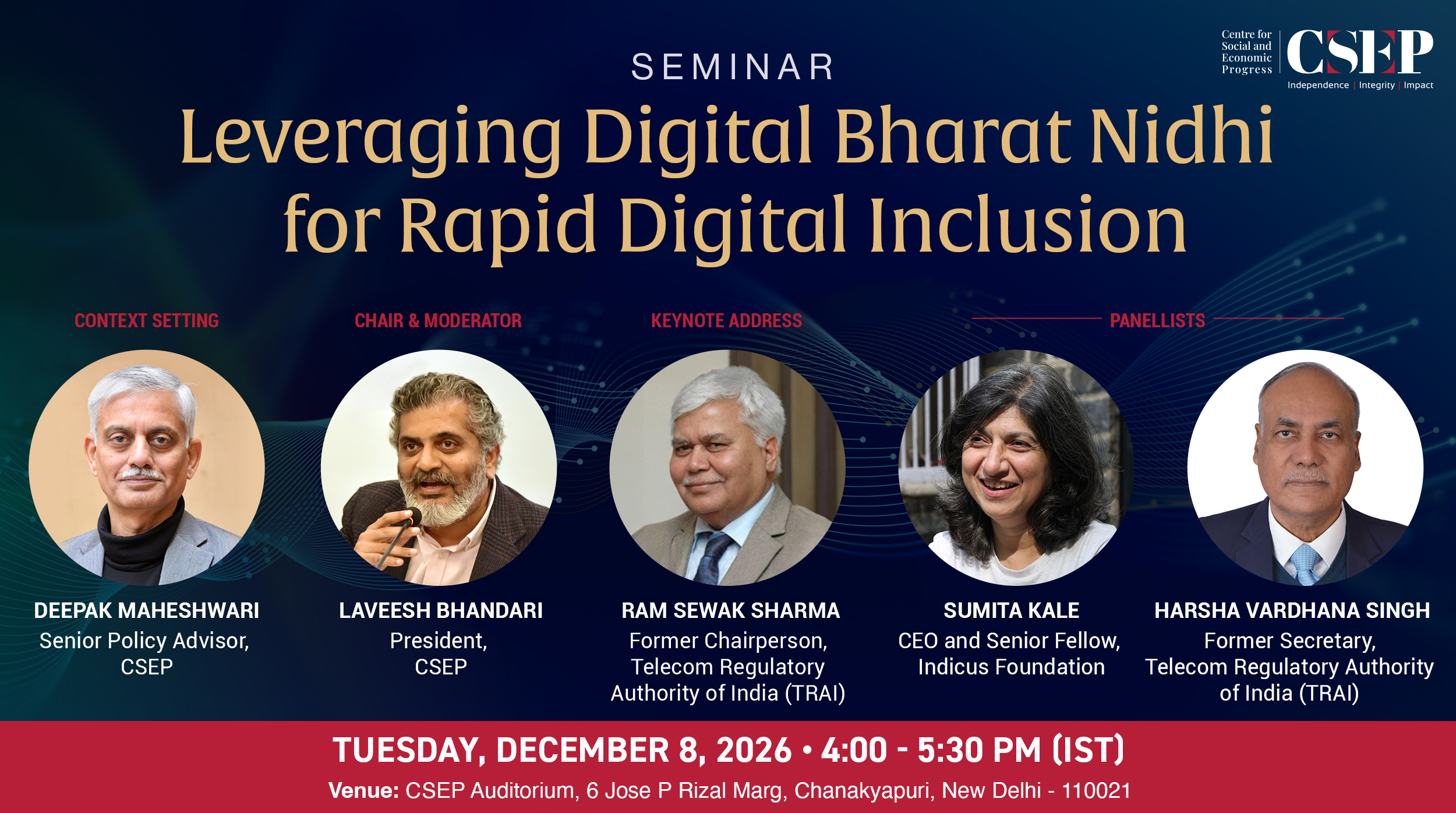
The Centre for Social and Economic Progress (CSEP) is pleased to invite you to a seminar titled “Leveraging Digital Bharat Nidhi for Rapid Digital Inclusion” on Tuesday, December 8, 2026, from 4:00 to 5:30 pm.
The event will feature a keynote address by Ram Sewak Sharma, Former Chairperson, Telecom Regulatory Authority of India (TRAI), followed by a panel discussion with Sumita Kale, CEO and Senior Fellow, Indicus Foundation; and Harsha Vardhana Singh, Former Secretary, Telecom Regulatory Authority of India (TRAI). The discussion will be chaired and moderated by Laveesh Bhandari, President, CSEP. Deepak Maheshwari, Senior Policy Advisor, CSEP, will set the context.
The seminar will be held at the CSEP Auditorium, 6, Dr Jose P Rizal Marg, Chanakyapuri, New Delhi – 110021.
Please note that this is an in-person event only. If you are in Delhi on the day, we invite you to join us for what promises to be a thought-provoking discussion. The event will be available on the CSEP website and YouTube channel upon completion.
About the event
India’s digital infrastructure has grown in terms of coverage and capacity as well as in terms of usage and utility. However, hundreds of millions remain beyond its reach, often due to geographical dark spots, the gender digital divide and generational challenges in adapting to the digital paradigm.
At the same time, the corpus of Digital Bharat Nidhi (DBN) – a statutory non-lapsable fund, has increasingly grown beyond Rupees One Lakh Crore since its debut in 2002, then known as the predecessor Universal Service Obligation Fund.
The seminar is an endeavour to explore pragmatic policy solutions to leverage the DBN for accelerated digital inclusion of those at the margins, considering that the Supreme Court recently held that the access and use of the internet is a fundamental right under the Constitution.
Keynote Address
Ram Sewak Sharma
Ram Sewak Sharma is a retired IAS officer of the 1978 batch belonging to the Jharkhand cadre, with an outstanding career of almost half a century in public service.
He has been an ardent practitioner of using technology for inclusion and empowerment. As the founding Director General of UIDAI, he co-architected Aadhaar, giving over a billion people a foundational digital identity. Later, as Secretary of Electronics and Information Technology, he brought the ‘Digital India’ programme to life with breakthroughs like UPI, DigiLocker, and eKYC that transformed how Indians use public services and payments.
As the TRAI Chairperson, he laid out the foundation of Net Neutrality, and as the first Chair of the National Health Authority, he worked towards universal healthcare through Ayushman Bharat and CoWIN.
An oft-invited speaker and columnist, he also authored a bestseller on Aadhaar.
Chair & Moderator
Laveesh Bhandari
Laveesh Bhandari is an economist, entrepreneur, and strategic advisor with extensive experience in economic policy, business strategy, data analytics, and institution building. He is President and Senior Fellow at the Centre for Social and Economic Progress (CSEP), one of India’s leading public policy think tanks.
He has founded, scaled, and successfully exited three businesses, including Indicus Analytics, a pioneering economic research and data analytics firm in India. An accomplished economist, his research spans industrial development, economic reforms, financial inclusion, sustainable livelihoods, and energy transition.
Dr Bhandari holds a PhD in Economics from Boston University, where his doctoral research received the Best Thesis Award in International Economics. He is also a Visiting Professor of Practice at the London School of Economics and Political Science (LSE).
Panellists
Sumita Kale
Sumita Kale, CEO and Senior Fellow at Indicus Foundation, is a financial and macro-economist. She works extensively on financial inclusion, leading the Indicus Centre for Financial Inclusion since 2011 and has a keen interest in urban environmental issues.
Sumita is also associated with Jocata, researching small businesses. She has numerous research publications and op-eds in major newspapers. Sumita has an MPhil in Economics of Developing Countries from the University of Cambridge and a PhD in Economics from the University of Pune.
Harsha Vardhana Singh
Harsha Vardhana Singh is chairperson of IKDHVAJ Advisers LLP, a boutique consulting firm on trade policies, industrial policies, and regulatory policies. He is a distinguished visiting fellow at the Institute of Studies in Industrial Development; senior fellow at the Pune International Centre; adviser at Global Trade Observer, New Delhi; member of the Confederation of Indian Industry’s Trade Policy Council; and board member of the International Institute for Sustainable Development (Canada and Switzerland).
A Rhodes Scholar, he has been a senior fellow at think tanks in India, the United States, Canada, and Switzerland; member or chair of high-level policy groups and committees in India and abroad on trade, industrial, and competition policy; member of the GATT/WTO Secretariat for twenty years, including eight years as deputy director general of the World Trade Organization; secretary of the Telecom Regulatory Authority of India; and chairman of the governing body of the Agricultural Economics Research Centre, University of Delhi.
Context Setting
Deepak Maheshwari
Deepak Maheshwari, Senior Policy Advisor at the Centre for Social and Economic Progress, is a policy professional in the realm of digital ecosystem with more than three decades of experience across think tanks, industry, and associations.
He has served on the government committees on AI and Accessibility. He has also volunteered as Global Chair of the IEEE Internet Initiative; Secretary of the ISP Association of India; and advisory board member of the IIM Ahmedabad–Idea Telecom Centre of Excellence. He co-founded National Internet Exchange of India and the ITU-APT Foundation of India.
A graduate in engineering from the Indian Institute of Technology, he also holds a law degree, providing him with a multidisciplinary lens with sharp insights across technology, governance, and inclusion.
All content reflects the individual views of the speakers. The Centre for Social and Economic Progress (CSEP) does not hold an institutional view on any subject.
Please contact Gurmeet Kaur at GKaur@csep.org for general queries and Ayesha Manocha at AManocha@csep.org for media queries.







The Centre for Social and Economic Progress (CSEP) is an independent, public policy think tank with a mandate to conduct research and analysis on critical issues facing India and the world and help shape policies that advance sustainable growth and development.