

Are Quality Control Orders Disrupting India’s Supply Chain? Evidence from the Chemical Sector
Reading Time: 5 minutesEditor's Note
Editor’s Note: This blog draws on the authors’ CSEP working paper, Quality Control Orders in India’s Chemical Sector: Supply-Chain Pressures and Firm-Level Outcomes, which examines how quality control orders affect chemical-using firms and manufacturing supply chains, with particular attention to differences across firm sizes. This blog presents the paper’s key findings in a more accessible format.
The year 2025 brought some relief to industries that had been facing competitiveness pressures arising from Quality Control Orders (QCOs), as the Government of India revoked or suspended several QCOs covering products such as plastics, steel, chemicals, textiles, and critical minerals. Many of these products are key intermediate inputs used across manufacturing supply chains. This shift towards a more calibrated approach continued with the Transition Facilitation (Quality Control) Order, 2026, which provides eligible firms greater flexibility in meeting BIS certification requirements. However, a substantial number of QCO-covered products remain subject to mandatory standards, including several important intermediate goods, raising concerns about their potential impact on domestic manufacturing supply chains.
What are Quality Control Orders?
Put simply, QCOs turn product standards into conditions for market access. They are intended to protect human, animal, and plant health, improve environmental safety, prevent unfair trade practices, and address national-security concerns.
QCO coverage has expanded rapidly, from 70 products in 2017 to 756 by December 2024
QCOs derive their legal backing from the Bureau of Indian Standards [BIS] Act, 2016, which was notified on 22 March 2016 and brought into force in October 2017, replacing the BIS Act, 1986. The Act enables the government to make compliance with specified Indian Standards mandatory through QCOs. Under Section 16, the relevant line ministry notifies a QCO, while the BIS oversees certification and conformity requirements.
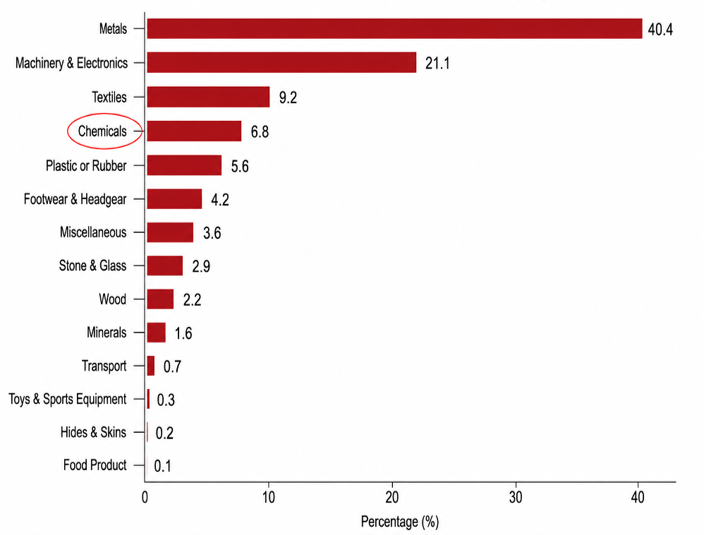
The chemical sector is the fourth-largest sector to be affected by QCOs, after Metals, Machinery & Electronics, and Textiles
QCO coverage has expanded rapidly, from 70 products in 2017 to 756 by December 2024. Importantly, around 46% of QCO-covered products were intermediate goods. This expansion has raised concerns about the implications of QCOs for domestic manufacturing and supply chains.
Empirical analysis for the period 2000 to 2023 shows that India’s imports of QCO-impacted goods declined by around 24% over a three-year period after QCO implementation, while imports of QCO-impacted intermediate goods experienced an even larger decline of approximately 30% (Prabhakar, 2025). This suggests that QCOs are likely to create supply chain disruptions for import-dependent domestic production.
The chemical sector is particularly relevant in this context. It is the fourth-largest sector to be affected by QCOs, after Metals, Machinery & Electronics, and Textiles (Figure 1).
Figure 1: Sectoral Distribution of QCOs (in %)
Source: Reproduced from Prabhakar (2025).
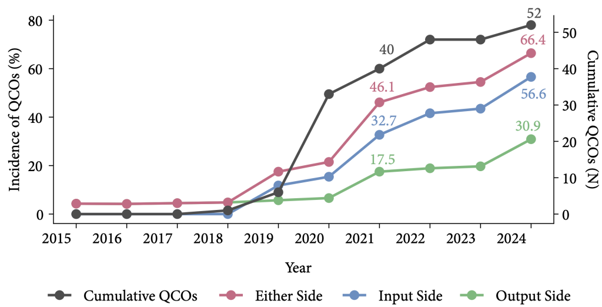
Exposure to the regulation expanded from 12% of chemical-using firms in 2019 to 56.6% of firms by 2024
Growing QCO Exposure Across Chemical-Using Firms
Table 1 ranks the top chemical-using manufacturing industries. Unsurprisingly, the chemicals and chemical products industry itself is the largest consumer, followed by rubber and plastic products, pharmaceuticals and electronics. Chemicals are a foundational input into many downstream manufacturing sectors. Therefore, regulations on chemical products can have economy-wide supply chain implications.
Table 1: Top Chemical User Industries
| Rank | National Industrial Classification Code | Industry: Manufacture of | Per cent |
| 1 | 20 | Chemicals and chemical products | 29.0 |
| 2 | 22 | Rubber and plastic products | 18.3 |
| 3 | 21 | Pharmaceuticals, medicinal chemical and botanical products | 12.6 |
| 4 | 27 | Electrical equipment | 6.7 |
| 5 | 23 | Other non-metallic mineral products | 3.9 |
Source: Reproduced from Prabhakar and Gupta (2026)
As shown in Figure 2, the first QCO on chemicals was introduced in 2018, with coverage expanding to 52 chemical products by 2024 (denoted by the black line). Consequently, exposure to the regulation expanded from 12% of chemical-using firms in 2019 to 56.6% of firms by 2024 (denoted by the blue line).
Figure 2: Proportion of Quality Control Order-Impacted Firms in the Chemical-Using Sector (%)
Source: Reproduced from Prabhakar and Gupta (2026).
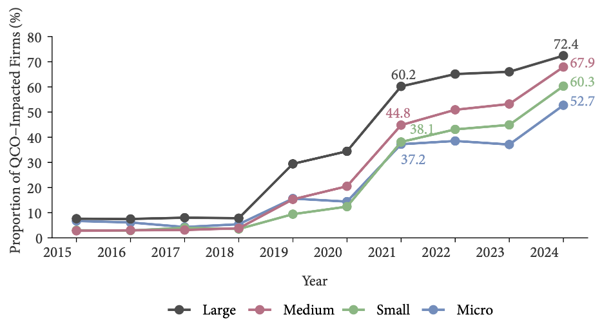
In 2024, large firms accounted for about 72.4% of all chemical-using firms impacted by QCOs, followed by 67.9% of medium firms, 60.3% of small firms, and 52.7% of micro firms.
Figure 3 shows how QCO exposure varies across firms of different sizes from 2015 to 2024. Firms are classified into four categories based on turnover (total output), following the post-2020 MSME definition: micro (< ₹5 crore), small (₹5–50 crore), medium (₹50–250 crore), and large (> ₹250 crore).
The data show that, in 2024, large firms accounted for about 72.4% of all chemical-using firms impacted by QCOs, followed by 67.9% of medium, 60.3% of small, and 52.7% of micro firms. For the period before 2019, the impact of QCO exposure on chemical-using firms is observed only through the output channel, since the first QCO on chemicals was introduced in 2018.
Figure 3: Proportion of Quality Control Order-Impacted Firms Across Various Sizes
Source: Reproduced from Prabhakar and Gupta (2026)
Policy Recommendations
QCOs on chemical inputs affect a growing number of downstream firms, both large and small, indicating the potentially widespread implications of these regulations for manufacturing supply chains.
To rectify the situation, QCOs need to be rethought from two broad perspectives: their introduction and their implementation. Concerning the introduction, it is important to understand how the criteria for introducing QCOs are determined, particularly in cases where the objective of ensuring product quality must be balanced against maintaining supply-chain efficiency and cost competitiveness in the domestic market.
In terms of implementation, MSMEs, being crucial suppliers within many production value chains, need targeted support to comply with QCO requirements. Ensuring smoother compliance processes will be essential to prevent supply-chain disruptions and to maintain the competitiveness of smaller firms.
Table 2: Policy Focus Areas
| Policy Area | Policy Recommendation |
| Clear criteria for QCO implementation | Implement QCOs strictly for quality and safety objectives; clearly specify the rationale (human, animal, plant health, environment, child safety, unfair trade practices) in notifications |
| Limiting QCOs on intermediate goods | Avoid or minimise QCOs on intermediate goods, particularly in upstream sectors like metals, chemicals, and textiles |
| Assess domestic production capability | Evaluate domestic availability and capacity before imposing QCOs; ensure domestic production can meet demand |
| Compliance and testing capability | Strengthen testing, standards, and certification infrastructure, and provide targeted support to MSMEs |
To achieve India’s Viksit Bharat goals, the manufacturing sector is likely to play a pivotal role, with its competitiveness critically dependent on the efficiency and resilience of domestic supply chains. In this context, regulations that potentially disrupt the functioning of manufacturing supply chains require careful attention and reassessment. Ensuring that the regulatory framework facilitates rather than constrains efficient access to critical inputs will be essential for strengthening India’s global competitiveness and enabling Indian firms to integrate more deeply into global value chains.

Prerna Prabhakar

Nancy Gupta


Find on this page

The Centre for Social and Economic Progress (CSEP) is an independent, public policy think tank with a mandate to conduct research and analysis on critical issues facing India and the world and help shape policies that advance sustainable growth and development.