
Deep-Sea Mining and India’s Critical Minerals Challenge
Reading Time: 5 minutesThe global transition towards clean energy has placed critical minerals at the centre of economic and strategic policymaking. These minerals are essential for electric vehicles, battery storage systems, and renewable energy technologies, yet their extraction and processing remain concentrated in a small number of countries. India is 100 per cent import-dependent for several critical minerals, including lithium, cobalt and nickel, which can lead to supply chain disruptions and vulnerabilities. Therefore, India is seeking to strengthen domestic supply, including exploration of its deep-sea resources.
Among the most promising deep-sea resources are polymetallic nodules, naturally occurring mineral deposits found on abyssal plains at depths of around 4,000 to 6,000 meters. Formed through the gradual accumulation of dissolved metals from seawater, they contain commercially significant concentrations of manganese, nickel, copper and cobalt within a single resource, making them an increasingly attractive complement to terrestrial mineral sources.
India holds exploration rights over 75,000 km² in the Central Indian Ocean Basin (CIOB) under a contract with the International Seabed Authority (ISA)
India holds exploration rights over 75,000 km² in the Central Indian Ocean Basin (CIOB) under a contract with the International Seabed Authority (ISA), covering part of the international seabed beyond national jurisdiction, where an estimated 366 million metric tonnes of polymetallic nodules have been identified. Through the Deep Ocean Mission (DOM), India is developing the scientific, technological and engineering capabilities needed to assess these resources to better understand deep-sea ecosystems.
India’s deep-sea resources could help diversify its critical mineral supplies, but their potential remains uncertain.
India’s deep-sea resources could help diversify its critical mineral supplies, but their potential remains uncertain. Assessing whether they can contribute to mineral security responsibly will require stronger scientific baselines and environmental monitoring.
India’s Evolving Deep-Sea Resource Strategy
Although India’s focus on critical minerals is relatively recent, its interest in deep-sea mineral resources dates back several decades. India began surveying the Indian Ocean for polymetallic nodules in the early 1980s, collecting its first sample in 1981. This early exploration preceded the allocation of an area in the international seabed in the CIOB in 1987.
All exploration beyond national jurisdiction is regulated by the ISA, established under the United Nations Convention on the Law of the Sea (UNCLOS). The ISA awards exploration contracts and is developing the Mining Code, which will govern future commercial exploitation. Commercial deep-sea mining (DSM) has not yet begun, as the ISA is yet to finalise and adopt the exploitation regulations required to authorise mining in international waters. The prospect of mining these resources remains highly contested.
India’s key milestones in deep-sea exploration and international seabed governance are outlined below.
| Year | Milestone | Significance |
| 1981 | India collected it’s first polymetallic nodule sample from the Indian Ocean. | Marked an early step in India’s deep-sea mineral exploration. |
| 1987 | India became the first country to be registered as a Pioneer Investor and received an initial exploration area of 150,000 km². | Established India’s formal position in the international seabed exploration regime. |
| 1987–2002 | India relinquished 50 per cent of its allocated area in phases, retaining 75,000 km² for further exploration. | Defined the area available for continued exploration. |
| 2001 | The ISA awarded its first exploration contract for polymetallic nodules. | Marked an early milestone in the ISA’s system of exploration contracts. |
| 2026 | India’s representative, Mayank Joshi, was elected President of the ISA Council for its 31st session, following nomination by the Asia-Pacific Group and election by acclamation. | Reflected India’s representation in international seabed governance. |
India’s early investment established a long-standing exploration programme and provided a basis for continued assessment of polymetallic nodules in the CIOB. Its retained exploration area enables further investigation of seabed resources, alongside research into deep-sea technologies and environmental conditions.
India’s deep-sea activities also extend to its own maritime areas. In 2024, it demonstrated the collection of over 100 kg of cobalt-rich polymetallic nodules from a depth of 1,173 metres in the Andaman Sea, illustrating the development of its deep-sea collection capabilities.
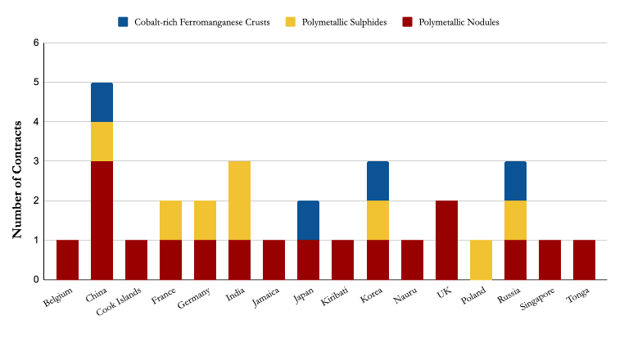
Figure 1 places India’s exploration programme in the wider international context, showing ISA exploration contracts by sponsoring government and resource type.
Figure 1: ISA Contracts for Seabed Mining by Sponsoring Government and Resource Type, as of 2026
Source: Authors’ illustration based on publicly available data from International Seabed Authority.
The scale and composition of these resources have helped shape the direction of India’s deep-sea programme. According to the Ministry of Earth Sciences, the polymetallic nodules contain average concentrations of 25.2% manganese, 1.14% nickel, 1.09% copper, and 0.14% cobalt. India has also expanded its engagement beyond nodules, signing its first ISA exploration contract for polymetallic sulphides in 2016 and a second in 2025, covering areas of the Indian Ocean.
Globally, several countries and regional groupings have called for a precautionary pause or moratorium pending greater scientific understanding of the potential environmental impacts of deep-sea mining, including the European Union and a number of small island states. Others, such as Japan, continue to support exploration and the development of a regulatory framework.
India’s long-standing engagement with deep-sea exploration has therefore evolved alongside efforts to strengthen its scientific and technological capabilities, most notably through the DOM.
The Deep Ocean Mission as a Critical Minerals Capability Project
India’s long-standing engagement with deep-sea exploration has therefore evolved alongside efforts to strengthen its scientific and technological capabilities, most notably through the DOM. Launched in 2021 with an approved outlay of ₹4,077 crore (US$428.6 million), the DOM represents India’s flagship programme for developing indigenous capabilities in deep-sea exploration. Through seabed surveys, geological mapping and resource assessment, India is expanding its understanding of these resources while generating the baseline data needed to inform future exploration and environmental decision making.
Led by the National Institute of Ocean Technology, India has developed an integrated mining system comprising a seabed collector, riser and lifting system, and remotely operated technologies capable of operating at depths of up to 5,500 metres. Developing these capabilities reduces dependence on foreign technology and strengthens India’s long-term capacity to undertake deep-sea operations – essential to DSM.
The Mission has developed MATSYA 6000, a human occupied submersible designed to carry three personnel to depths of 6,000 metres. Although not intended exclusively for mineral exploration, it will support scientific methods to evaluate deep-sea resources responsibly.
The DOM also dovetails with the objectives of the National Critical Mineral Mission, launched in 2025 to secure a long-term supply of critical minerals and strengthen India’s mineral value chains. Its mandate also explicitly includes exploration in India’s offshore areas, creating a policy link between critical mineral security and the development of deep-sea capabilities.
The presence of polymetallic nodules alone does not guarantee resource security as it will also require the operations to be economically viable and a downstream industry to offtake and overcome significant technological, economic and scientific challenges.
From Resource Potential to Resource Security: Challenges Ahead
The presence of polymetallic nodules alone does not guarantee resource security as it will also require the operations to be economically viable and a downstream industry to offtake and overcome significant technological, economic and scientific challenges.
Technological readiness remains one of the principal barriers. Operating at depths of 4,000 to 6,000 metres requires highly specialised equipment capable of functioning under extreme pressure over extended periods. Through DOM, India has developed these capabilities, but scaling these systems into a reliable operation capable of sustained commercial-scale mining remains a complex challenge.
Economic viability is equally uncertain. No country has yet commenced commercial DSM, and questions surrounding extraction costs, processing requirements and competitiveness with terrestrial mining remain unresolved in India.
Unlike terrestrial mining, DSM could reduce some pressures associated with land disturbance, displacement and freshwater use, while polymetallic nodules offer multiple minerals from a single resource. Continued baseline research and environmental monitoring will therefore be essential before commercial operations can be responsibly considered. However, scientific uncertainty presents another challenge as deep-sea ecosystems remain among the least understood environments on Earth, limiting knowledge of the long-term impacts.
Way Forward
Deep-sea polymetallic nodules represent a potential long-term component of India’s broader critical mineral strategy. Their relevance will ultimately depend on whether the technological, economic, and environmental conditions for responsible extraction can be established.
Future research should focus on determining where and under what conditions deep-sea resources could complement terrestrial supplies. This will require stronger baseline data on deep-sea ecosystems, improved environmental monitoring and better assessment of the potential impacts of seabed disturbance. The ISA’s ongoing work to develop a Regional Environmental Management Plan for the Indian Ocean, including the CIOB, provides an important framework for building this evidence base.






Find on this page

The Centre for Social and Economic Progress (CSEP) is an independent, public policy think tank with a mandate to conduct research and analysis on critical issues facing India and the world and help shape policies that advance sustainable growth and development.