
India–Kenya Green Energy Cooperation: A South-South Partnership for the Next Decade
Reading Time: 6 minutesKenya presents a particularly promising partner for India: its strong RE base and priorities offer opportunities to complement India’s experience. This creates the potential for a co-creative model of South–South partnership, through which India and Kenya can leverage their respective strengths through resource exchange, technology transfer and knowledge sharing
The India–Africa Strategic Partnership Meet in March 2026 reiterated the growing importance of energy cooperation between India and Africa, with discussions focusing on expanding renewable energy (RE) capacity and modernising grid infrastructure. This reflects a broader trend in which the global energy transition has emerged as a key driver of geopolitical and economic alignment across the Global South. For both New Delhi and African economies, building resilient and localised green energy ecosystems is therefore becoming an important area for cooperation. Within this broader landscape, Kenya presents a particularly promising partner for India: its strong RE base and priorities offer opportunities to complement India’s experience. This creates the potential for a co-creative model of South–South partnership, through which India and Kenya can leverage their respective strengths through resource exchange, technology transfer and knowledge sharing. This blog examines why Kenya stands out as a strong contender for expanding India–Africa green energy cooperation over the next decade, and what this partnership could offer both countries.
Kenya’s Strategic Value for India’s Green Energy Goals
First, India–Kenya energy collaboration can test whether the partnership model being advanced by India, led by concessional finance and capacity building, particularly in decentralised solar energy, is a successful means of South–South energy cooperation. With nearly 90% of power generated from renewables, Kenya is an ideal case to examine where exactly the India-led model adds value and where it does not.
Second, Kenya’s relatively advanced renewable journey offers a learning opportunity for India: the International Energy Agency (IEA) already places Kenya in Phase 3 of variable RE integration. India is heading the same way, with non-fossil sources supplying 29.2% of total generation. As wind and solar energy begin to play a greater role in both countries, neither has fully overcome the challenges of integration, which opens the pathway for a two-way exchange.
Directional Alignment in RE
Kenya leads off-grid solar adoption across East Africa, providing an overseas market for Indian companies skilled at developing and deploying low-cost solutions and vice versa.
Kenya has a significant RE resource base. It is Africa’s largest geothermal power producer and the world’s seventh largest, with 943.7 MW of installed capacity. Located along the East African Rift System, it has an estimated 10,000 MW of geothermal potential. Additionally, led by the Lake Turkana Wind Power project, Kenya has expanded its wind energy sector, and the Kipeto Wind Power project further strengthens the country’s RE base.
As wind and solar are significant pillars of India’s energy security, and Kenya is making substantial advances in these areas, there is incredible momentum for collaboration and knowledge exchange.
For instance, in 2025, India was the world’s second-largest solar growth market, displaying considerable expertise. Kenya leads off-grid solar adoption across East Africa, providing an overseas market for Indian companies skilled at developing and deploying low-cost solutions and vice versa. Partnerships like this would propel companies on both sides to achieve economies of scale, ultimately lowering unit costs and improving their competitiveness in global markets.
In terms of knowledge exchange, Kenya’s high renewable share provides India best practices to learn from, especially in advancing low-cost geothermal capacity.
The project’s funding model reduces pressure on public financing and circumvents additional government debt. This not only provides a fiscally solid foundation to deepen pre-existing energy cooperation but also creates a blueprint for actualising effective collaboration.
India–Kenya Bilateral Engagement
There is a solid base of bilateral cooperation on which to build more targeted partnerships (Table 1). In January 2026, the Kenya Electricity Transmission Company Limited (KETRACO) signed a USD 311 million public–private partnership agreement with a consortium comprising Africa50 and the Power Grid Corporation of India (PGCIL), to build a 180 km and a 72 km high-voltage transmission line. This project serves as a key physical anchor for bilateral energy cooperation to help move electricity efficiently across the grid.
The project’s funding model reduces pressure on public financing and circumvents additional government debt. This not only provides a fiscally solid foundation to deepen pre-existing energy cooperation but also creates a blueprint for actualising effective collaboration.
Table 1: India–Kenya Green Energy Cooperation Overview
| Project / Initiative | Status | Details |
| EXIM Bank Line of Credit | Historical | India’s Exim Bank extended Kenya a USD 60 million concessional line of credit for setting up power transmission lines |
| PGCIL & Africa50 | Ongoing | The PPP includes construction of two transmission lines, Lessos–Loosuk double-circuit line and Kibos–Kakamega–Musaga double-circuit line
|
| ITEC scholarships and training | Ongoing | Kenya receives hundreds of India’s Technical and Economic Cooperation (ITEC) training slots annually, including in renewable energy and smart grid management |
| Bilateral trade and dialogue | Ongoing | India and Kenya trade officials have held talks naming renewable energy as a cooperation area |
| India-Africa Strategic Partnership | Ongoing | India’s Power Minister named renewable energy, grid modernisation, energy storage, and institutional capacity as India-Africa cooperation priorities. |
| IEA policy exchange on VRE integration | Ongoing | Kenya’s grid planners have referenced India’s experience integrating variable renewable energy (VRE) as a model for managing Kenya’s solar and wind integration challenges. |
Fiscal Permissiveness
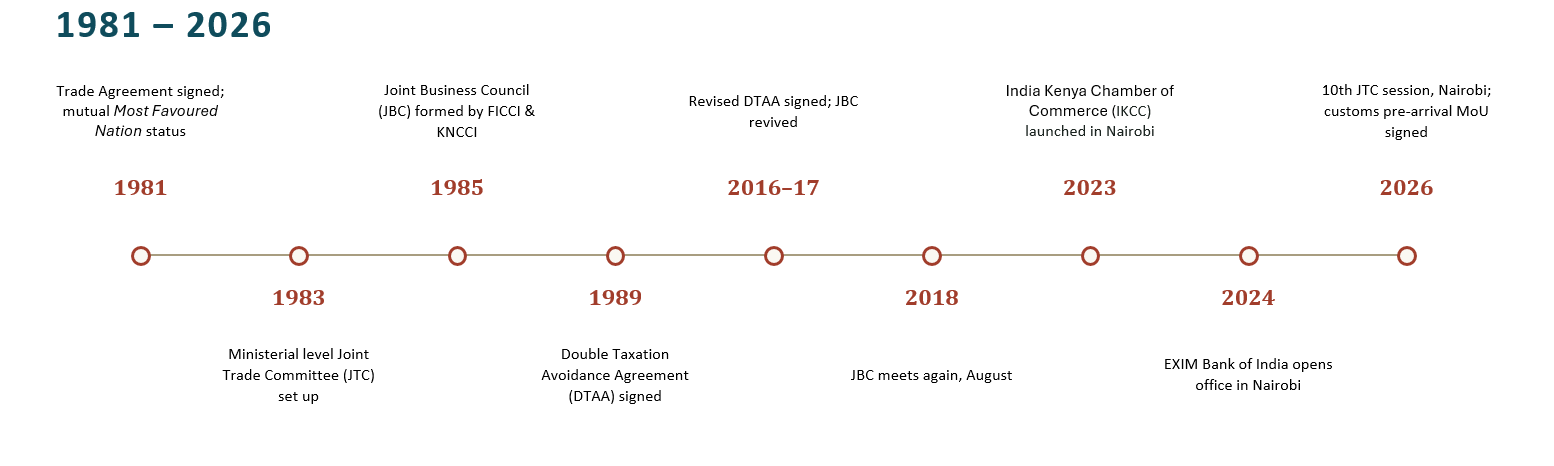
India and Kenya also share a strong economic relationship (Figure 1). At the 10th India–Kenya Joint Trade Committee meeting in April 2026, bilateral trade stood at USD 4.31 billion for FY 2025–26, reflecting a 24.91% increase from FY 2024–25.
Such measures provide an added layer of security, which has been a noted aspect of concern, and encourage industry stakeholders to invest in long-term energy projects.
To support this growth, the two countries advanced local currency settlement arrangements, and Kenyan banks opened Special Rupee Vostro Accounts (SRVAs) with Indian financial institutions. These allow trade settlement in KES and INR, reducing reliance on third currencies and limiting foreign exchange risk for energy and infrastructure investments. Such measures provide an added layer of security, which has been a noted aspect of concern, and encourage industry stakeholders to invest in long-term energy projects.
Figure 1: Bilateral Trade and Investment Relations
Information Source: Bilateral Trade and Investment (n.d.)
Another possible avenue of collaboration is Kenya’s use of the pay-as-you-go (PAYG) model, which links solar systems to mobile payments, such as M-KOPA. In such models, companies bear the upfront costs and, by receiving gradual payments, make solar units affordable, allowing households to gradually own these systems.
Opportunities: Grid Stability, Storage, and Pay-As-You-Go Solar
As Kenya already has substantial RE generation capacity, its primary challenge is grid stability and storage, not generation capacity. India can support Kenya through hardware and capital rather than direct grid-stability technology. As of June 2026, India’s cumulative solar module manufacturing capacity stood at 261.7 GW, with a solar cell manufacturing capacity of 36.6 GW. Similarly, India co-founded the International Solar Alliance, which Kenya is in the process of joining and which can help mobilise funds for grid stability. Conversely, Kenya can share early lessons on integrating variable renewables, which India will need as it progresses on its own RE journey.
Another possible avenue of collaboration is Kenya’s use of the pay-as-you-go (PAYG) model, which links solar systems to mobile payments, such as M-KOPA. In such models, companies bear the upfront costs and, by receiving gradual payments, make solar units affordable, allowing households to gradually own these systems. This PAYG repayment infrastructure could improve the efficiency of several RE schemes in India. For example, India’s PM-KUSUM programme encourages solar energy adoption in the agricultural sector. While it is driven by central subsidies, the success of the scheme is hindered by high upfront costs, which exclude small and marginal farmers who were the intended beneficiaries. In such areas, there is stronger potential for peer learning and adaptation of innovative financing methods for large-scale deployment of RE solutions.
Areas for further Exploration in India–Kenya Energy Cooperation
Several areas merit attention in deepening India–Kenya energy cooperation.
First, the potential expansion of SVRAs to include long-term infrastructure projects could be explored. In this context, the role of the Reserve Bank of India and the Central Bank of Kenya in establishing mechanisms to denominate energy project tariffs directly in INR or KES could be examined as a means of supporting private investment.
Second, given the immediate need for advanced grid management tools, the scope for KETRACO and PGCIL, alongside other leading Indian public utilities, to collaborate on smart-grid technologies warrants further consideration, particularly as this has already been identified as an area of bilateral cooperation.
Third, the Bureau of Indian Standards and the Kenya Bureau of Standards could broaden their existing MoU to promote conformity of technical standards and potentially harmonise quality standards for RE components across both countries.
Kenya and India are both developing economies undergoing energy transitions, and both must expand energy access and support economic growth while maintaining affordability. These shared priorities create opportunities for mutual learning and knowledge exchange, creating strong possibilities for them to become collaborators and peer partners in India–Africa cooperation, rather than serving solely as resource suppliers for each other.

Pallavi Baraya


Find on this page

The Centre for Social and Economic Progress (CSEP) is an independent, public policy think tank with a mandate to conduct research and analysis on critical issues facing India and the world and help shape policies that advance sustainable growth and development.