

Advancing India-China Climate Cooperation
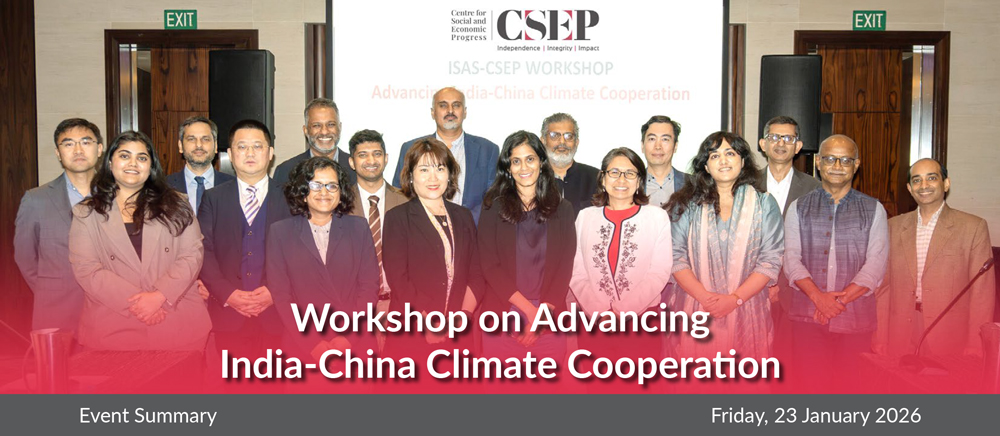
- The Centre for Social and Economic Progress (CSEP) and the Institute of South Asian Studies, National University of Singapore (ISAS-NUS) hosted a workshop on “Advancing India-China Climate Cooperation” at Carlton Hotel, Singapore. This workshop was the second in an ongoing project to explore the potential for India–China cooperation in climate and clean energy.
- The discussions focused on exploring complementarities, identifying feasible joint initiatives and articulating policy recommendations for engagement to inform Indian, Chinese, and international policymakers.
- The workshop spanned over four sessions and hosted experts from India and China.
- The discussion included participants from academic institutions, think tanks, and industries.
Advancing India-China Climate Cooperation
India–China climate cooperation has moved from multilateral cooperation to intensified bilateral engagement, and since 2015 has witnessed a decline due to rising geopolitical tensions and weakened institutional continuity. Future cooperation is likely to focus on low-sensitivity and non-competitive domains. The discussion therefore deliberated on climate finance mobilisation,
power sector modernisation, climate adaptation and urban resilience, and climate diplomacy as areas for engagement. The discussion highlighted several areas shaping the scope and limits of cooperation, while exploring the potential for engagement beyond government channels.
Discussants highlighted diverging energy transition pathways, with China shaped by large-scale industrial capacity and manufacturing dominance, and India by growth imperatives and longer decarbonisation timelines. Despite this, the two transitions remain closely interconnected through supply chains and technological dependencies. India’s reliance on imported components was identified as a key vulnerability, reflecting trade-offs between efficiency, resilience, and strategic autonomy. Thus, Southeast Asia was seen as a complementary region for India’s climate and industrial strategies, given its manufacturing base and experience in managing economic engagement with China. Further, increasing climate risks are elevating adaptation and urban resilience as shared priorities. Given its relatively low geopolitical sensitivity, adaptation offers scope for cooperation through governance, planning, and risk assessment. Agriculture and electrification were also identified as areas with potential to deliver on mitigation and adaptation.
Climate Finance Mobilisation
India–China climate finance cooperation is shaped by geopolitical, regulatory, and market factors. Discussants stressed the need to enhance predictability, strengthen reporting and enforcement, and improve project bankability by reducing uncertainty and lowering the cost of capital through data harmonisation and standards alignment. Stronger disclosure and reporting systems could also reduce fragmentation and transaction costs, facilitating cross-border investment without deep financial integration. Taxonomy alignment was identified as a promising research avenue, with potential for India and China to act as norm-setters for the Global South. While private capital will remain the main investment driver, public finance is essential for de-risking projects through guarantees and blended finance. Effectiveness depends on sound design, clear risk allocation, credible reporting, and sustained institutional confidence that supports multilateral or plurilateral pathways. Discussants highlighted that foreign exchange risk and high hedging costs remain barriers to scaling climate finance. While financing in domestic currencies presents a potential pathway, they remain a longer-term consideration dependent on deeper financial and regulatory coordination.
Power System Modernisation
With clean electricity becoming central to decarbonisation in both countries, power system modernisation emerged as a key area for cooperation. As electrification expands across sectors, the effectiveness of climate policy increasingly depends on system-level execution. The growing digitalisation and decentralisation of power systems have also heightened concerns over interoperability between information technology and operational systems, with discussants noting parallels to trust deficits seen in financial systems when digitally embedded hardware is integrated into critical infrastructure. The discussion highlighted the need to strengthen implementation capacity in transmission, grid management, and regulatory frameworks to keep pace with renewable deployment. Emerging gaps are being reflected in rising curtailment, congestion, and integration costs, undermining system efficiency and investor confidence. Limited system flexibility across storage, market responsiveness, and operational practices was identified as the principal constraint. Participants emphasised that without such flexibility, lower generation costs will not translate into lower overall system costs.
Discussants also identified market reforms as a politically sensitive challenge. Limited spot market penetration, continued reliance on long-term physical contracts, weak utility finances, and subnational political constraints were identified as structural barriers to efficient system operation. Notably, discussants viewed these constraints not as a policy failure but as a feature of developing countries’ political economy requiring context-specific solutions.
Climate Adaptation and Urban Resilience
Urban resilience emerged as a shared and intensifying climate challenge for India and China, as rapid urbanisation, dense populations, and infrastructure interdependence heighten exposure to extreme heat, flooding, water stress, and coastal risks. It was identified as a relatively low-sensitivity area for cooperation through technical exchange, joint research, and comparative assessments. Financing constraints remain central, with India facing limits in municipal finance and accountability, and China confronting risks from over-leveraging and legacy public–private partnership models. Blended finance, municipal bonds, and green finance were highlighted as potential instruments to diversify funding. Discussants also emphasised nature-based and hybrid infrastructure approaches, including sponge city models, alongside the development of resilience standards that could help preserve policy space, leverage public procurement, and position both countries as norm-setters for the Global South.
An analysis of different approaches in urban resilience highlighted that China emphasised standards-based planning and data-driven decision-making. Its experience underscored the advantages of strong municipal capacity, integrated planning, and large-scale execution. Meanwhile, in India, the approach was to make low-cost but high-impact interventions. Indian cities have demonstrated adaptive governance, institutional flexibility, and responsiveness.
Climate Diplomacy Frameworks
Discussants observed that earlier cooperation efforts were overly broad in scope but limited in execution due to a lack of clear prioritisation, robust implementation mechanisms, and accountability frameworks. This suggests that a new baseline for climate diplomacy is emerging, emphasising the need for adaptive approaches that combine targeted institutional reform with experimentation across alternative and flexible governance pathways. Discussants highlighted persistent divergences in emissions trajectories, technology leadership, and rule-making ambitions between India and China, while identifying adaptation, mitigation, sectoral decarbonisation, and development finance reform as pragmatic areas for cooperation.
Discussants noted that both India and China are pursuing dual-track climate strategies by reforming existing institutions while engaging in regional and sectoral platforms such as BRICS and multilateral development banks. China’s investment and infrastructure-led approach contrasts with India’s emphasis on institutional and normative pathways, creating scope for mutual learning. Given persistent mistrust and security concerns, cooperation is likely to remain limited to technical exchange, informal dialogue, and other low-risk interactions.






The Centre for Social and Economic Progress (CSEP) is an independent, public policy think tank with a mandate to conduct research and analysis on critical issues facing India and the world and help shape policies that advance sustainable growth and development.