
India’s Future in Geoeconomics, Emerging Technologies and Multilateral Governance
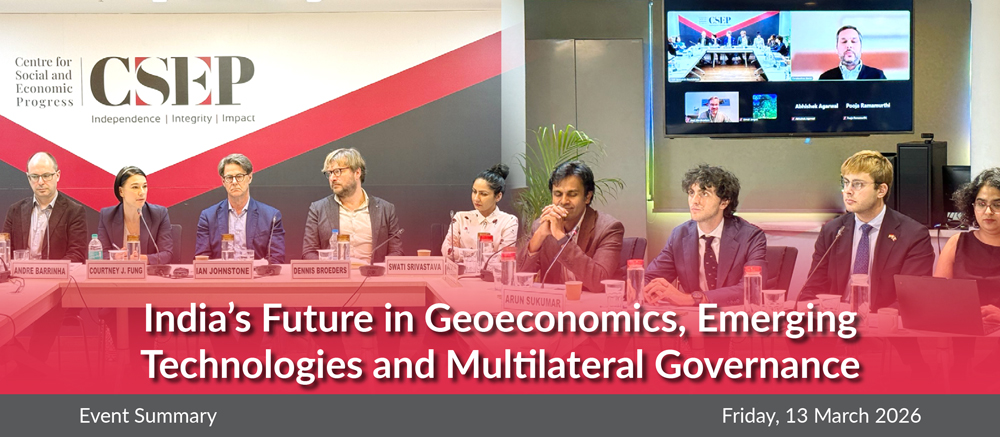
- The Centre for Social and Economic Progress hosted the 39th edition of its Foreign Policy and Security Tiffin Talk series on “India’s Future in Geoeconomics, Emerging Technologies and Multilateral Governance” in partnership with Ashoka University’s International Relations department.
- The discussion examined India’s posture in an evolving multilateral landscape shaped by rising geoeconomic competition, with a particular focus on cybersecurity, artificial intelligence, and other emerging technologies. It explored the implications of India’s pursuit of technological self-reliance amid deepening digital interdependence, as well as its engagement with both traditional multilateral institutions and informal governance arrangements.
- The lead presenters were Andre Barrinha, Reader (Associate Professor) International Relations, University of Bath; Courtney J. Fung, Associate Professor, Security Studies, School of International Studies, Macquarie University; Swati Srivastava, Associate Professor of Political Science and University Faculty Scholar, Purdue University; Dennis Broeders, Professor, Global Security and Technology, Leiden University; and Ian Johnstone, Professor of International Law, The Fletcher School, Tufts University. The talk was moderated by Arun Sukumar, Assistant Professor, Ashoka University International Relations Department.
- The discussion included participants from international non-governmental organisations, embassies, media, academic institutions, and think tanks from India and abroad.
- This series of closed-door research seminars is curated by Constantino Xavier, Senior Fellow, CSEP and Shivshankar Menon, Distinguished Fellow, CSEP and Former National Security Adviser. It focuses on contemporary, evidence-based research with policy relevance to bridge Delhi’s scholar-practitioner divide.
State of Technology Diplomacy
As technology becomes central to global security and foreign policy, states are increasingly deploying tools to advance their interests in cyberspace and adapting strategies to keep pace with the rapidly evolving technological landscape.
The discussion highlighted that globally, diplomatic engagement on emerging technologies such as 5G, quantum computing, and artificial intelligence (AI) is no longer confined to Ministries of Foreign Affairs (MFAs). Rather, a range of ministries are increasingly being involved, adopting a process of institutional “absorption” that integrates technology portfolios into broader strategic units. This approach aims to ensure diplomatic coherence, as technological issues intersect with defence, commerce, and regulatory policy and require a whole-of-government coordination. Concurrently at the international level, states are also participating in a growing number of informal forums (or “clubs”) on technology governance that often operate in parallel and remain loosely connected. One participant noted that since 2006, nearly 50 global forums have emerged, yet only one has produced a binding convention.
The discussion focused on how states can balance participation in formal legal processes with engagement in more flexible diplomatic forums. Here, India’s cyber diplomacy was cited as an issue based, flexible policy, enabling it to preserve strategic autonomy rather than align with competing blocs in global cyber governance debates. However, despite active participation in negotiations, India has yet to articulate clear positions on emerging issues, such as lethal autonomous weapons. Its future posture will depend on how it defines its strategic objectives and the role it wants to play in shaping the international technology order.
The discussion underlined the need for states to develop a coherent technology statecraft that they can employ to achieve their objectives. On this note, a discussant pointed out that, unlike the private sector, which is dominated by experts, governments face capacity constraints due to short diplomatic tenures and limited expertise. Long-term appointments and structured engagement with technical communities were identified as potential solutions, with Denmark, France, and the United States (US) being cited as examples of countries that have appointed technology or digital diplomacy ambassadors.
Regulating Frontier Technology
Discussants flagged AI as the fastest-evolving global policy challenge with a dual-use capability that will shape future economic growth, industrial transformation, and security. The discussion highlighted the tendency of the US to link technological leadership with national security objectives to shape global technological ecosystems by pressuring other countries to adopt US technology security standards as their own.
In this context, discussants highlighted the potential for closer cooperation between India and Europe in developing an alternative governance framework. Discussants evaluated India’s options to “counter-weaponise” technology, that is, the building of regulatory and market coalitions to resist strategic coercion as a possibility, but one that would require sustained political will. On this note, a discussant highlighted that India could seek to shape a “Delhi consensus” in data governance as an alternative to the “Silicon Valley consensus” and analogous to the regulatory influence exercised by Europe (the “Brussels effect” e.g. through the General Data Protection Regulation).
The discussion stressed that India’s large digital population provides significant leverage in global AI governance debates since these systems require continuous access to vast datasets for improvement. At the same time, discussants recognised that leveraging this advantage would entail difficult trade-offs for India, particularly the need for substantial investments in computing capacity and data infrastructure. It was noted that India may have a two to three-year window to articulate a coherent AI strategy. It could do so by building credible alliances, mobilising support among the Global South, and demonstrating leadership through concrete policy choices.
Competition in the Multilateral Order
The discussion underscored that debates on global technology regulation have become increasingly informalised and currently rely largely on non-binding principles rather than hard international law. As a result, small and medium-sized countries often find their diplomatic capacity overstretched across multiple forums, increasing the risk of policy incoherence and reactive engagement. However, such flexibility allows governance frameworks to adapt more quickly to technological change.
In the same vein, the discussion drew attention to India’s active participation in minilateral groupings and issue-based coalitions as both an opportunity and a challenge. It was suggested that India’s engagement in informal forums should complement India’s commitments to multilateral institutions, as balancing these parallel tracks will be essential for India to exercise leadership. Highlighting the importance of the private sector, discussants suggested that Indian technology firms and business associations should play a role in multilateral processes by engaging through government channels and independently with international organisations. Their participation allows for leveraging corporate expertise and market power to shape global norms.
The discussion also focused on China’s expanding role in global governance and its implications for India’s diplomatic strategy in a fluid multilateral order. Increasingly, Beijing is offering a targeted set of public goods, such as capacity building and technological partnerships, that appeal to small and developing countries. Such engagement is becoming central to Chinese foreign policy, especially in areas such as data governance, AI, security, and governance. Through initiatives like the Global Security Initiative and the Global Development Initiative, China has also adopted an intentionally expansive and ambiguous narrative that allows messaging to be tailored to different regions and audiences. In this context, discussants emphasised that India should remain actively engaged in multilateral institutions, particularly the United Nations, and continue to advocate for institutional reform.







The Centre for Social and Economic Progress (CSEP) is an independent, public policy think tank with a mandate to conduct research and analysis on critical issues facing India and the world and help shape policies that advance sustainable growth and development.