The Future of the Past: Policy and Practice in Archival Preservation
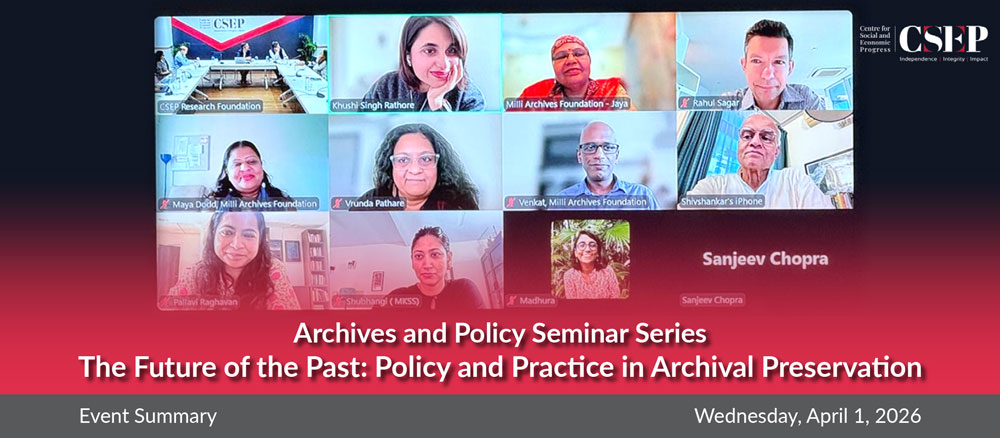
- The Centre for Social and Economic Progress (CSEP), in partnership with King’s College London, NYU Abu Dhabi, and the New International Histories of South Asia (NIHSA) network, hosted the third session of its Archives and Policy Seminar Series, titled “The Future of the Past: Policy and Practice in Archival Preservation”. The discussion drew on the work of the Milli Archives Foundation and focused on the challenges and possibilities of building more accessible, collaborative, and digitally responsive archival ecosystems in India.
- The discussion featured Venkat Srinivasan, Head of Archives at the National Centre for Biological Sciences (NCBS) and co-founder of the Milli Archives Foundation; Jaya Ravindran, Former Assistant Director at the National Archives of India and co-founder of the Milli Archives Foundation; and Maya Dodd, Professor of Digital Humanities at FLAME University and Director of the Milli Archives Foundation, who shared insights from their work on building collaborative and accessible archival ecosystems in India, and was moderated by Constantino Xavier, Senior Fellow, CSEP and Khushi Singh Rathore, Max Weber Fellow, EUI and Non-Resident Associate Fellow, CSEP, with concluding remarks delivered by Rahul Sagar, Associate Professor of Political Science, NYU Abu Dhabi.
- The seminar brought together archivists, policymakers, and scholars for a focused conversation on the evolving archival landscape in India, examining how digital technologies are reshaping access, how archives can function as shared public resources, and what institutional and policy shifts are required to make archival systems more inclusive, interoperable, and responsive to diverse users.
- The Archives and Policy Seminar Series is a closed-door discussion platform curated by CSEP, King’s College London, NYU Abu Dhabi, and the NIHSA network to explore challenges and policy solutions for improving archival access and governance in India.
- Initiated by Shivshankar Menon, Distinguished Fellow, CSEP and Visiting Professor of International Relations, Ashoka University; Constantino Xavier, Senior Fellow, CSEP; Bérénice Guyot Réchard, Reader (Associate Professor) in International and South Asian History, King’s College London; and Rahul Sagar, Associate Professor of Political Science, NYU Abu Dhabi, the series is curated by Khushi Singh Rathore, Non-Resident Associate Fellow, CSEP.
Reimagining the Archive as a Public Commons
The session began with discussion on the work of Milli Archives Foundation, outlining a set of interventions aimed at strengthening archival practice in India. These include building a network of archives, developing shared standards and training resources, and creating open-access digital tools to improve discovery and access. They also highlighted efforts to foster collaboration across institutions and to reorient archives toward more public-facing and user-driven engagement.
The discussion began with reflections on a set of foundational questions that shape archival practice: who decides what enters the archive, who describes and interprets it, who visits it, and what kinds of public life archives are meant to sustain. Archives were discussed as part of a broader “commons,” with the potential to function as public-facing institutions that connect memory, research, pedagogy, and community life. The discussion noted that archives often remain central to scholarship, public policy, and cultural memory while receiving far less professional attention and infrastructural support than their importance warrants.
Building Networks, Standards, and Shared Tools
A major theme of the session was the absence of common platforms, standards, and professional support structures across India’s archival landscape. The discussion highlighted how this fragmentation affects nearly every aspect of archival work, from discovery and cataloguing to conservation, digital access, and user engagement.
The conversation explored a number of initiatives designed by Milli to strengthen this ecosystem, including training manuals, workshops, ethical and legal guidance, public programming, and open-access archival tools. Such efforts were presented as especially important in a context where archives across India vary widely in terms of resources, governance structures, and technical capacity. One initiative discussed in this context was the “Archives Health Tool,” designed to help institutions evaluate themselves across dimensions such as access policy, cataloguing methods, digital tools, preservation standards, public engagement, research services, and ethics of practice.
Digital Archives, Annotation, and New Forms of Access
It was noted that the pandemic accelerated both the demand for digital access and the creation of digital archival material, bringing renewed attention to the end user, whether student, researcher, teacher, or member of the public. The discussion emphasised that digitisation is not only a technical exercise in scanning and uploading records. It also changes the ways in which archives are encountered, interpreted, and used. Speakers shared the importance of public annotation tools that would allow users to contribute additional descriptive layers to archival material, including references to people, place, subject, language, and even affective or reflective responses. Rather than relying only on fixed institutional metadata, archives could become spaces in which interpretation remains open, layered, and collaborative.
The idea of a common catalogue or “catalogue of catalogues” was also shared as an important intervention. Such a system could help users search across repositories, improve discoverability, and support more equitable access to archival material.
Participants noted that archives in India today increasingly include private collections, institutional repositories, community initiatives, oral history projects, and digital humanities platforms. This shift has widened both the range of archival actors and the kinds of material being preserved and circulated. Examples discussed during the session pointed to the growing importance of multilingual archives, crowdsourced projects, women’s movement materials, oral histories, and community-led digital platforms in reshaping the archival field. The discussion suggested that future archival policy in India will need to account for this hybrid ecosystem rather than focusing only on conventional state archives.
Toward More Inclusive and Usable Archival Futures
A recurring concern in the discussion was that access to archives is shaped not only by what is digitised or catalogued, but also by what remains invisible. Participants highlighted the importance of knowing what is not being transferred, not being digitised, or not being made available. This includes missing files, non-digitised materials, marginal notes within files, and records that remain restricted without transparent procedures for access requests. The point was made that archival reform must include a stronger accounting of absence. Questions of privacy, born-digital records, and the future of Right to Information frameworks were also discussed as important policy challenges in an era when more records are created digitally from the outset.
The discussion concluded with a strong emphasis on practical, collaborative reform. The session underscored that the future of archives in India lies in building systems that are at once technically robust, ethically grounded, publicly engaged, and institutionally collaborative. By bringing together reflections on standards, digital infrastructure, user participation, and archival ecosystems, the seminar advanced the broader goal of the series: to move from isolated conversations about archives toward practical and inclusive policy thinking for India’s documentary future.






The Centre for Social and Economic Progress (CSEP) is an independent, public policy think tank with a mandate to conduct research and analysis on critical issues facing India and the world and help shape policies that advance sustainable growth and development.