

Transforming India’s E-commerce: Innovation and Business Models
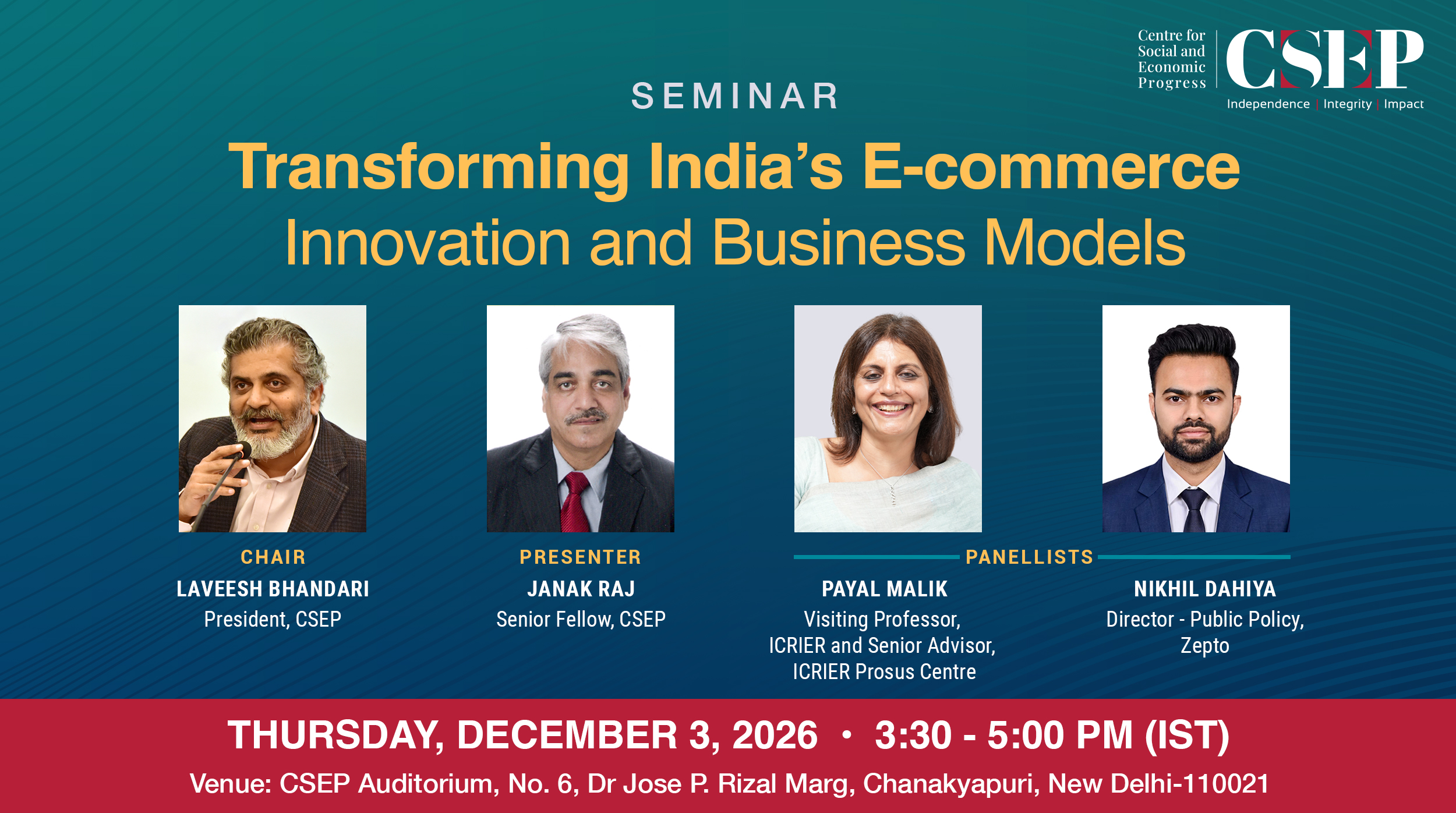
The Centre for Social and Economic Progress (CSEP) is pleased to invite you to a seminar titled “Transforming India’s E-commerce: Innovation and Business Models” on Thursday, December 3, 2026, from 3:30 to 5:00 pm (IST).
The seminar will begin with a presentation by Janak Raj, Senior Fellow, CSEP, based on the CSEP Report titled “India E-Commerce Report 2026: Innovation in the Merchandise Space”. This will be followed by a discussion with Payal Malik, Visiting Professor, ICRIER and Senior Advisor, ICRIER Prosus Centre, and Nikhil Dahiya, Director, Public Policy, Zepto. The session will be chaired by Laveesh Bhandari, President, CSEP.
The seminar will be held at the CSEP Auditorium, 6, Dr Jose P Rizal Marg, Chanakyapuri, New Delhi – 110021.
Please note that this is an in-person event only. If you are in Delhi on the day, we invite you to join us for what promises to be a thought-provoking discussion. The event will be available on the CSEP website and YouTube channel upon completion.
About the event
India’s e-commerce market for merchandise goods has grown from USD 14 billion in 2014 to USD 120–130 billion in 2024, and is projected to reach USD 300–350 billion by 2030 at 20–25% annual growth, becoming central to India’s economy.
Market structure is concentrated, with Amazon and Flipkart holding 55–65% share, a pattern common to platform economies globally due to scale, network effects and logistics efficiencies. Concentration alone does not imply insurmountable entry barriers, as niche players continue to emerge.
The core challenge is profitability, not concentration. Despite 40–43% gross margins, Indian platforms remain largely unprofitable at net level, unlike Alibaba (9%) and Mercado Libre (6.9%). Low ARPU (USD 107), low order values, ∼50% cash-on-delivery reliance, high last-mile costs (60% of logistics cost) and 25–40% return rates compress margins.
Policy gaps persist in measurement, enforcement of FDI rules distinguishing marketplace from inventory models, and gig worker protections. The report argues for enabling, predictable regulation targeting specific anti-competitive conduct rather than blunt structural caps, to preserve innovation, fairness and growth.
Chair
Laveesh Bhandari
Laveesh Bhandari is an economist, entrepreneur, and strategic advisor with extensive experience in economic policy, business strategy, data analytics, and institution building. He is President and Senior Fellow at the Centre for Social and Economic Progress (CSEP), one of India’s leading public policy think tanks.
He has founded, scaled, and successfully exited three businesses, including Indicus Analytics, a pioneering economic research and data analytics firm in India. An accomplished economist, his research spans industrial development, economic reforms, financial inclusion, sustainable livelihoods, and energy transition.
Dr Bhandari holds a PhD in Economics from Boston University, where his doctoral research received the Best Thesis Award in International Economics. He is also a Visiting Professor of Practice at the London School of Economics and Political Science (LSE).
Panellists
Payal Malik
Payal Malik is a public policy economist. Her areas of expertise are competition law and policy, digital markets, antitrust litigation, technology policy, and economic regulation of network industries. She has been an Economic Adviser and Head of the Economics Division at the Competition Commission of India for ten years between 2012-2023, where she played a key role in advising the Commission on the economics of competition law across an expansive range of markets and led interfaces between the CCI, sector regulators, government, industry and the international competition community.
Notably, she was the Convener of the Working Group on New Age Economy and Bigdata constituted by the Ministry of Corporate Affairs, Government of India (GoI), for the Competition Law Review Committee (CLRC). She was also nominated as a member of the task force of the GoI formulating the e-commerce policy of India and a member of a sub-group of the Committee on Digital Competition Law (CDCL), devising an ex-ante regulatory mechanism for digital markets through a separate legislation.
Nikhil Dahiya
Nikhil Dahiya is the Director and Head of Public Policy at Zepto, leading the public policy and advocacy initiatives for the company. He carries deep sector expertise in the e-commerce and modern retail sector, having worked in Amazon Public Policy for about 3 years before joining Zepto.
Nikhil is a Chartered Accountant and Lawyer by qualification and carries over a decade of experience in public policy and the regulatory space.
In his previous stints, he has helped shape the policy narrative across a diverse range of sectors including mobile phones and electronics manufacturing, online gaming, infrastructure, logistics, Electric Vehicles, and warehousing policies etc.
Presenter
Janak Raj
Janak Raj is a Senior Fellow and leads the macroeconomic segment in the Growth, Finance and Development vertical at the Centre for Social and Economic Progress (CSEP). He specialises in climate-related issues, with a strong focus on climate finance, the reforms of multilateral development banks (MDBs) and the International Monetary Fund (IMF) to advance the climate finance agenda and the macroeconomic impact of climate change. In addition to his primary role at CSEP, he currently serves on the Board of Clearing Corporation of India Ltd. (CCIL) as an Independent Director. He is also a member of the Global Advisory Board of the Centre for Economic Transition Expertise (CETEx) hosted by the London School of Economics and Political Science, London; the Task Force of the Boston University Global Development Policy Centre; and the Advisory Board of JM Financial Centre for Financial Research of Indian Institute of Management (IIM), Udaipur.
With over four decades of experience, he has held important positions across prominent institutions in India and abroad. He served as an Executive Director at the Reserve Bank of India (RBI), where he was also a member of its statutory Monetary Policy Committee (MPC), Principal Adviser of the Monetary Policy Department and International Department, and head of the Department of Economic Policy and Research. His extensive experience also includes serving as Senior Advisor to the Executive Director for Bangladesh, Bhutan, India, and Sri Lanka at the IMF in Washington D.C. and Senior Consultant at the Ministry of Finance (Department of Financial Services), India. He also served as RBI nominee director on the Governing Board of the BSE (formerly Bombay Stock Exchange).
He holds a PhD in Economics from Indian Institute of Technology, Bombay (IIT Bombay) and is an alumnus of the Senior Executive Programme at Columbia Business School, New York.
All content reflects the individual views of the speakers. The Centre for Social and Economic Progress (CSEP) does not hold an institutional view on any subject.
Please contact Gurmeet Kaur at GKaur@csep.org for general queries and Ayesha Manocha at AManocha@csep.org for media queries.







The Centre for Social and Economic Progress (CSEP) is an independent, public policy think tank with a mandate to conduct research and analysis on critical issues facing India and the world and help shape policies that advance sustainable growth and development.